The Marinelli Pontifical Bell Foundry in Agone, Italy, made this bronze bell for the New York City Fire Museum to honor 9/11 firefighters and responders who died that day and people who got sick from their work at Ground Zero. The bell was unveiled and blessed Sept. 11. (NCR photo/Camillo Barone)

Join the Conversation
Send your thoughts to Letters to the Editor. Learn more
In a dark, centuries-old workshop high in the Apennine Mountains of Southern Italy, there are few signs that the modern world has arrived.
Heavy chains descend from wooden beams. Clay molds stand beside brick furnaces. Bells of different sizes crowd the floor, some rough and unfinished, others already bearing elaborate figures and inscriptions. The air carries the dust, metal and earthy smell of a craft that has changed remarkably little since the Middle Ages.
It was here, in the small Molise town of Agnone, that artisans at the Marinelli Pontifical Bell Foundry spent months making a bell destined for a place more than 4,000 miles away: New York City.
Cast by hand using methods handed down through generations, the bronze bell was unveiled Sept. 11 at the New York City Fire Museum on the 25th anniversary of the 9/11 attacks. It commemorates not only the firefighters who died that morning, but also the police officers, emergency medical personnel, construction and sanitation workers, military members and other responders who took part in the rescue and recovery effort, including those who later became sick from their work at Ground Zero.
Some 343 FDNY firefighters and at least 69 other police officers, paramedics and emergency personnel were killed at the scene that day, rushing toward the World Trade Center as thousands fled these buildings. And in the 25 years since, the toll has continued to climb: Hundreds more first responders have died from illnesses linked to their work at Ground Zero, including more than 450 FDNY members, while hundreds of responders and survivors continue to live with cancers, respiratory diseases and other conditions associated with their 9/11 exposure.

Among the artifacts at the New York City Fire Museum is the original uniform of firefighter chaplain Franciscan Fr. Mychal Judge, who died on Sept. 11, 2001. (NCR photo/Camillo Barone)
The New York City Fire Museum pays tribute to these firefighters in its Sept. 11 gallery — filled with photographs of firefighters killed in the attacks, original missing-person posters, artifacts used during the rescue effort and the uniform of chaplain Franciscan Fr. Mychal Judge — but it had no single memorial dedicated to those who became sick after responding to Ground Zero.
Dominick R. DeRubbio, executive director of the museum, felt there needed to be something more, to also pray tribute to those who died in the months and years after their work at Ground Zero.
So the bell's journey to New York began with a deeply personal idea.
"I pray in this room every day," DeRubbio told the National Catholic Reporter during an interview before the anniversary. "I say the Lord's Prayer. I speak to my uncle. I speak to these members up here on this memorial."
For DeRubbio, the room is also a family space.
His father, Dominick A. DeRubbio, is a retired FDNY battalion chief who responded on Sept. 11 and survived. His uncle, David DeRubbio of Engine 226 in Brooklyn, was killed in the South Tower. Altogether, four members of the DeRubbio family — his father and three uncles — served in the department.
DeRubbio was still in high school in 2001. He later studied emergency management and fire science at John Jay College, earning bachelor's and master's degrees before building a career in emergency management and safety. He joined the Fire Museum's board in 2022 and became executive director in 2025.
"The FDNY has just always been very special to me," he said. "It was family."

The Marinelli Pontifical Bell Foundry in Agnone, Italy, has operated since 1339 with the same ancient manual techniques, which do not involve any use of electricity. (NCR photo/Camillo Barone)

Inside Marinelli Pontifical Bell Foundry looks as if it still operates in the Middle Ages. (NCR photo/Camillo Barone)

Bells exported all over the world are made at the Marinelli Pontifical Bell Foundry in Agnone, Italy, which dates to the 14th century. (NCR photo/Camillo Barone)

The artist used chalk negatives of the decorations for the bell portraying 9/11 firefighters and responders, unveiled at the New York City Fire Museum Sept. 11. (NCR photo/Camillo Barone)

Marinelli Pontifical Bell Foundry artist Stefania Forte works on bell decorations in her studio at the foundry, which uses no electricity to make bells. (NCR photo/Camillo Barone)
Soon after taking over the museum, he began thinking about how to recognize not only those killed on Sept. 11, but also the firefighters and responders whose illnesses emerged years later.
A Google search led him more than 4,000 miles away, to Agnone, a medieval-looking hill town in the central Italian Apennines in Molise where metalworking traditions stretch back more than a millennia.
There, inside the Pontifical Marinelli Foundry, very little about the making of a bell resembles modern industrial production.
The workshops appear almost suspended in another age. Heavy wooden beams cross dim rooms. Chains and pulleys hang overhead. Bells in different stages of completion stand amid brick furnaces, old iron tools, molds, sculpted reliefs and worktables crowded with drawings and plaster forms. Clay, wax, brick, bronze and fire remain at the center of the work.
"We do manual work that was already being done a thousand years ago," Pasquale Marinelli, who runs the foundry with his brother Ettore, told NCR. "Even today we still work without using electricity of any kind."
A bell, he said, takes roughly four months to make.
That deliberate pace has survived through generations in a world increasingly organized around speed. Marinelli described the foundry's method as almost "countercultural." It involves knowledge transmitted within the family and hands performing many of the same operations performed centuries ago.
According to Silvana Di Toro, a member of a local cooperative which promotes Agnone's cultural heritage, in the Middle Ages and Renaissance the town once counted about 200 artisan workshops, about 170 devoted to copper and nine bell foundries.

The Marinelli Pontifical Bell Foundry in Agnone, Italy, dates to the Middle Ages. (NCR photo/Camillo Barone)
The Marinelli family has been associated with bellmaking since the Middle Ages. Its bells were already being signed by a Marinelli bell founder in the 14th century, and the family's documented tradition stretches for centuries.
The foundry received the right to use the pontifical emblem under Pope Pius XI slightly more than 100 years ago.
"Today, the Marinelli Foundry ranks among the three oldest continuously family-run businesses in the world," Di Toro said.
In late 2025, an email from New York reached that ancient workshop.
DeRubbio explained that he wanted, in Marinelli's words, to "stop time" through a bell, to commemorate firefighters, police officers, emergency medical personnel, military members, construction and sanitation workers and the many others who helped rescue the living, search for the missing and recover remains.

Bells exported all over the world are made at the Marinelli Pontifical Bell Foundry in Agnone, Italy. (NCR photo/Camillo Barone)
DeRubbio was insistent that the memorial not belong to the FDNY alone.
"There was a conversation throughout the process: Should this be an FDNY-only bell?" he recalled. "And I came out and I said, in the days, the weeks, the months and the years after September 11th, you had multiple agencies and responders that looked for my uncle and his remains, that looked for other members of the FDNY."
"To me," he added, "it was a unifying memorial."
The design developed through video calls, photographs and sketches exchanged between New York and Agnone. The museum sent images of Ground Zero and its rubble as inspiration. At the foundry, prominent artist Stefania Forte and the Marinelli artisans translated those photographs into figures modeled by hand in clay, then into plaster negatives used to create the reliefs that would encircle the bronze.
The finished bell — about 21 inches in diameter and weighing approximately 200 pounds — depicts a firefighter against the catastrophe of the collapsing, smoke-filled towers, surrounded by figures representing the different groups that responded.
"They did not want to leave anyone out," Marinelli said.
The process followed the foundry's centuries-old sequence. Artisans constructed a brick core, coated it with layers of clay and created a "false bell" over it. Decorations were formed using traditional techniques before molten bronze was finally poured into the mold. After cooling came finishing, chiseling and acoustic testing. The process ends with a blessing from a priest.
The bell was cast on July 31.
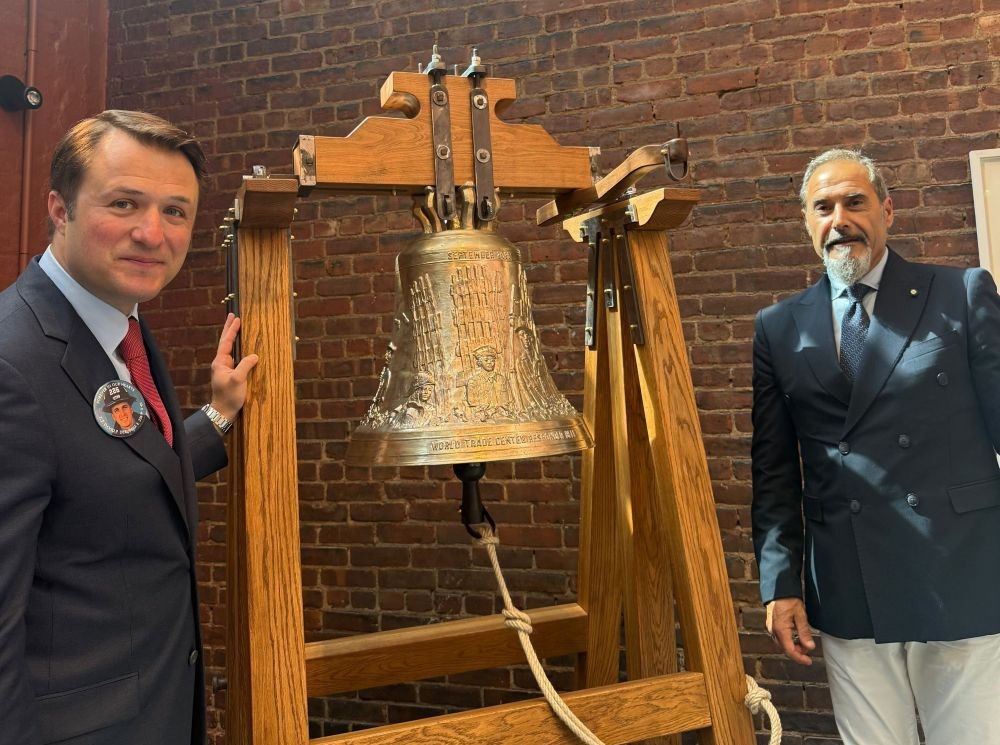
Dominick R. DeRubbio, executive director of the New York City Fire Museum (left), and Pasquale Marinelli, who runs the Marinelli Pontifical Bell Foundry in Agnone, Italy, stand with the memorial bell after the unveiling ceremony on Sept. 11, 2026. (Courtesy of Rosita Marinelli)
For Marinelli, whose office desk in Agnone is piled with envelopes, drawings and commissions from around the world, the New York project stood apart.
"To have been chosen for this project was a great and unique honor," he said.
DeRubbio and American firefighters traveled to Agnone during the process, where they met their Italian counterparts.
At the end of August, firefighters from Isernia helped transport the bell across Italy to the U.S. military installation at Sigonella in Sicily. From there, according to DeRubbio, the U.S. military carried it to Joint Base McGuire-Dix-Lakehurst in New Jersey.
Then Virginia Beach firefighters transported the bell north as New Jersey State Police escorted the convoy along the turnpike. Near Manhattan, Port Authority police joined, followed by FDNY, NYPD and sanitation vehicles. With sirens sounding, the convoy entered New York.
Before going to the Fire Museum, it made one deliberate pass by the World Trade Center.
The bell's supporting frame contains a physical fragment of Sept. 11.
Four steel bolts taken from a piece of World Trade Center steel now help hold the frame together. Members of FDNY Rescue 1, which once occupied the building that houses the museum, removed them from the steel for inclusion in the memorial.
On Sept. 11, in the intimate museum room that inspired the project, invited firefighters, families and guests gathered around the bell. The memorial was rededicated, the bell was blessed, its covering was removed and Joe LaPointe — the longtime head of the department's ceremonial unit, who for decades attended the funerals of firefighters who died from illnesses linked to their service — sounded it.
Advertisement
For DeRubbio, however, the project was never intended to end with one anniversary ceremony.
The challenge now, he said, is ensuring that people who have no personal memory of Sept. 11 understand what happened there and who answered the call for help.
He said he hopes the museum will eventually install interactive displays allowing visitors to learn the individual stories of firefighters and other responders. "We have to work harder and find ways that children, younger generations know what these individuals sacrificed that day," he said.
The goal is simple, he said: "Keeping that story alive."