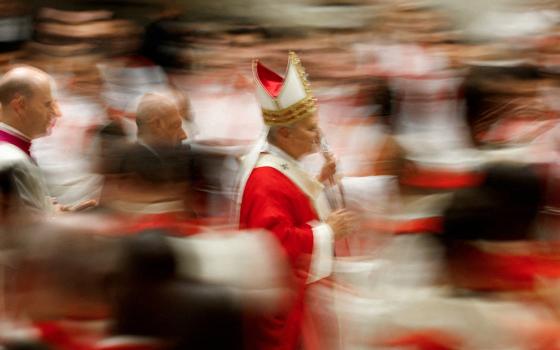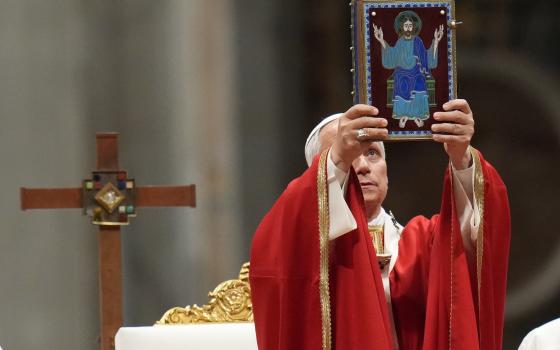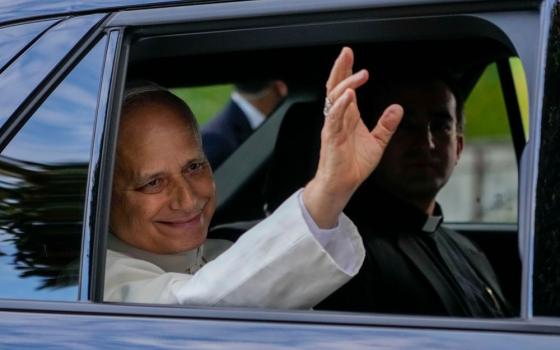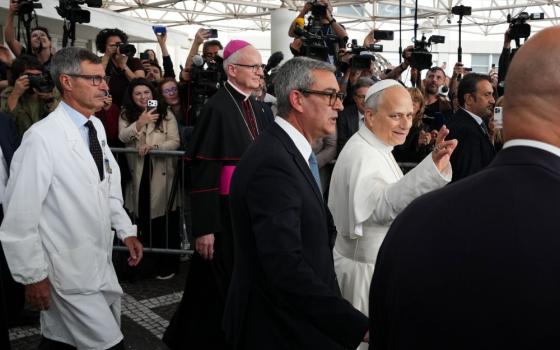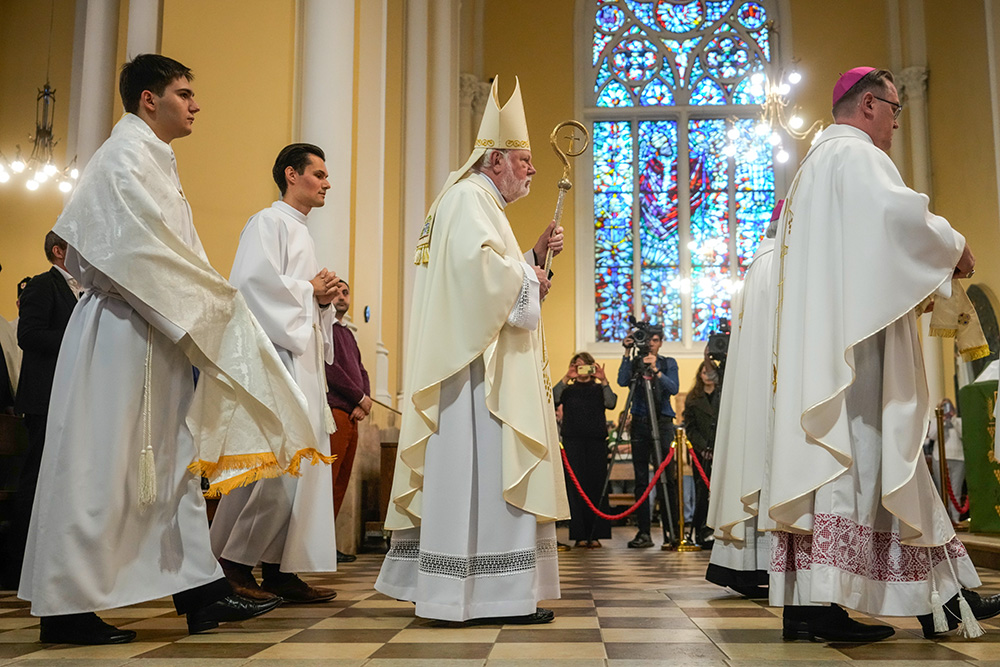
Archbishop Paul Richard Gallagher, center, the Holy See's secretary for relations with states, celebrates a Mass at the Cathedral of the Immaculate Conception in Moscow Aug. 27, 2026. (AP/Pavel Bednyakov)

Religion News Service
Join the Conversation
Send your thoughts to Letters to the Editor. Learn more
The CIA director made an unannounced visit to Moscow Aug. 25 as the Vatican's foreign minister led a five-day mission to the Russian capital, in disparate attempts to influence an end to the war in Ukraine.
Multiple reports said CIA Director John Ratcliffe privately delivered a warning to the Kremlin to avoid an escalation to the conflict, although accounts differed over the principal purpose of his visit. Meanwhile, Archbishop Paul Gallagher, who leads the Vatican's diplomacy with states, publicly offered Russian officials dialogue and humanitarian assistance.
"In a simplistic way, it looked like a good cop, bad cop operation," said Victor Gaetan, author of God's Diplomats: Pope Francis, Vatican Diplomacy, and America's Armageddon.
Gallagher's visit marked an important moment for Vatican diplomacy under Pope Leo XIV, who has expressed more conspicuous sympathy for Ukraine than his predecessor, Pope Francis, while preserving the Holy See's traditional insistence on dialogue with both sides. And the simultaneous presence of Ratcliffe raised questions about whether the first U.S. pope's peace diplomacy might intersect with Washington's strategic pressure on Moscow.
Gaetan noted that Washington and the Holy See have cooperated secretly before, most prominently in the negotiations that led to the 2014 restoration of diplomatic relations between the United States and Cuba.
Neither the government nor the Vatican has indicated the Moscow visits were coordinated. But their convergence presented Russia with two complementary messages from the West.
Ratcliffe's Tuesday visit, which lasted roughly eight hours, was his first trip to Russia as CIA director. A practicing Catholic who earned his law degree from the University of Notre Dame, Ratcliffe reportedly met Sergei Naryshkin, the head of Russia's Foreign Intelligence Service, and carried several messages to Moscow. The New York Times reported that he gave Russia a "bleak assessment" of its war prospects, while The Wall Street Journal and Politico reported he warned against attacking NATO members — in particular, the Baltic states.
Meanwhile, Gallagher's five-day trip to Moscow mixed diplomacy with spirituality and included meetings with his Russian counterpart, Sergey Lavrov, the Orthodox Church in Russia and the local Catholic community.
"The position of the Holy See remains clear: The conflict cannot be resolved by military means," the archbishop said in a joint press conference with Lavrov after their meeting.
Gallagher pointed to the challenges of promoting dialogue the longer the conflict continues. The war in Ukraine has been ongoing for four-and-a-half years, and combined casualties may have reached 2 million, according to the Center for Strategic and International Studies.
Advertisement
"Let us be clear, this war must end," Gallagher said, urging leaders to "look beyond the conflict."
He also underlined that the Holy See and Russia discussed peaceful avenues and that the church offered to continue its humanitarian efforts, especially in caring for children impacted by the war.
The Holy See will "continue to provide strong spiritual, diplomatic and humanitarian support by contributing to and offering a space for dialogue," he added.
Lavrov recognized that Vatican-Russian relations "continue to be characterized by trust, friendship and pragmatism" and thanked the Holy See for its "balanced position" on the Ukrainian crisis. But the Russian minister for foreign affairs also leaned on what he considers the "root causes" of the conflict, pointing to Ukrainian attacks against Russian civilians, including children, and Ukrainian efforts to curtail the influence of the Russian language and the Moscow-linked Ukrainian Orthodox Church.
Ukraine has stated that it's not attempting to suppress the Russian Church but prevent it from being used as a Russian tool for influence, while it argues that the Russian language has been only restricted in official contexts.
"The joint press conference with Mr. Lavrov demonstrated that the Holy See diplomacy matters, especially in a context of war," Gaetan said.
Gallagher's most discreet engagement came in closed-door talks with Yuri Ushakov, Russian President Vladimir Putin's senior foreign policy adviser and a central figure in Moscow's negotiations over Ukraine. Neither the Vatican nor the Kremlin disclosed details of the meeting.
On Aug. 25, Gallagher also met with Metropolitan Anthony of Volokolamsk, who leads the Moscow Patriarchate's relations with other churches.
The meeting addressed "pressing issues concerning the situation in the world," according to a statement by the church's department for external church relations, and presented Gallagher with information about the "persecution of the Ukrainian Orthodox Church by the Ukrainian state authorities."
While the Holy See has historically maintained a neutral stance in conflicts to provide a platform for dialogue and peace, "Leo does appear to be more preoccupied with the Ukrainian tragedy," Gaetan said.
He suggested Leo's American Catholic formation during the Cold War may help explain why his public posture toward Russia differs from that of his predecessor. Francis, by contrast, approached the conflict from a Latin American perspective generally more suspicious of Western geopolitical narratives.
Despite this week's effort by the Vatican to approach a dialogue with Russia, it maintained a strong posture in defense of the Ukrainian people.
Gallagher's arrival in Moscow occurred on the anniversary of Ukraine's 1991 Declaration of Independence from the Soviet Union. That same day, Leo addressed Portuguese military and security personnel at the Vatican and affirmed that their "noble mission" is that of "defending the sovereignty of your homeland and the rule of law."
Although the pope did not mention Ukraine in that passage, the language resonated with a conflict rooted in Russia's violation of Ukrainian sovereignty and sits in stark contrast with Francis' suggestion in 2022 that the "barking of NATO at Russia's door" may have led to the invasion.
Leo also appealed for peace in Ukraine in his first Sunday address as pontiff in May 2025, and he spoke with Ukrainian President Volodymyr Zelenskyy. That same month, Italian Prime Minister Giorgia Meloni stated that Leo attempted to mediate a peace between the warring nations, but Lavrov shut down the idea of a Catholic country hosting peace talks between two Orthodox nations. Leo met Zelenskyy again in his summer residence at Castel Gandolfo in July and December of last year.
Speaking to journalist Elise Allen of Crux, Leo recognized the Holy See's "great efforts" to maintain a neutral position on the Ukraine-Russia war, "as difficult as it might be."
The first and only phone call between Leo and Putin took place in June of last year.
With the possibility of hosting peace talks seemingly off the table, Leo seems to have shifted tactics, opting for traditional Vatican diplomacy with an emphasis on humanitarian efforts. In July 2026, he sent Cardinal Matteo Zuppi, the head of the Italian bishops' conference and a skilled diplomat, to Ukraine, quickly followed by a visit by Gallagher.
On July 4, Leo also had an unprecedented informal dinner with the U.S. ambassador to the Holy See, Brian Burch. This week, Burch met with President Donald Trump, Vice President JD Vance and Secretary of State Marco Rubio to discuss how the U.S. "can partner with the Holy See to promote global peace and religious freedom," according to a post by the U.S. Embassy to the Holy See on X.
Burch presented baseballs signed by Leo "as a gesture of friendship."
But the Vatican's mission to Russia was chiefly a spiritual one. In a solemn Mass in the Cathedral of the Immaculate Conception of the Blessed Virgin Mary on Aug. 27, Gallagher appealed to the heart of the Russian people.
"We come from different countries, cultures and histories, yet we are gathered here, in the heart of Moscow, as one family united by the same faith in God," he said in his homily.
The cathedral was closed by Soviet authorities in 1938 and wasn't returned to the church until the 1990s. Clergy connected to it were caught up in Stalinist persecution.
"The cathedral represents the brutality that the Russian people suffered under communism," Gaetan said, describing Gallagher's Mass there as a way of tying Russia's historical suffering to the Vatican's diplomatic mission.
Citing Leo's appeals for peace, Gallagher urged the faithful to help build "bridges of dialogue and understanding, disarming hearts and healing" and to become "true artisans of peace."