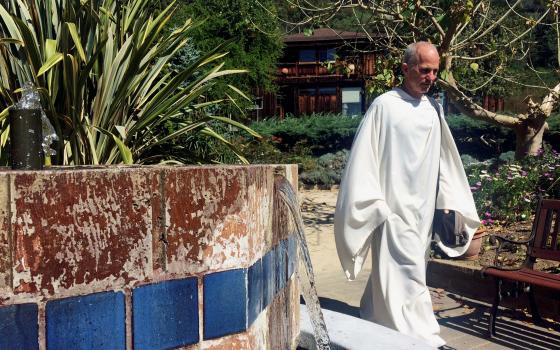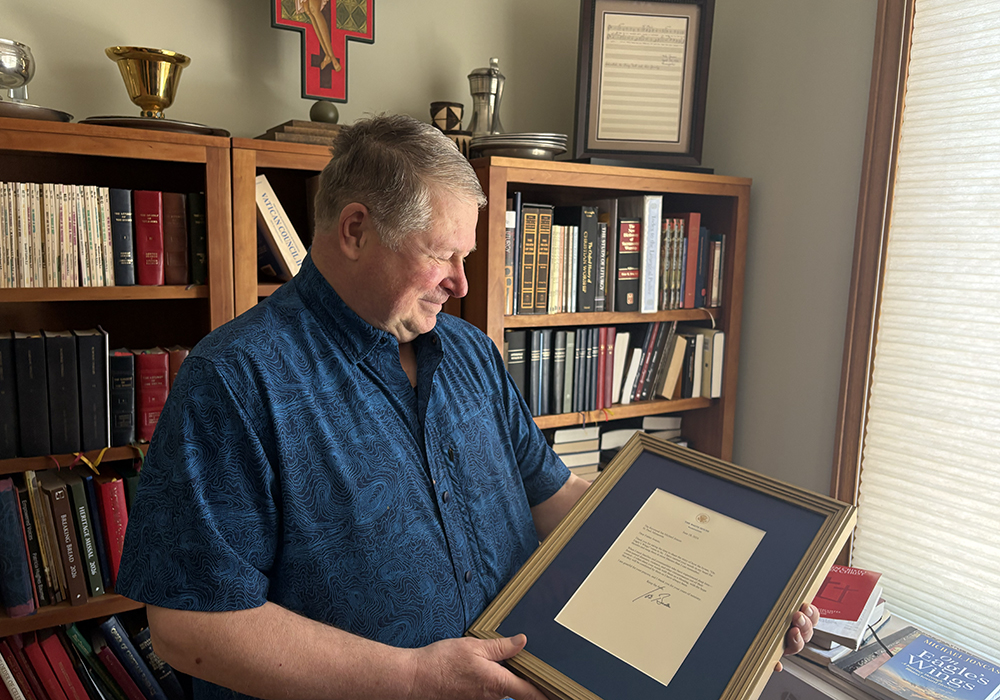
Author, composer and professor Fr. Michael Joncas holding a June 2024 letter from former U.S. president Joe Biden by the bookcase where he framed and displayed the original 1976 score of "On Eagle's Wings," in his apartment in St. Paul, Minnesota, May 2026. (NCR photo/Camillo Barone)

Join the Conversation
Send your thoughts to Letters to the Editor. Learn more
By the mid-1970s, Fr. Michael Joncas was a 24-year-old from Minneapolis who had temporarily left the path to priesthood, uncertain about his vocation, immersed in church music, liturgy and the turbulence of America after Vietnam.
Five decades later, the hymn he wrote during a moment of private grief, "On Eagle's Wings," has become one of the most recognizable religious songs in the English-speaking world, crossing denominational boundaries and accompanying funerals, memorial services and moments of national mourning, from parish churches to presidential speeches.
This year marks the 50th anniversary of the hymn's creation, a song born quietly in 1975 and first sung publicly at a funeral in Omaha, Nebraska, in April 1976.
"It was honestly to help my friend Doug and his family deal with the death of their dad," Joncas told the National Catholic Reporter at his apartment in St. Paul, Minnesota, where the original handwritten score remains framed beside a large wooden crucifix. "Consolation. That was the reason."
The song's reach would eventually extend far beyond the Catholic Church. Protestants adopted it into Lutheran, Presbyterian and Methodist hymnals. It was sung after the 1995 Oklahoma City bombing, at Luciano Pavarotti's funeral in its Italian version "Su Ali d'Aquila," and repeatedly by former U.S. President Joe Biden, who quoted its words during his 2020 victory speech.
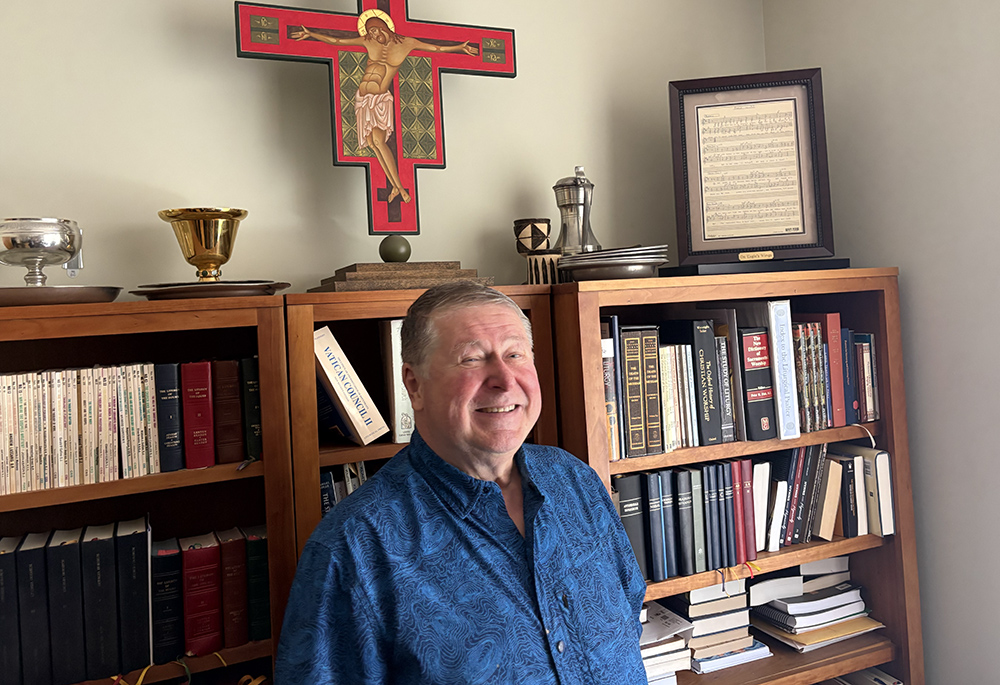
Fr. Michael Joncas poses by the original 1976 score of "On Eagle's Wings" in his apartment in St. Paul, Minnesota, May 2026. (NCR photo/Camillo Barone)
The story of "On Eagle's Wings" begins inside a crowded Minneapolis home filled with music. Joncas, who played the piano, was the oldest of eight children. His father worked in technical theater and television production before teaching at the University of Minnesota. His mother, a Polish-American lyric soprano, abandoned a professional music career to raise the family.
"At Christmas, all of us would sing in four-part harmony," Joncas said. "My mother would play piano and sing, my sisters would play instruments and the picture is really of us making music together."
Joncas entered Nazareth Hall Preparatory Seminary at age 13 during the years of the Second Vatican Council, when the Catholic Church was transforming its liturgy and moving from Latin into vernacular languages.
"We needed new things to sing," he said. "So I said, 'Well, I can help.' "
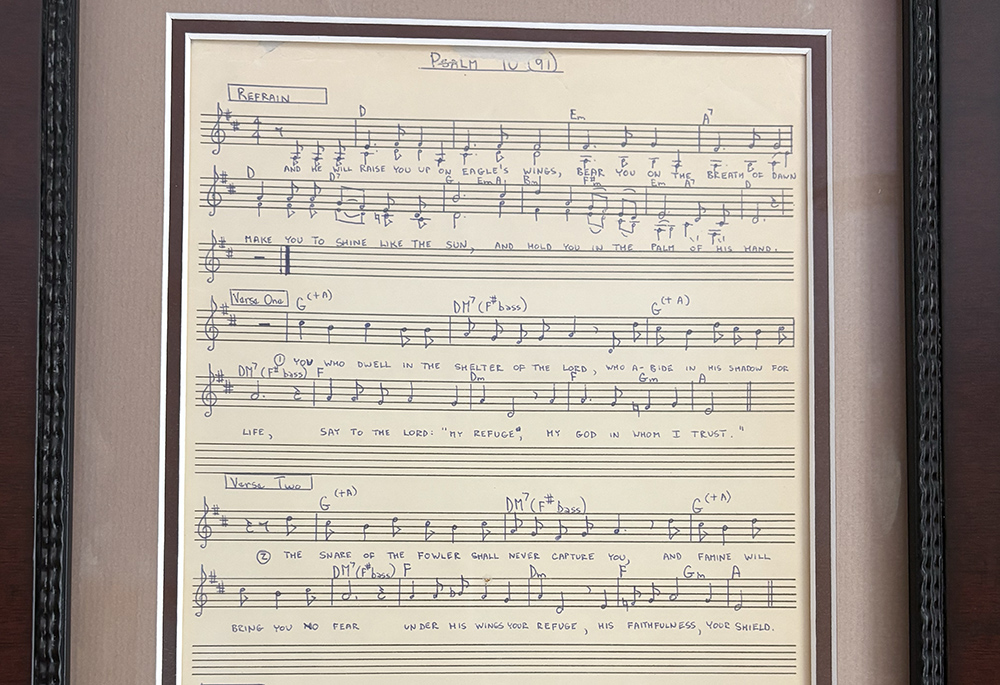
The original 1976 score of "On Eagle's Wings" by Fr. Michael Joncas, framed and displayed on his bookcase in his apartment in St. Paul, Minnesota, May 2026. (NCR photo/Camillo Barone)
The timing proved decisive. Joncas belonged to a generation standing between two Catholic worlds: the solemn Latin rites of the pre-Vatican II church and the folk-inspired liturgical experimentation that followed.
"I have deep respect for and memory of pre-Council Vatican II," he said, recalling the Latin prayers of his childhood. "But then suddenly there was this opening for English."
By his late teens, he was already writing music for fellow seminarians. Still, his vocational path remained uncertain.
After graduating from the University of St. Thomas in 1975 with a degree in English, Joncas left seminary formation and took a position as music and liturgy director at St. Joseph's Parish in New Hope, Minnesota.
After college he was convinced he shouldn't be a priest but the parish community changed his mind.
"The people there basically said, 'We trust the way you think, we trust the way you preach, we trust your ministry. Why don't you go back to the seminary?' "
That encouragement eventually led him back toward priesthood. But before returning permanently, another event intervened — one that would alter the course of his life. In late 1975, Joncas visited his seminary friend, future priest Douglas Hall in Washington, D.C. During the visit, Hall received devastating news: His father had had a heart attack.
Joncas immediately began composing.
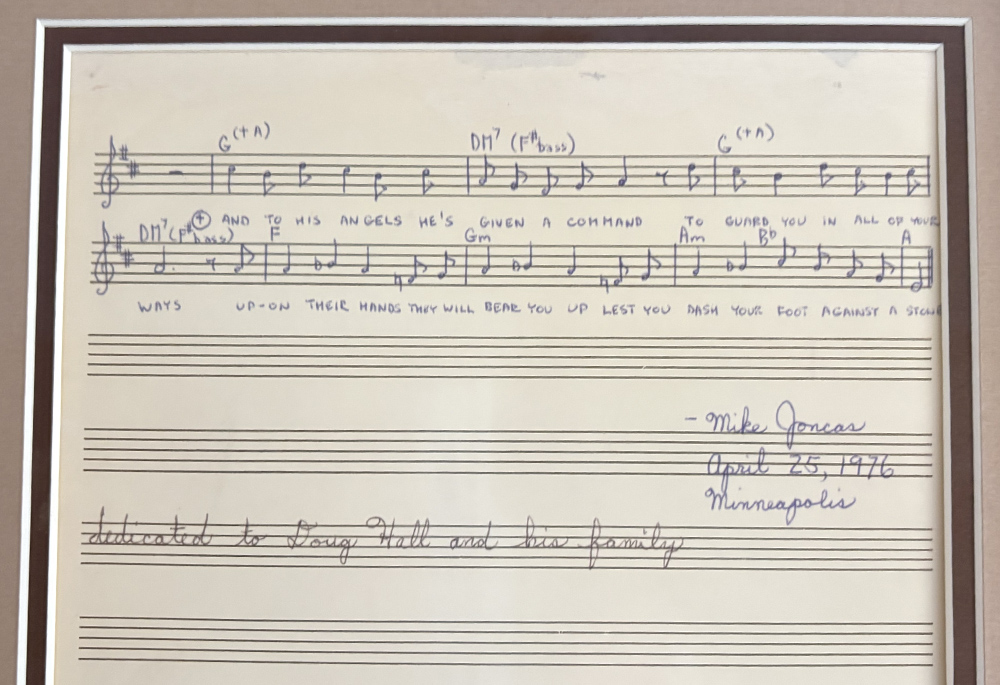
The original 1976 score of "On Eagle's Wings" by Fr. Michael Joncas is framed and displayed on his bookcase in his apartment in St. Paul, Minnesota, May 2026. (NCR photo/Camillo Barone)
The verses came directly from Psalm 91, long familiar to him through compline, or night prayer, in the Liturgy of the Hours. "I prayed Psalm 91 for years," he said. "That text seemed to be deeply consoling to me."
At the time, grief surrounded Joncas personally as well. His sister, Babette, who had lived with physical difficulties throughout her life, had recently died in her early 20s.
Beyond personal loss, America itself felt fractured, he said, with the Vietnam War, civil rights struggles and social upheaval.
"There was a sense of grieving over the direction the United States was going," he said. The refrain of "On Eagle's Wings" did not come directly from a single biblical passage but from combined scriptural images. The hymn was first performed at the wake service for Hall's father in Omaha in April 1976 and then again the following day at the funeral Mass as the responsorial song.
He could not have imagined what would follow, he said.
The first major turning point came when North American Liturgy Resources, a small publishing company, accepted the song for publication and recording in 1979. Soon afterward, "On Eagle's Wings" appeared in Glory and Praise, a hymnal that spread rapidly through Catholic parishes in the United States in the post–Vatican II era.
Advertisement
Joncas remembers the song's rise less as something he observed almost from a distance. "I was just discovering that it's happening," he said as the hymn was picked up by Protestant hymnbooks. Then came Oklahoma City.
After the 1995 bombing of the Alfred P. Murrah Federal Building, "On Eagle's Wings" was included in the televised memorial service, introducing the hymn to millions of Americans outside church contexts. Joncas said that later came the song's use in military chapels, Native American communities drawn to the eagle imagery, and translations into Italian, Spanish, Catalan, Polish, Dutch, German, French and Portuguese.
Joncas, who never aggressively managed the song's spread, said he's "just happy that people can use it to give prayer."
"Music integrates things," Joncas said when asked about the power of sacred music in everyday life. "Where we might make divisions between our physical existence and our spiritual existence, it brings it all together."
But he also resists easy explanations. "I wish I knew what its power really is," he admitted. "But at its best, it becomes prayer."
In 2003, Joncas received the kind of consolation his music had offered others. While teaching liturgical studies at the University of Notre Dame, he noticed during Holy Thursday Mass that he could no longer lift the chalice and the paten properly.

Author, composer and professor Fr. Michael Joncas sits in his apartment in St. Paul, Minnesota, May 2026. (NCR photo/Camillo Barone)
Within days, he lost the ability to walk and move. Doctors eventually diagnosed Guillain-Barré syndrome, a rare neurological disorder that initially left him almost completely paralyzed.
He spent weeks intubated, heavily sedated and unable to communicate. When we woke up he said there was a very short period where he said he wondered why he was being punished but then he instead asked in prayer what he should be learning in this experience.
The illness permanently altered aspects of his musical life since he lost some physical abilities. He never regained his former singing voice and could no longer play guitar, the instrument associated most closely with his compositions. Yet the experience transformed his ministry.
His own prayer for the future, he said, remains simple.
"I pray that God's will be done on earth as it is in heaven," Joncas said with a faint smile and watery eyes. "I just keep hoping that more and more we will respond to the spirit of God and have a transformation of our world."
Looking back, he says the most surreal moment for "On Eagle's Wings" may have been Nov. 7, 2020. While he was watching television, Joncas heard Biden quote the hymn during his victory speech. Later, Joncas wrote the president elect a letter explaining the song's origins.
"I have carried your words in my heart for decades and sung them at more Masses than I can remember," Biden wrote back. "When I meet families and communities who have experienced deep loss — from natural disasters, violence, and other circumstances out of their control — I often share your words with them as a blessing, with the hope that they will be comforted by them, as I have always been."
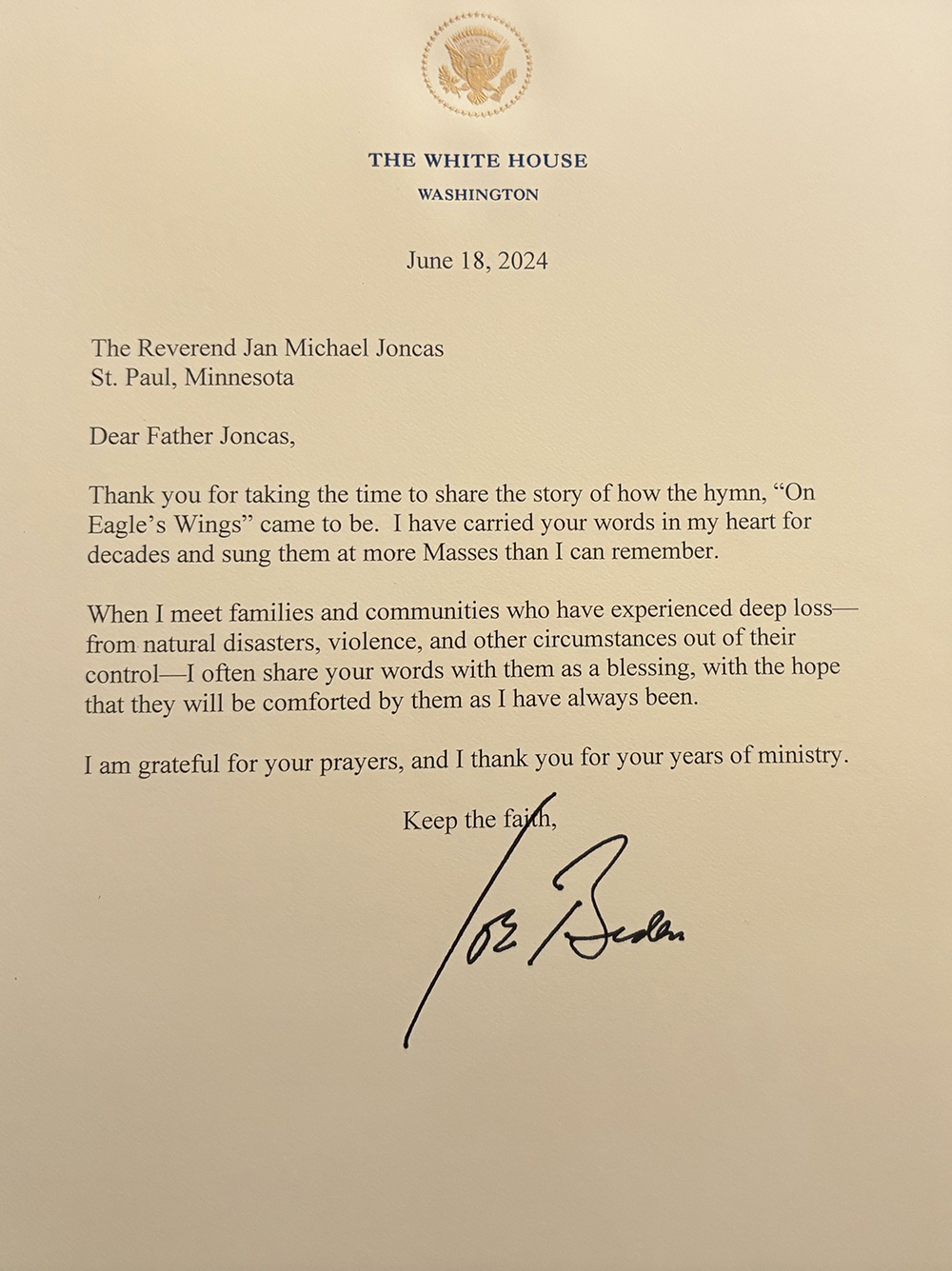
A June 2024 letter that former U.S. President Joe Biden wrote to Fr. Michael Joncas (NCR photo/Camillo Barone)
That night, the popstar Lana Del Rey posted a rendition of the hymn on her social media, making it viral in a few hours. That moment echoed when Joncas heard the Italian translation of his hymn performed during Pavarotti's funeral.
Today, at 74, the composer lives quietly in St. Paul, continuing to mentor, write and compose while remaining attentive to the suffering around him — from racial tensions in Minneapolis to immigrant communities living in fear of deportation.
"I feel blessed by being here," he said.
And as "On Eagle's Wings" turns 50, Joncas said he remains almost detached from the scale of its massive influence. Asked about royalties and success, he shrugs them off, explaining that much of the income goes into charitable giving and church-related causes.
What matters more to him is whether the song still consoles people facing grief and uncertainty, as it did at a small funeral in Omaha half a century ago.