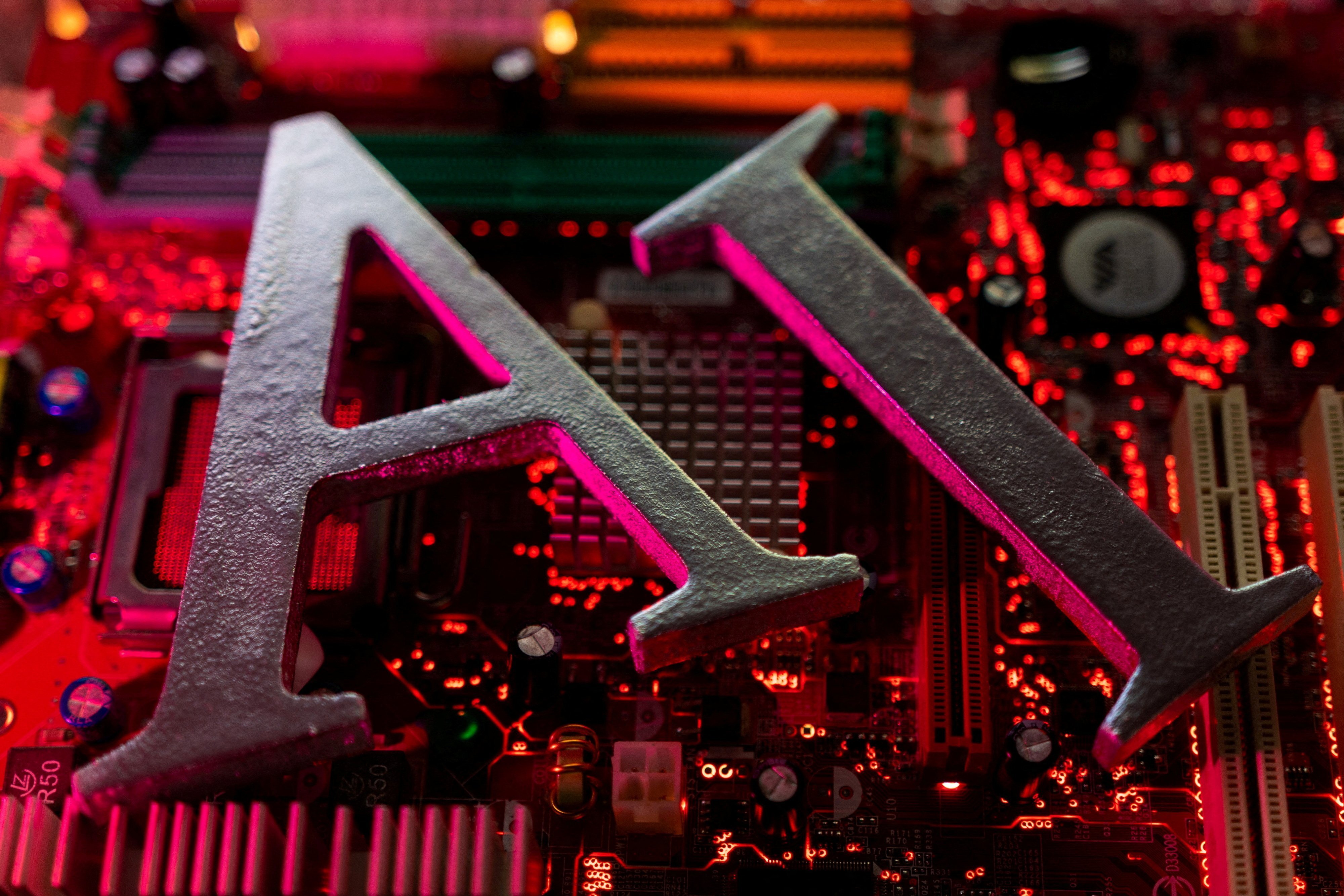
The letters AI (for "artificial intelligence") are placed on computer motherboard in this illustration taken June 23, 2023. (OSV News/Reuters/Dado Ruvic)

OSV News
Join the Conversation
Send your thoughts to Letters to the Editor. Learn more
Mim Scholle was reading an advertisement for a parish women's group one day when she noticed something strange.
Scholle, a Northern Virginia-based parish volunteer and event planner, finished reading the text, and then looked more closely at the accompanying photo. Where one woman's hands should have been folded in her lap, instead the image showed a cluster of hands piled on top of each other.
"It was very unsettling," said Scholle. "As a Catholic community, we're drawn to truth, beauty and goodness." But she's worried that artificial intelligence, or AI, flyers are moving the Church away from that ideal.
All kinds of businesses and organizations from coffee shops to dentist offices are using AI to create promotional flyers. Increasingly, Catholic parishes are, too.
Deacon Matthew Glover, chancellor and general counsel for the Diocese of Little Rock, Arkansas, noted that one of the most common ways he's seeing AI used in Arkansas schools and parishes has been to create flyers advertising parish festivals and other gatherings.
Throughout his pontificate, Pope Leo XIV has encouraged Catholics to think critically about artificial intelligence, including in the creation of visual art.
"It is becoming urgent to distinguish human art from what machines produce. There is an ontological difference, even before an aesthetic one, between art and what a machine can generate through statistical calculation based on millions of images created by others," the pope posted on his X account Oct. 2. "Algorithms lack the spark of humanity. For this reason, the Church wishes to renew an alliance with artists and cultural institutions to safeguard our humanity."
Though AI technology offers parish employees and volunteers a quick, easy way to create event flyers, the results can be offputting to some. Scholle finds the design of many AI-generated posters to be too busy and generic-looking, full of overly earnest copy and devoid of good graphic design principles.
Advertisement
"All of that just gives you this sense of unease, and that's not even mentioning the things that are blatantly incorrect, like the number of hands per person," she said.
More than anything, she finds that the computer can't comprehend the heart of the matter as well as a person could.
"I don't fault anyone who makes an AI flyer because I understand what everyone's up against," she said. "But I do think it's worth fostering a 'do all things with love' mentality. Taking the time to sit down and make a flyer is setting aside time to think of other people."
Alden McRae, a Texas-based Catholic writer and content creator, has thousands of views on an Instagram reel she created titled "Remaking AI Slop Church Posters." In it, she demonstrates how to make a flyer using Canva, a free graphic design website.
"I hoped when I put that reel out there redesigning a social flyer for a church social that I could demonstrate just how simple it is to avoid using AI — and more than anything, how much more beautiful a flyer can look with the tiniest bit of human effort put into the design," said McRae.
She worries that parish employees and others who make AI flyers are undervaluing the importance of their work, even something as small as the creation of an ad.
"If you have the choice between spending 15 minutes working to generate an AI image for the front of your bulletin versus 15 minutes combing through public domain artwork — just perusing museum websites — I hope that they would see that this is a chance for them to express themselves creatively, worship the Lord, evangelize to their community and open themselves up to the immense treasures of beauty that are available at their fingertips," she said.
Connor McLaughlin works as director of institutional partnerships at Truthly, a tech company that offers AI from a Catholic perspective. But before that, he worked in parishes. He sees AI as a valuable tool for many overworked parish employees, especially for its research capabilities but also for tasks like making flyers.
Recently he saw an advertisement for a children's All Saints' Day festival that showed a variety of saints drawn in the design of Fisher-Price Little People toys. The flyer felt like a creative use of AI that fit well with the style of the event and was likely to attract attendees, he thought.
But poor use of AI can have the opposite effect, he said. "The danger is the second someone recognizes that it's an AI, they assume that the parish doesn't care enough to take the time to promote something (well)," he said. "(And that) the thing that they're promoting is likely going to be of low quality as well."
He advises flyer-makers to either use Canva or educate themselves on how to best use AI. It's a tool that has the potential to connect people to Christ, said McLaughlin. "Like any tool, if it's used carefully for a specific purpose and with the proper design and style knowledge, it can produce good results," he said. "If it's misused, it will hurt."
Glover oversaw the creation of diocesan-wide guidelines for the use of AI in Little Rock. Church employees are encouraged to use AI judiciously, both due to the environmental impact of AI and the possibility of copyright or trademark infringements. They are not permitted to create or alter an image depicting a real person without their permission, and photos of minor or vulnerable adults can never be changed. In all cases where AI is used to create public content, the use of AI must be disclosed to the readers and users.
"It goes to the matter of truthfulness," said Glover. "I think it's really easy for people to be deceived (if they see an image of) a particular priest going around town doing X, Y, or Z on a motorcycle. It's easy for an AI image to be generated that might be in good fun and not necessarily have any nefarious intent behind it, but if (it's) taken out of context and people don't know it's AI, it can create confusion or possibly even scandal."
Disclosing the use of AI promotes transparency and trust, said Glover. "It is getting harder and harder to discern the truth in the content that we're receiving, and when we are unable to readily and easily discern the truth, it becomes toxic for our relationship with other people on a fundamentally human level," he said.
Overall, the guidelines help Arkansas Catholics think deeply about their use of AI, said Deacon Glover.
"I think that if we do not learn how to use AI appropriately and morally and spiritually consistent with our Catholic faith, it will be using us," he said. "It's going to impact how we view and interact with one another."