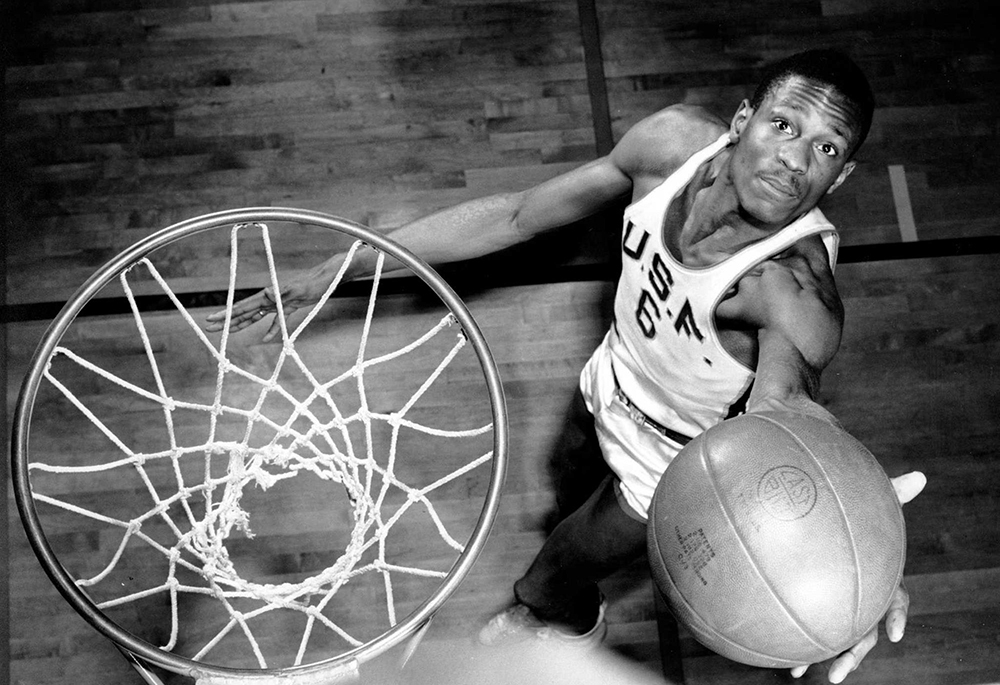
Bill Russell, playing for the University of San Francisco Dons, grabs a rebound. (Courtesy of the University of San Francisco)

by Jay Sorgi
Join the Conversation
Send your thoughts to Letters to the Editor. Learn more
The basketball journeys of four players at Catholic universities — who made four men's Final Fours, and won two NCAA titles and 14 NBA championships — demonstrate not only accomplishments on the court but something bigger: societal progress against racism.
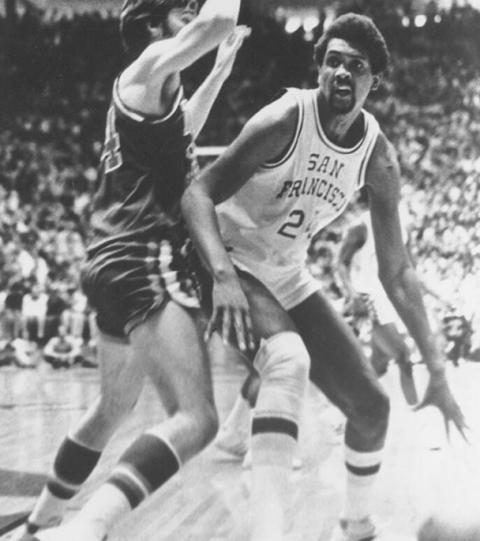
Bill Cartwright, playing for the University of San Francisco Dons (Courtesy of the University of San Francisco)
Months before Rosa Parks and the Rev. Martin Luther King Jr.'s groundbreaking civil rights work, Bill Russell became the first Black man to lead a championship in a major U.S. team sport, winning the 1955 NCAA men's Final Four for the Jesuit-run University of San Francisco Dons.
"They had an opportunity to do something really special. In order to do that, you need to be bonded as a team, as a community," said USF Director of University Initiatives Bill Cartwright, who followed in Russell's footsteps two decades later as a center for the Dons.
USF already had established a history of fighting against racism in the athletic arena. Their 1951 football team went undefeated, but when the Orange Bowl in Miami, Florida, banned their Black players from participating, the team refused to play in one of college football's biggest games without all their teammates.
"Everybody knows what's right and what's wrong," Cartwright said. "That team was not about to let that happen."
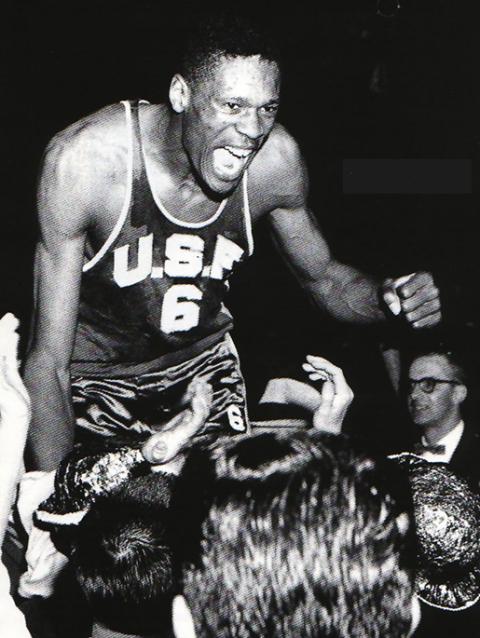
Bill Russell celebrates a victory with the University of San Francisco Dons. (Courtesy of the University of San Francisco)
Years later, Russell's Dons fielded the first majority-Black starting lineup for an integrated college basketball team.
Russell and future Boston Celtics teammate K.C. Jones led USF to Final Four titles in 1955 and 1956. Russell's experience with the Jesuits at USF helped mold him not only into the most decorated championship athlete in American pro sports history, with 11 titles as leader of the Celtics, it also aided his growth into a leader for social change.
As Russell led the Celtics to their first NBA title in 1957, Bob Lanier was 9 years old, falling in love with the game. Later, the 6-foot-11 center from Buffalo received a scholarship at St. Bonaventure University, run by the Franciscan Order of Friars Minor.
Lanier and his Bonnies teammates followed the friars' ethos of community in a similar statement of solidarity to what the 1951 USF football team made, during a 1967 tournament in Tampa, Florida.
"The team goes to the hotel dining room and the Black players are told, 'You won't eat here. We have a special place for you,' " said former St. Bonaventure University President Sr. Margaret Carney, a Franciscan sister who became close with Lanier in the later decades of his life.
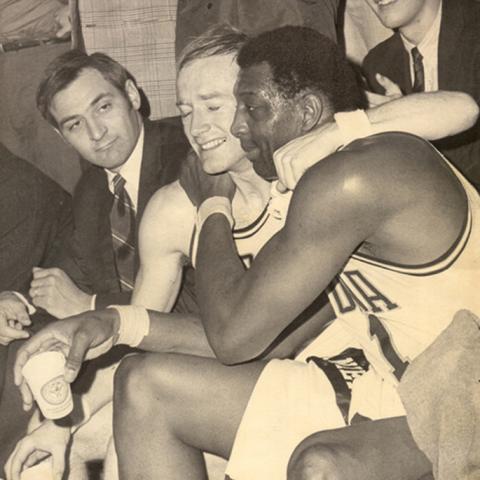
Bob Lanier, right, hugs teammate Bill Kalbaugh during a St. Bonaventure University game in 1970. (Courtesy of St. Bonaventure University)
"They refused. The white members refused to go in without the Black guys, [and] it forged the bonds of that team even closer," she said.
Lanier's sense of community with fellow Bonnies like roommate Bill Kalbaugh forged them into a Final Four team in his senior year of 1970.
"It's about love, man, about guys being there for each other, and it's about relationships," Lanier said in a 2007 interview with the university, 15 years before his death. "This Franciscan experience is about love and caring, and lending a helping hand, and lifting and uplifting other people."
While Lanier was growing up in the late 1950s, Brooklyn native Al McGuire was enduring his own realization of what he called the "checkerboard problem" of segregation as he took his first head basketball coaching job at Belmont Abbey College, a Benedictine school outside of Charlotte, North Carolina.
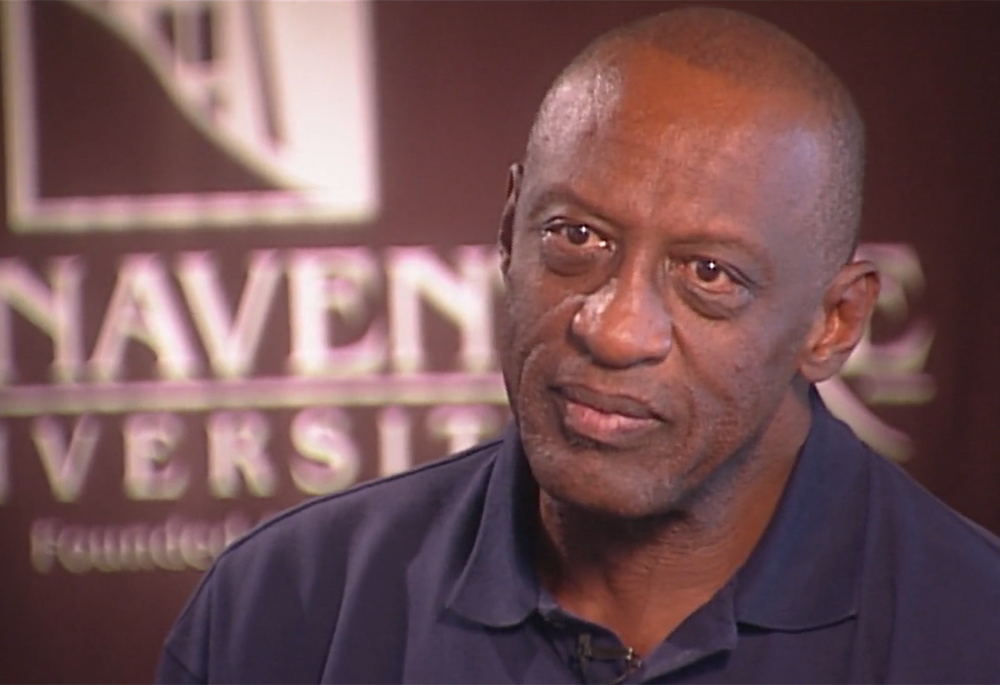
Bob Lanier is pictured in 2007. (Courtesy of St. Bonaventure University)
Unable to recruit or have his team play against Black players, the son of an Irish bar-owner scheduled "scrimmages" against historically Black colleges and universities.
Jesuit-run Marquette University hired him in 1964 and allowed him the freedom to recruit Black student-athletes like Lloyd Walton, a 1971 graduate of Mount Carmel High School in Chicago.
"Coach McGuire was my coach, but he was more," said Walton, now a personal and business consultant for athletes. "He had such great humanity, such great vision for his players."
McGuire started five Black players, including George Thompson, in Marquette's 81-74 win over all-white Kentucky in the 1969 NCAA Tournament, the last game before Hall of Fame coach Adolph Rupp finally integrated his team.
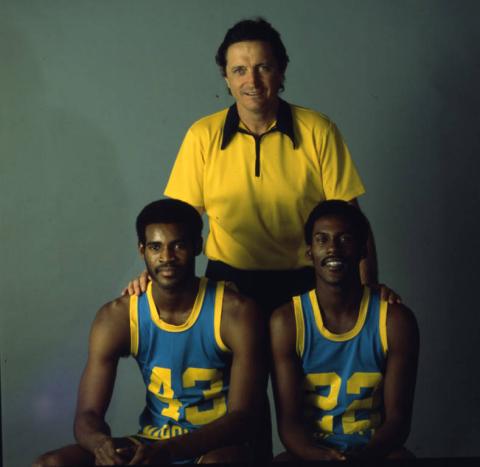
Marquette University coach Al McGuire, guard Earl Tatum and guard Lloyd Walton, from the 1975-76 team (Courtesy of Marquette University)
McGuire also regularly roomed Black student-athletes from New York and Chicago together with their white counterparts from small-town and suburban Wisconsin.
He talked less about strategy in practice.
"We talked about life, what life meant to you, what it should mean to you, what basketball should mean to you. [He said,] 'Use basketball. We want you to be in a position to be a self-sufficient, independent person when you leave Marquette,' " said Walton.
He played on McGuire's first of two Final Four teams in 1974 and became a second-team All-American before his NBA career. McGuire later led Marquette to the 1977 NCAA Championship in his last game as head coach.
"I look back now in retrospect and say that was God talking through him," Walton told the National Catholic Reporter.
Advertisement
Cartwright, a native of suburban Sacramento, experienced those lessons through the same Jesuit experience at USF, receiving an education to help him use basketball.
"At USF, you learn that, 'Hey, wait a minute, I can have my own business. I can be the CEO of a company.' So it gave you a bigger vision of the world,' " the 1979 USF alum said.
Cartwright's NBA career included three titles with the Michael Jordan-powered Chicago Bulls in the early 1990s.
But in the college game is where he discovered how sports creates a common goal that catalyzes community and also weaves through the Jesuit ethos.
"That's what sports is all about," he said, "that people become good friends with a clear understanding of who they really are."