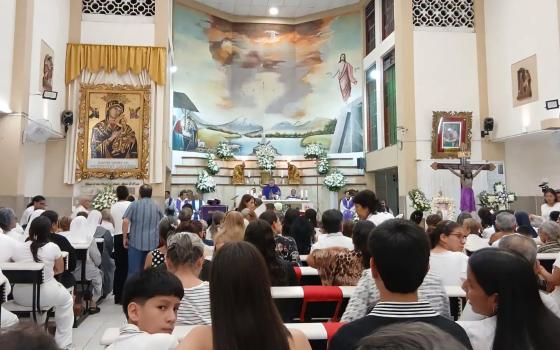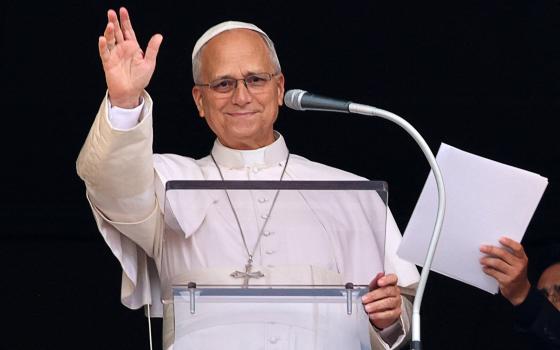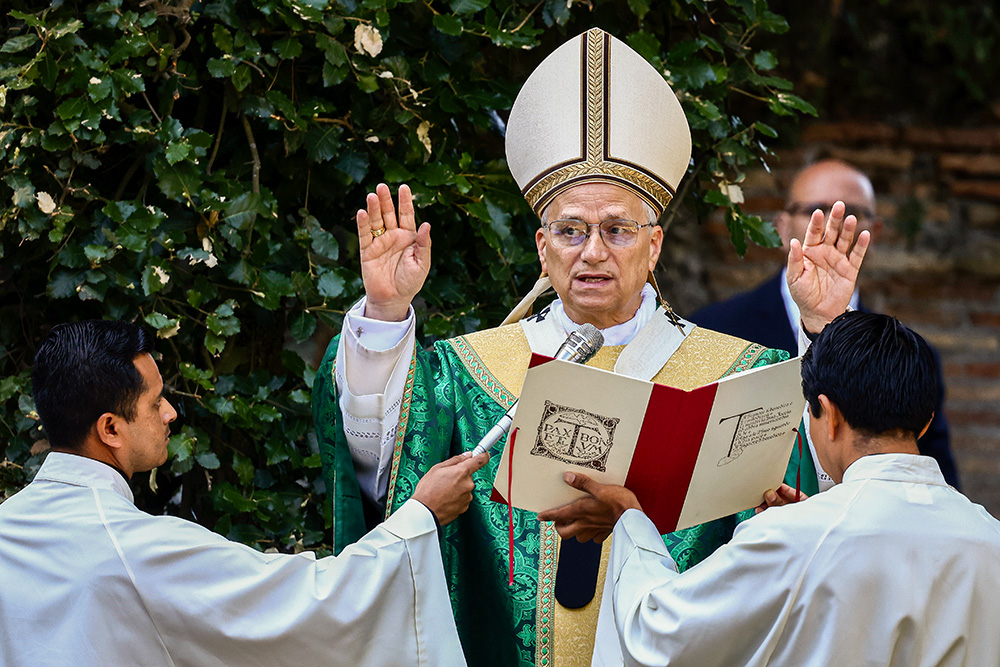
Pope Leo XIV leads the Mass for the Care of Creation, in Castel Gandolfo, Italy, July 9, 2025. (Pool Via AP/Yara Nardi)

Join the Conversation
Send your thoughts to Letters to the Editor. Learn more
The Mass for safeguarding the environment that Pope Leo XIV first celebrated last summer is now available for Catholic churches in the U.S., just in time for the upcoming ecumenical Season of Creation.
The Vatican's Dicastery for Divine Worship and the Discipline of the Sacraments finalized Aug. 4 English and Spanish translations of the Mass "for the care of creation," a new set of prayers and texts the Vatican added to the Roman Missal in June 2025.
The completion of the translations proved providential for the Seattle Archdiocese, which plans to use the new texts (known as a formulary) at a Mass Sept. 2 celebrated by Archbishop Paul Etienne at St. James Cathedral to open its celebration of the Season of Creation. The monthlong period of prayer and actions for God's creation runs from Sept. 1, the World Day of Prayer for the Care of Creation, to Oct. 4, the feast day of St. Francis of Assisi.
"The timing is ideal to be able to celebrate it when it's new and fresh and just start a new tradition, I guess, to do this each year," said Corinna Laughlin, the cathedral's pastoral assistant for liturgy and consultant for the archdiocese's liturgy office.
The Mass for creation joins 17 other "civil needs" formularies in the Roman Missal, among others for particular needs and other circumstances. Several touch on environment-related themes, such as times of harvest and famine along with prayers for good weather.
Vatican officials said its development was in response to requests for a liturgical means to celebrate the messages of Pope Francis' 2015 encyclical, "Laudato Si', on Care for Our Common Home." In that papal teaching document, Francis bemoaned the numerous ecological threats facing the planet, including climate change and biodiversity loss, and called on Christians to act.
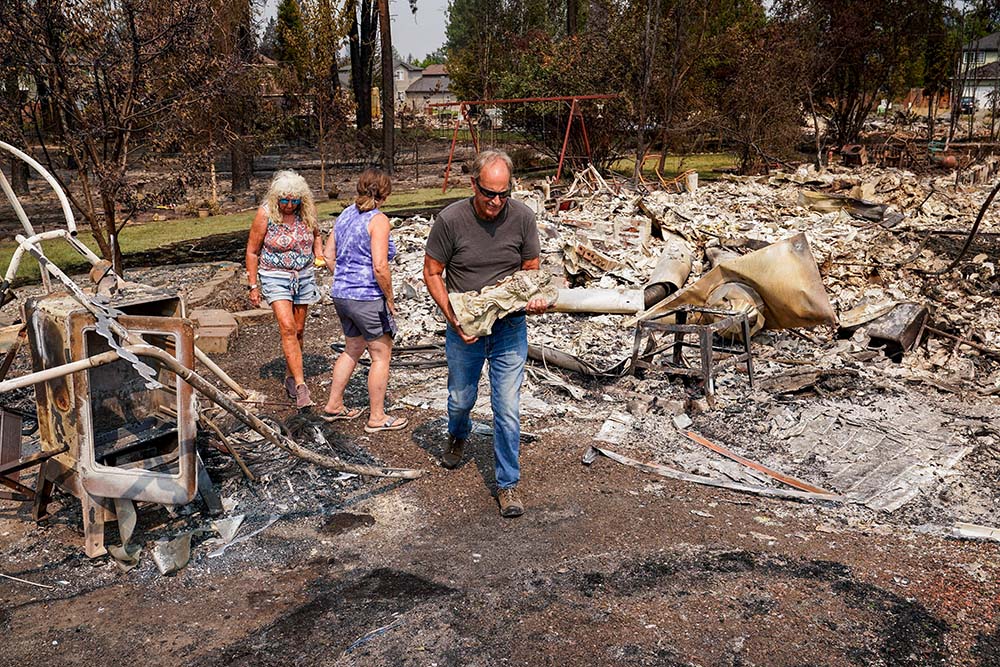
Tim Hansen carries a statue of an angel retrieved from the debris as his wife, Shelly, and Nancy Fuller survey their destroyed home in Spokane, Wash., Aug. 3, 2026, after a wildfire swept through the neighborhood. (OSV News/Reuters/David Ryder)
"At this time it is evident that the work of creation is seriously threatened because of the irresponsible use and abuse of the goods God has endowed to our care," Cardinal Arthur Roche, prefect of the divine worship dicastery, wrote in the decree issuing the new formulary.
The first iteration of the Mass for creation was celebrated in July 2025 by Leo at the Borgo Laudato Si' ecology project in Castel Gandolfo outside Rome. He is set to do so again on Sept. 1. But before it could be used in most churches in the U.S., it first needed to be translated from Latin.
Along with the exemplar originale Latin text, the Vatican released working translations to assist national bishops' conferences in preparing them for use in their native languages. The English translation was led by the International Commission on English in the Liturgy, which includes the U.S. Conference of Catholic Bishops. In June, the U.S. bishops' unanimously approved the translation, which were then sent back to Rome for final confirmation.
A similar process unfolded for the Spanish translation, which was undertaken through a collaboration by the U.S. bishops' conference and the Mexican Episcopal Conference.
Fr. Dustin Dought, executive director of the U.S. bishops' Secretariat of Divine Worship, said the procedure for approving adaptations of liturgical texts was outlined in Francis' 2017 motu proprio ("on his own initiative") Magnum Principium. That document gave bishop conferences responsibility for translating into local languages.
Advertisement
"His insight there was that the conference of bishops is closest to the culture and language that it serves," Dought said.
The new formulary will be included in future editions of the Catholic Lectionary for Mass. In the meantime, the U.S. bishops' conference has posted translations for both the English and Spanish versions of the Mass for the care of creation on its website, as well as bulletin inserts.
Along with creation-themed prayers, the formulary suggests readings for the Liturgy of the Word, including passages from Matthew's Gospel where Jesus calms the sea and where he instructs his disciples to learn from the birds in the air and flowers in the field to trust in God's providence.
Before the Mass for creation was issued, some Catholic churches prepared ecological liturgies at various times, even at the occasion of the first Earth Day in 1970. The practice has grown in the past decade, including with "Green Masses," following Francis' invitation for Catholics to join fellow Christians in marking the Season of Creation.
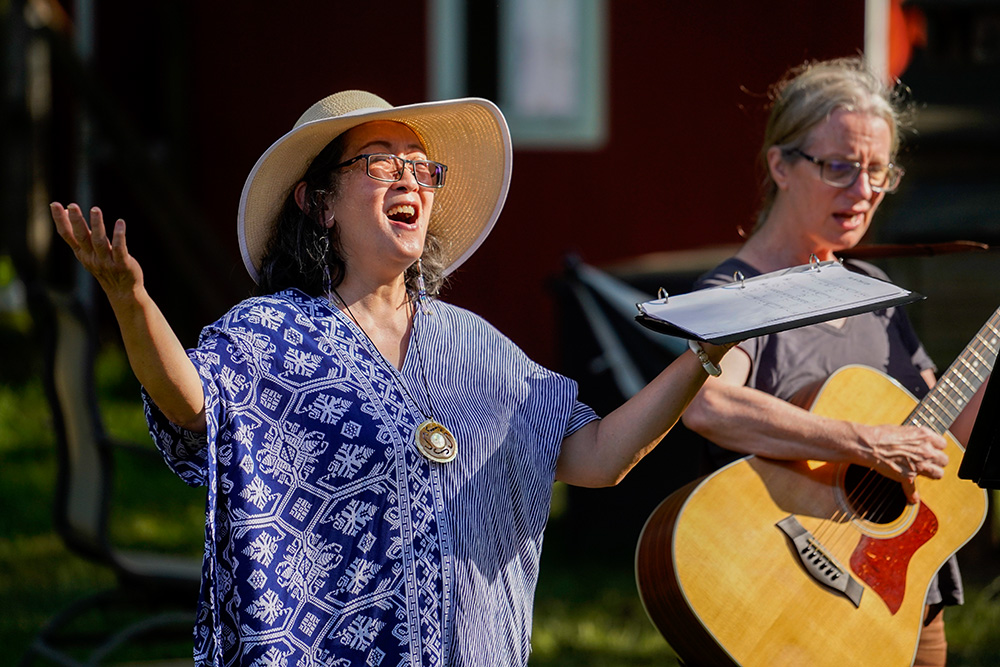
Tuty Gunawan sings during a prayer service marking the summer solstice and celebrating the beauty of creation at the motherhouse campus of the Sisters of St. Joseph of Brentwood, N.Y., June 20, 2024. (OSV News/Gregory A. Shemitz)
Having a Mass for the care of creation formally added to the Roman Missal is a major step, said Jesuit Fr. James Hug, who for years has developed liturgical resources for the Season of Creation.
"It's official, and that makes it legitimate to use," he said, calling the prayers "lovely" and affirming the Christian mission to care for the world God has created.
That stamp of approval from the Vatican is important, Hug added, for many priests who may have been hesitant to use other creation-centered liturgical resources in the past, whether ones he prepared or from groups like the Catholic Climate Covenant or Laudato Si' Movement.
"It says that this is the concern of the whole church," Laughlin said. "This isn't just a thing we pray about but a really important universal concern."
At Seattle's St. James Cathedral, the new formulary will be used at the Mass with the archbishop as well as a weekend Mass later in the month. Other parishes have also expressed an interest in planning their own liturgies for creation.
Dought said his office has received many inquiries about when the Mass for the care of creation would be available.
Preparations are already in the works in at least a half-dozen dioceses to celebrate the Mass for the care of creation. That includes the St. Paul-Minneapolis Archdiocese, where Archbishop Bernard Hebda will be the lead celebrant Sept. 6 at St. Francis of Assisi Catholic Church in Lake St Croix Beach, situated along the St. Croix River in Minnesota.
School Sister of Notre Dame Kathleen Storms, who too for decades has developed creation prayer services, is eagerly anticipating the first use of the new formulary in the Twin Cities region.
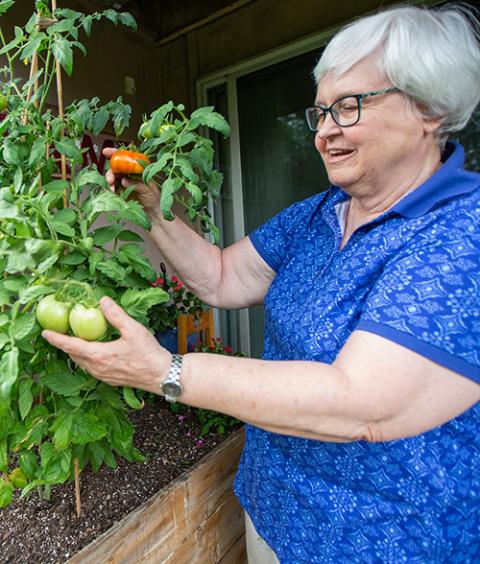
Sr. Kathleen Storms shows tomatoes grown in a raised garden bed made by her brother with recycled cedar planks at her apartment in West St. Paul, Minn., Aug. 17, 2022. (CNS/The Catholic Spirit/Dave Hrbacek)
"Even with everything we've seen just this summer — with the fires and the floods and the huge hurricanes and all of the rest — sometimes there is no connection between what's going on there and what the church teaches about care for creation," she said.
Storms hopes the new Mass for creation will lead more priests to uplift Catholic social teaching on creation and to preach on environmental concerns. How and when a formulary is used is mostly left to the discretion of the pastor, who weighs it against other feast days and holy dates on the liturgical calendar.
Catholics who have been eagerly anticipating the new formulary see in it the potential to expand awareness of Laudato Si' and other church teachings on creation, as well as cultivate the ecological conversion both Leo and Francis have said is essential to spur the level of collective action needed to address crises like climate change and deforestation.
"The liturgy does something that a lecture can't do. The liturgy does something that a catechism can't do," Dought said.
Laughlin, the liturgical consultant in the Seattle Archdiocese, turned to the church adage "Lex orandi, lex credendi" — how we pray expresses what we believe.
"What we lift up at Mass really shapes our understanding of what church teaching is, even without going to other documents. ... It tells us this is part of what we believe. This is significant enough and substantial enough that this is part of the Mass, which is source and summit.
"So I think planting the seeds there will make a difference, because obviously we need to be praying about this."