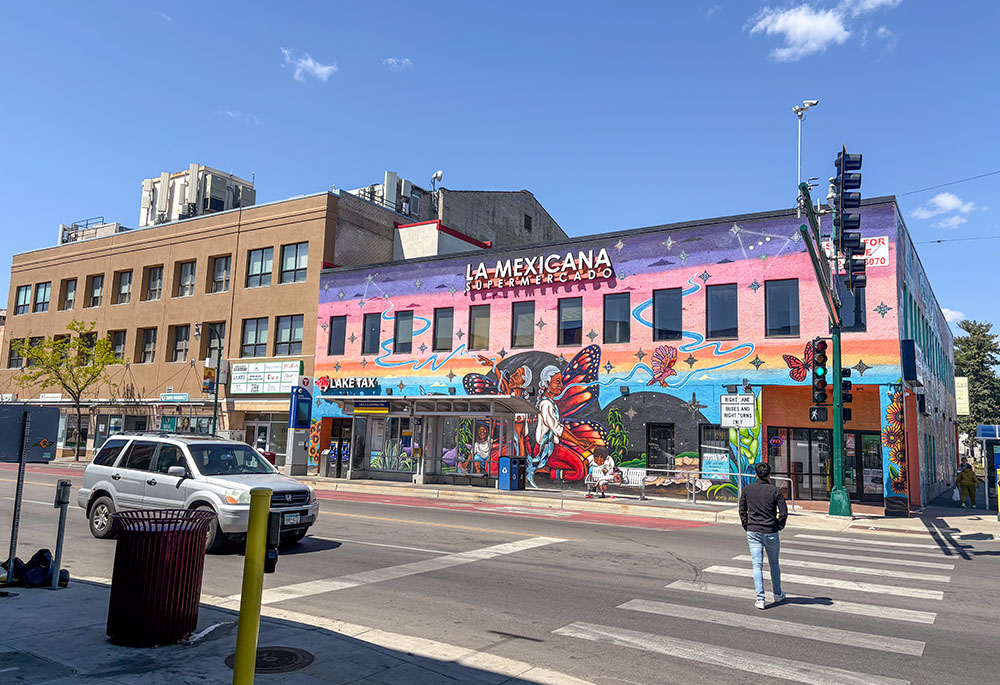
A view of East Lake Street, a Latino neighborhood in South Minneapolis, in May 2026 (NCR photo/Camillo Barone)

Join the Conversation
Send your thoughts to Letters to the Editor. Learn more
The murals begin before one can even step inside. At Mercado Central on East Lake Street in South Minneapolis, the walls pulse with color: painted Virgen de Guadalupe portraits, Aztec imagery, bright lettering, and scenes from Mexican history and everyday life.
Downstairs, families browse stores filled with rosaries, candles, cowboy boots, quinceañera dresses and devotional statues. The smell of tacos, tamales and fresh pan dulce drifts through the corridors. Spanish words and phrases echo from storefront to storefront.
For decades, Mercado Central has functioned as an anchor for Minneapolis' Latino community — a place where immigrants could find food from home, legal advice, familiar language, and community.
Upstairs, above the restaurants and shops, community organizations occupy modest offices tucked behind narrow hallways. Among them is Unidos MN, a grassroots organization born out of the Dreamer movement that today organizes around immigration, education, economic justice and climate justice. Unidos describes itself as a multiracial, women-led organizing network focused on "building power with Minnesota's working families to advance social, racial and economic justice for all."
Over the past year, those offices became a front line, too.
As immigration enforcement intensified across Minnesota, organizers, parish leaders and volunteers connected to Unidos and Catholic parishes across Minneapolis found themselves navigating fear, exhaustion and moral responsibility in real time. The trauma, they said, transformed churches, families and entire neighborhoods.
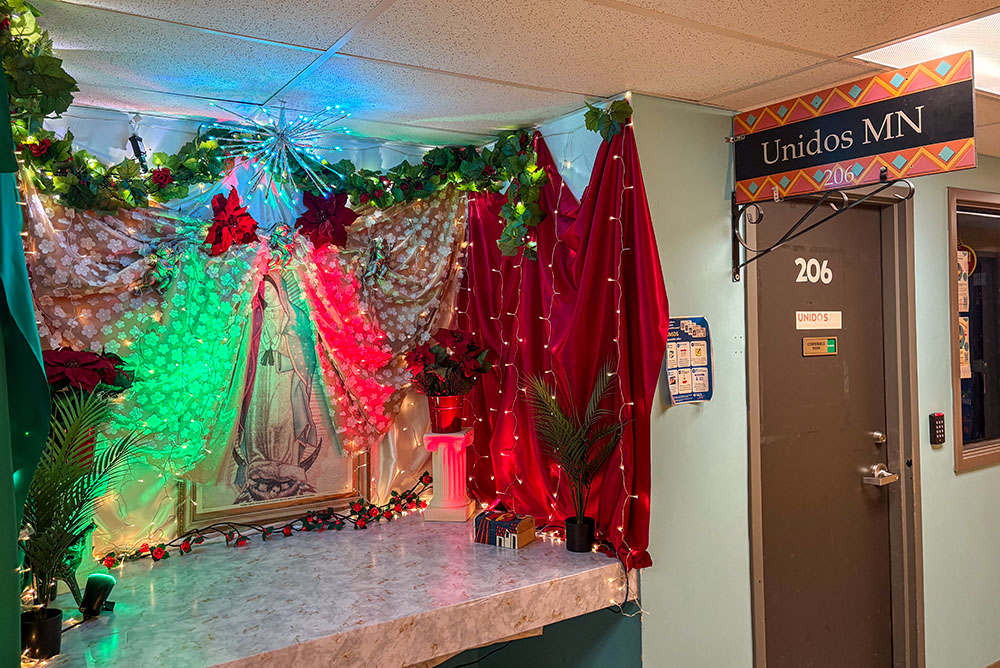
The entrance to Unidos MN on the upper floor of Mercado Central, next to an icon of Our Lady of Guadalupe, in South Minneapolis in May 2026. According to staff of Unidos MN, U.S. Immigration and Customs Enforcement entered Mercado Central in January. (NCR photo/Camillo Barone)
"Nobody prepares you for something like that," said Sofi Marrufo, an immigration organizer at Unidos MN who works primarily with Catholic parishes.
Marrufo remembers the atmosphere inside Mercado Central in the final weeks of the year. Rumors spread that large numbers of U.S. Immigration and Customs Enforcement agents would be deployed to Minneapolis. Businesses inside the market slowly began shutting their doors.
"We have our offices up here upstairs, and seeing like the thinning out of the shops, they were all closing one at a time," she told the National Catholic Reporter May 7. "There were less and less people in the parking lot, just being very afraid."
The fear, she explained, was not only for undocumented neighbors but for anyone who looked Latino.
"You just see the unmasking of a federal government that has contempt for you and for everyone that looks like you," Marrufo said. "And this very clear marker of you are not wanted, you are not welcomed here."
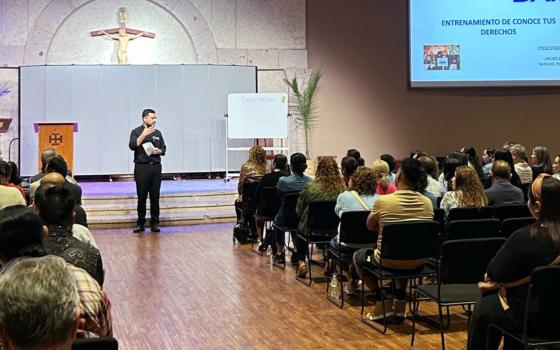
At Unidos, organizers shifted quickly into emergency mode. The organization trained tens of thousands of constitutional observers across Minnesota — volunteers prepared to document immigration enforcement actions and monitor whether constitutional rights were being respected.
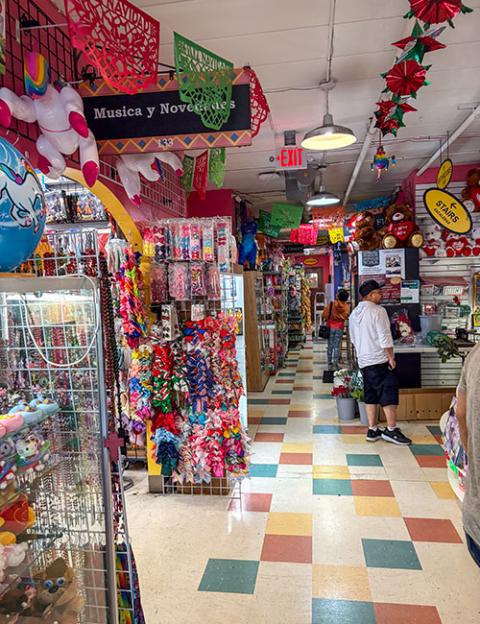
A store on the lower level of Mercado Central in South Minneapolis in May 2026 (NCR photo/Camillo Barone)
"We trained 50,000 of them and we never stopped," Marrufo said.
The trainings took place in churches, community spaces and private gatherings. Organizers drove across Minnesota daily, often uncertain about what might happen next.
The fear reached directly into Mercado Central itself.
"There was a time where somebody came with cameras, with three ICE agents, looking for the organizers," Marrufo recalled. "They went up to our offices up here. They came up and they tried to find us and to dox us," meaning the threat of revealing to the public Unidos' confidential information.
After that encounter, parts of the staff began working remotely or relocating to safe houses.
"I would check my phone and just look at my Signal and hope that none of us had been abducted or found," she said. Signal is a secure private messaging app that uses end-to-end encryption, mainly utilized to keep communications safer in delicate contexts.
Yet even while living under pressure, Marrufo said her Catholic faith became inseparable from the organizing work.
"God and I have a very, really tight relationship and we talk every day," she said. "I felt very called to be here, and there was nowhere else in the world that I wanted to be. Every day I would wake up and just pray to God like, 'Give me one more day, give me one more hour,' " she said, covering her face and bursting into tears.
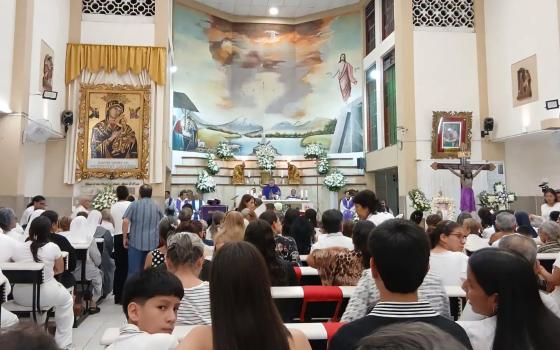
That same tension unfolded inside Catholic parishes across Minneapolis. At Church of the Ascension in North Minneapolis, Francisco Escamilla watched attendance collapse almost overnight.
Advertisement
Escamilla, 28, serves as the parish's faith formation director. Ascension's congregation is now predominantly Latino, the result of decades of demographic change; close to 70% of the parish is Hispanic, he said.
When rumors of increased immigration enforcement began circulating, Ascension started preparing families. The church hosted meetings with immigrant rights organizers and helped parishioners complete emergency documents authorizing guardianship for children if parents were detained.
During the annual novenas leading up to the feast of Our Lady of Guadalupe, attendance plummeted.
"The first day there were about 60 to 80 people," Escamilla told NCR. "And then it shifted to 70, and then 60, and then once I think Dec. 6 hit, I think we were down to about 10."
The phone calls started early every morning. What affected him most was hearing parishioners cry.
"Mentally, I wasn't ready for it," he said. "I had to kind of put a face for the people that I was serving. And it was saddening, because these are people that you grew up with."
The church adapted as best it could. Religious education classes moved online. Volunteers delivered groceries, milk, toys and hygiene supplies directly to homes because many families no longer felt safe driving to church. Within weeks, Ascension was supporting hundreds of families.
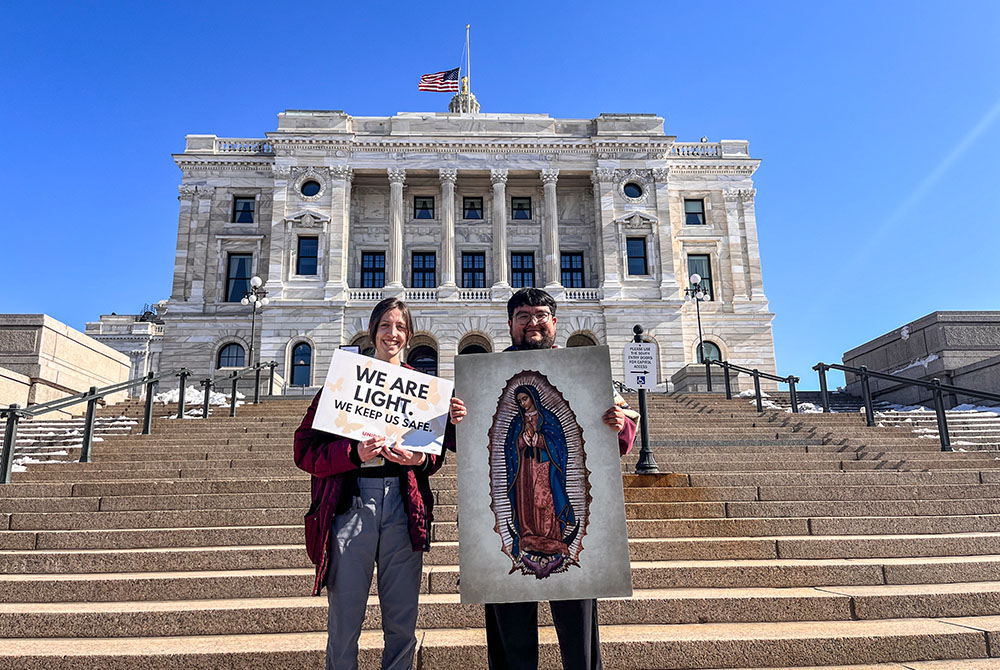
Francisco Escamilla, right, and a Catholic leader with Unidos MN outside the Minnesota State Capitol building in St. Paul before a demonstration in February 2026 (Courtesy of Sofi Marrufo)
"We started with 120 families," he said. "By the third week, we reached about 250 families."
The crisis also reshaped relationships between Latino and white Catholics inside the parish.
"We had about 225 volunteers and most of them were English-speaking folks or white volunteers that wanted to do something," Escamilla said. "When one community is struggling, the other one will be there to back it up," he added, crying.
Still, he said the psychological damage remains profound.
"This whole thing mentally will leave people with a lot of scars," Escamilla said. "You can help them out physically with groceries and rental assistance, but mentally, how do you tell people everything's going to be OK?"
At Unidos, executive director Emilia Gonzalez saw similar strain spreading through organizers themselves.
Gonzalez helped transform Unidos from a small undocumented student network founded in 2006 into one of Minnesota's largest Latino-led organizing groups. She remembers earlier crises — the COVID-19 pandemic, the unrest following George Floyd's murder, and white supremacists attempting to set fire to Mercado Central during the 2020 uprising.
But she said the latest wave of immigration enforcement carried a different quality.
"You're never prepared for the amount of violence, meanness, cruelty that these officers brought to Minneapolis," Gonzalez said. "Cruelty was the point. Humiliation was the point. The fear was the point."
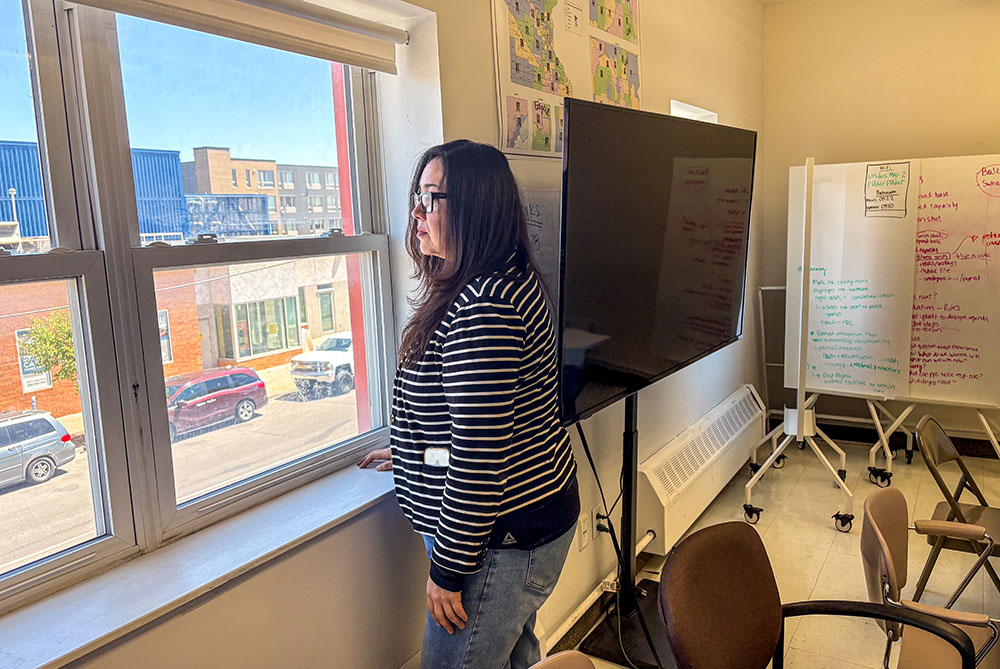
Emilia Gonzalez, executive director of Unidos MN, in her office at Mercado Central in South Minneapolis in May 2026 (NCR photo/Camillo Barone)
Before the new enforcement actions escalated, Gonzalez gathered her staff for a retreat where they studied examples from authoritarian regimes and social movements around the world. Then she offered them a choice.
"The job that I offer you before November looks very different than the job you're gonna get in January," she recalled telling her staff in late 2025. "If you want to leave, we will be very generous. But if you choose to stay, just know that the conditions here have entirely shifted."
Only one employee resigned.
Gonzalez insists that organizing cannot survive on emotion alone. During the pandemic, she said, mutual aid efforts consumed organizers entirely. This time, Unidos tried to separate emergency services from long-term organizing.
"Mutual aid is noble," she said, "but it doesn't change the conditions. It just helps people a day at a time."
For Marrufo, Escamilla and Gonzalez, Catholicism remains central to how they understand both the recent deportations crisis and their response to it — including what could be seen as a new healing process.
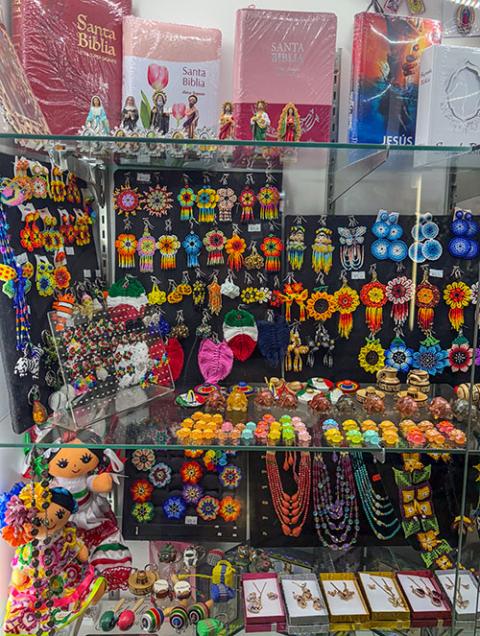
Spanish-language Bibles are seen among products for sale in Mercado Central in South Minneapolis in May 2026. (NCR photo/Camillo Barone)
"This is the time for us to act on our baptismal vows," Marrufo said. "That we welcome the stranger, we love one another, that we're all made in his image."
Escamilla saw people cling more tightly to prayer during the darkest weeks. "I found a lot of strength and a lot of light in this dark time through people wanting to get closer to God," he said.
"Healing is how we together build the systems that begin healing our relationships," Gonzalez said. "We are all made to the image and resemblance of God."
Still, amid constant anxiety, organizers and parish leaders continue showing up — at churches, community meetings, grocery deliveries and constitutional observer training, as part of the local immigrant community is still afraid of leaving their apartments.
Inside Mercado Central, business has gradually returned. Families once again gather downstairs for tacos and fresh fruit drinks. Some children run through the corridors. Shoppers stop at bakeries and taquerias. But those who lived through the winter say something fundamental changed: Even now, uncertainty lingers.
"There hasn't been a real solution to these issues," Marrufo said. "People are still uncertain."
Escamilla said he worries constantly that the fear could surge again.
"We tell people that right now everything's calmer," he said. "But who's to say that it's not going to ramp up again?"
Upstairs, beyond the noise of the marketplace below, organizers continue planning for what comes next. "I do pray with my feet, too," Gonzalez said.