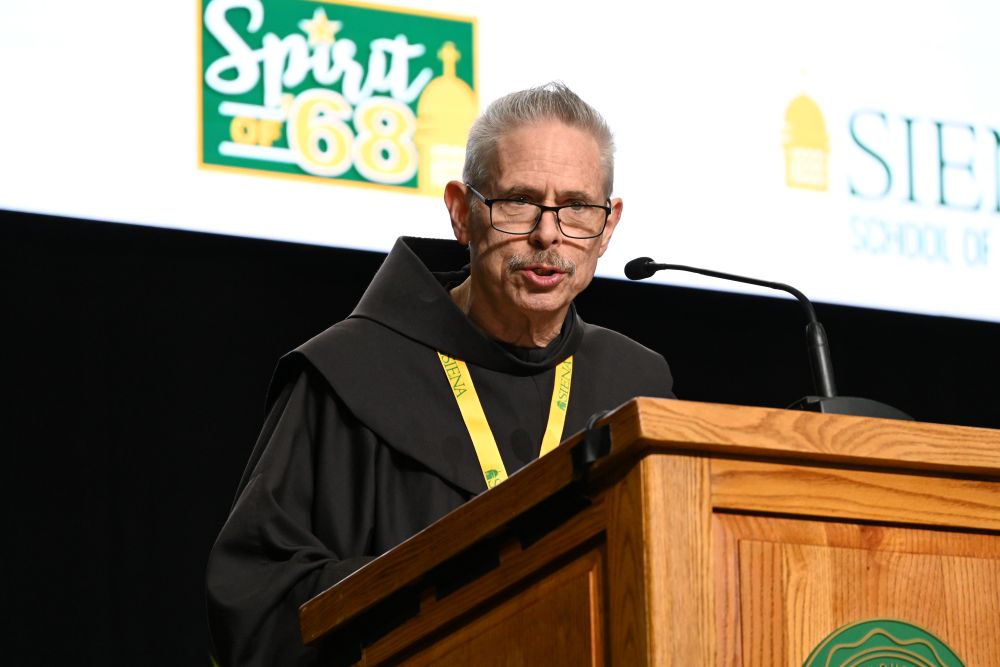
Franciscan Br. Michael Perry speaks during a Feb. 5, 2026, symposium on integral ecology at Siena University in Loudonville, New York. (Courtesy of Siena University)

by Michael J. O'Loughlin
NCR executive editor
Join the Conversation
Send your thoughts to Letters to the Editor. Learn more
When asked what St. Francis of Assisi would say to the world today, Franciscan Br. Michael Perry, newly elected leader of the U.S. Franciscans, said the saint would invite people to be "lights in the darkness," signs of hope and symbols of peace.
Perry was elected on July 15 to lead the largest province of the Franciscan Order of Friars Minor in the United States. In a recent interview with the National Catholic Reporter, he reflected on Pope Leo's leadership, how the order will minister with fewer friars and the need for authenticity in ministry.
"Even out of the darkest moments of human existence, out of the darkest moments of any individual's life with God, if we open ourselves to the mystery of life, even in our suffering, our confusion, great and important things can emerge," Perry told NCR. "Francis invites us to be to be lights in darkness, to be signs of hope, to be symbols of peace, to be brothers and sisters with everyone, no one excluded, absolutely no one."
A native of Indianapolis, Perry will serve as minister provincial of the Province of Our Lady of Guadalupe, a community of the Franciscan order with friars in the United States, Cuba, Puerto Rico and Jamaica.
Perry, 72, who once studied alongside the future Pope Leo XIV, is no stranger to leadership in the Franciscan order. He was elected in 2013 to lead the global Franciscan Order of Friars Minor, a post he held until 2021. During that time, he helped the order weather a major financial crisis, collaborated with Pope Francis and assisted U.S. friars as they deliberated about the future of their provinces. He takes charge of the U.S. branch of the friars at a time when the order has relatively few men joining its ranks and recently consolidated most of its U.S. provinces.
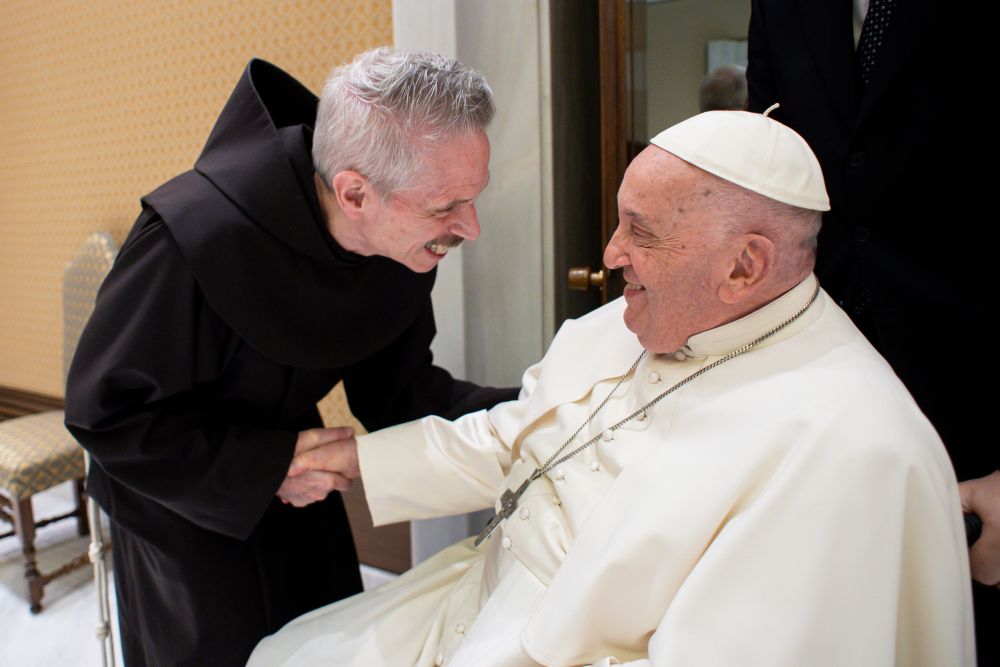
Franciscan Br. Michael Perry greets Pope Francis in 2024. (Courtesy of Siena University)
The new U.S. province, created in 2023 and headquartered in Atlanta, brought together six previous provinces and it serves as an acknowledgement that friars are aging and vocations are lagging; the order peaked in the 1960s and '70s, with about 3,200 members in the United States. The new province has about 700 men, with just under 30 in formation.
But Perry says that Franciscans here are at a "liminal" stage in their existence and that he has hope about the future of the order. He believes that the order has something to offer, especially for young people, "who are asking a lot of questions about their lives and their future, and they're looking for authentic signs of meaning."
"The challenge then is for us to become ever more authentic," he said.
The consolidation of the Franciscan structure mirrors trends in other religious communities in the United States. The Sisters of Charity of New York announced in 2023 that they are "on a path to completion" and no longer accept new members. The Society of Jesus, or the Jesuits, recently released plans that consolidate the novitiates in the United States and Canada into two locations and they have merged several provinces in recent years.
"We have to really believe that this is God's work," Perry said of the order's ongoing ministry even in the face of smaller numbers. "That doesn't mean we just sit around and wait for things to happen, and think that God's going to take care of it. It just, I think, calls us to reflect on and review the core elements that were attractive to people in St. Francis's time."
Perry said friars have an important message for people struggling spiritually today.
"We are good fundamentally," said Perry, who holds a doctorate in religious anthropology from the University of Birmingham, U.K. "That's our starting point: that we are good, that we are created good, and we are destined for good."
Reflecting on the 800th anniversary of the death of St. Francis, which Leo declared as a special jubilee year during 2026, Perry said, "The basic Franciscan approach to human life is founded in love, rooted in goodness."
Perry's career has taken him around the globe. He spent about a decade as a missionary in the Democratic Republic of the Congo and he previously worked for the International Office of Justice and Peace at the U.S. Conference of Catholic Bishops, as well as at Catholic Relief Services and Franciscans International. He is a 1984 graduate of the Catholic Theological Union in Chicago, where his time overlapped with that of the future Pope Leo XIV.
"Every once in a while, I'd go to the party at Augustinians, or he'd come to our party," he recalled. He sees in Leo someone who shares similar values to Francis but who is intent on charting his own course.
"He's trying to hold the church together," Perry said of Leo, pointing to the pope's early efforts at continuing Francis' program of wider consultation and dialogue known as synodality. "He's trying to keep people at the table to talk."
Advertisement
Perry made global headlines in December 2014 when, as minister general of the order, he disclosed that the Franciscan headquarters in Rome had lost millions of dollars in a botched investment scheme and nearly bankrupted the order.
The key lesson he learned from the experience was, "transparency is really important." Perry was reelected to serve a full six-year term the following year, serving in a role that Franciscans describe as the "successor of St. Francis" until 2021.
"We didn't have good systems in place and it was hard for us to do," he recalled. "But [we had] to make it clear to the world, we made a mistake, a big mistake, and we need to learn from that mistake."
In 2023, Perry became director of the Laudato Si' Center for Integral Ecology at the Franciscan-affiliated Siena University in Loudonville, N.Y. Last year, the order adopted as a priority listening to young adults — and Perry said he believes a posture of accompaniment is the best way to engage.
"To accompany, to be present with, not to judge," Perry said. "Just to be there and to try to understand."
Of the political divisions plaguing the United States, and its uncertain role in the world, Perry said he hopes that Americans will ask difficult questions of themselves. "If we say, pretend, we're one nation under God, what does that mean? To say that all people are created equal, what does that mean?" he asked.
For Franciscans, that means striving to ensure that no one is forgotten, Perry said.
Friars engage in a variety of work — campus ministry, homeless outreach, accompanying migrants — and they invite lay people to join them, not only as opportunities to give back to others but also to learn more about what it means to be a follower of Christ in the spirit of St. Francis.
These encounters, Perry said, invite individuals "to share in the deepest and darkest moments of people who are suffering, people who are marginalized, people who are brothers and sisters who are economically excluded, our brothers and sisters who are migrants and who are being hounded and hunted down."
This work, he said, "helps them discover an even deeper sense that all of us are human beings with fundamental dignity."