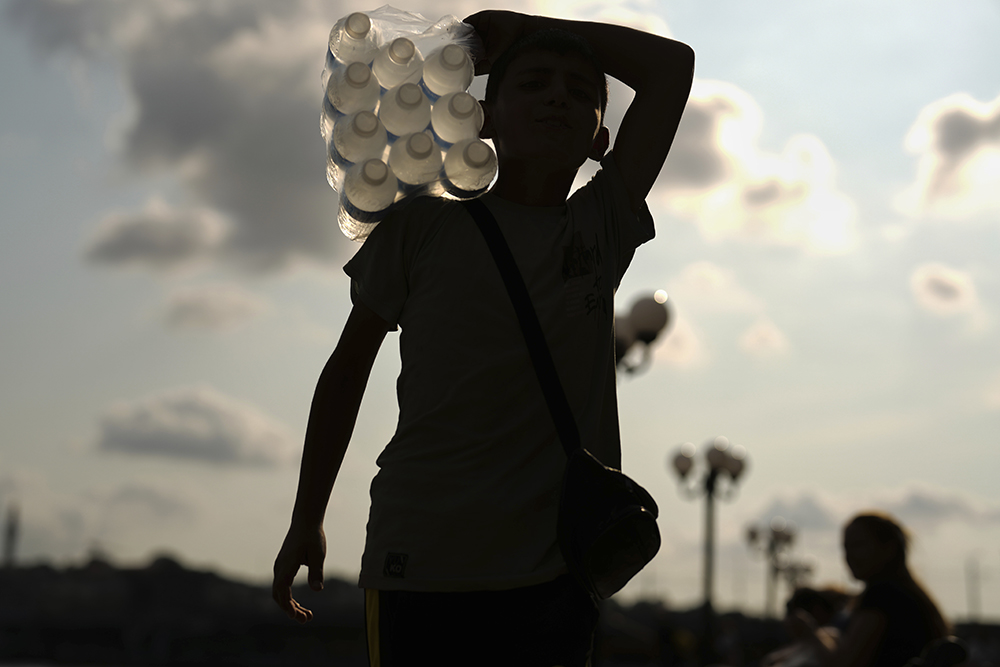
A young street vendor carries plastic bottles of water on his shoulder on a summer day, in Istanbul Aug. 8, 2025. (AP/Francisco Seco)

Join the Conversation
Send your thoughts to Letters to the Editor. Learn more
A global treaty to address plastic pollution remains elusive, as negotiations in Geneva in early August could not bridge divides. Delegates departed without a deal or a plan for when they might meet next.
For Catholics who have been following the multiyear process within the United Nations to craft the first-ever plastic treaty — to limit plastics' harms to both human health and ecosystems — the outcome in Switzerland was not unexpected as countries continued to hold fast to hard lines, primarily around plastic production.
"Disappointed but not surprised," said Sr. Patty Johnson, a Sister of St. Joseph of Carondelet who attended past plastic treaty negotiating sessions.
"Plastics continue to remain an important destructive force, in terms of human health and maintain[ing] our water resources, our oceans in particular," said Fr. John Pawlikowski, a member of the Climate Action Core Group at the Parliament of the World's Religions.
The negotiations in Geneva (Aug. 5-15) sought to deliver on a 2022 U.N. resolution that nations unanimously adopted to craft a treaty to address plastic pollution across the products' full life cycle.
Advertisement
The amount of plastic produced today — 475 million tons — is set to double by 2040 and nearly triple by 2060, according to a new report in The Lancet, a top medical journal, published days before the Geneva talks began. At the same time, the report said, less than 10% of plastic is recycled globally, and many plastic items currently cannot be recycled. Single-use plastics make up 35%-40% of current plastic production and roughly 65% of plastic waste. More than 98% of plastics are created from fossil fuels, and upward of 16,000 chemicals are used in their production, with hazard data not publicly available for two-thirds of them.
While plastic pollution often brings to mind scenes of littered landscapes or animals entangled in plastic, more medical research in recent years has highlighted the impact of plastic, and increasingly microplastics, on human health.
Plastics pose health harms at every stage of their life cycle and are linked to $1.5 trillion annually in health-related economic losses, costs born disproportionately by low-income and at-risk populations, The Lancet report concluded.
The report, led by Philip Landrigan, director of the Boston College Global Observatory on Planetary Health, was part of the launch of a new monitoring system to track and raise awareness of plastics' health impacts.
Landrigan, who is an epidemiologist and pediatrician, and the co-authors called plastics "a grave, growing, and under-recognized danger to human and planetary health."
More than 2,600 delegates from 183 countries met in Geneva across 10 days. The meeting was a continuation of one begun in December in Busan, South Korea, where countries were expected to conclude a fifth negotiating session with an agreement.
Such a deal did not develop, and nations agreed to reconvene eight months later in Switzerland, where the same fault lines from prior negotiations reemerged.
A primary sticking point has been the question of plastic production. More than 100 countries endorsed a legally binding cap on plastic production and limiting hazardous chemicals. But a smaller cohort of countries — mainly petrostates — resisted limits on plastic production and instead emphasized enhanced recycling and waste management. The U.S. under the Trump administration also opposed a cap on plastic production and limits on chemicals.
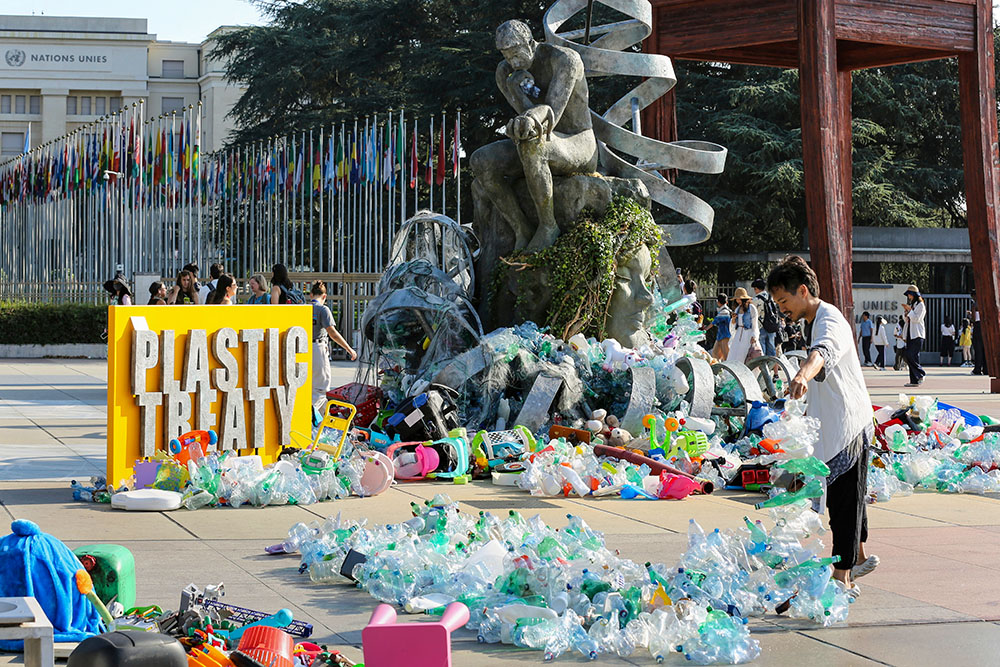
Benjamin Von Wong, right, a Canadian artist and activist, heaps piles of plastic waste onto a large sculpture that he designed in front of the United Nations office in Geneva on Aug. 11, 2025, during negotiations on a global treaty to address plastic pollution. (AP/Jennifer McDermott)
Several draft texts were put forward, but none were adopted. The meeting adjourned early Aug. 15, with expectations that nations will reconvene at a later date, though details of when and where were not determined.
Pawlikowski suggested that a stronger interreligious voice, including that of Pope Leo XIV, could help turn the tide on plastic pollution, and perhaps the treaty negotiations.
Johnson, the St. Joseph sister, expressed hope that the diverse alliance behind an impactful plastic treaty — involving countries, environmental groups, scientists, waste workers, Indigenous and faith groups — will eventually lead to a breakthrough on the growing plastic problem.
"It is clear to me that we will pursue ways to reduce plastic, perhaps through continued efforts towards a treaty, perhaps through multi-lateral non-UN agreements, perhaps through pressure on manufacturers or other ways that will emerge," she said in an email.
"Life on the planet depends on us doing something soon."