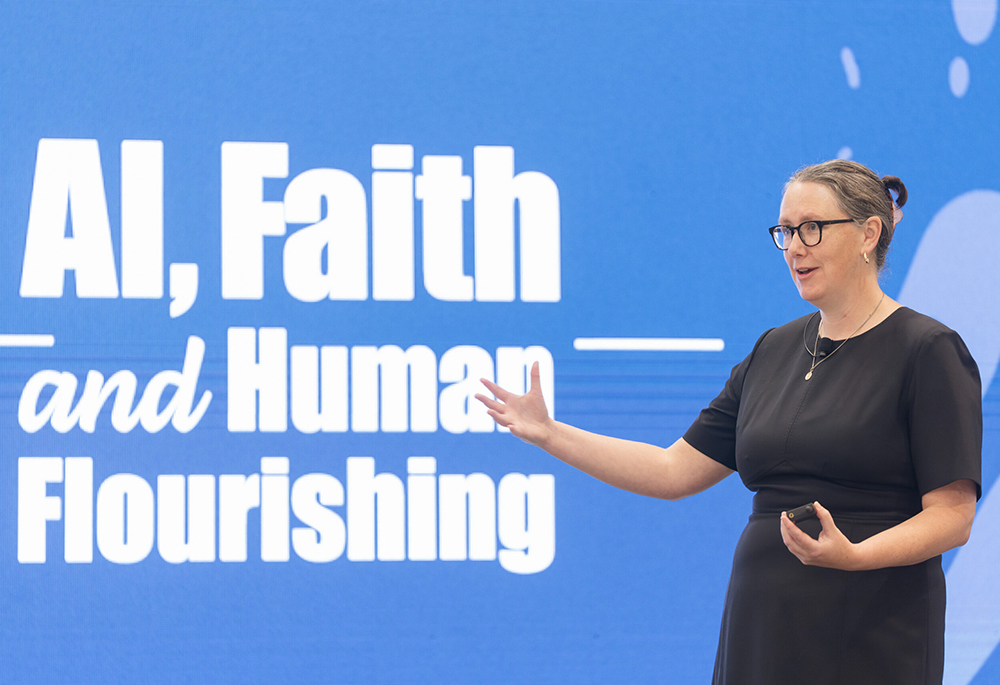
Meghan Sullivan, a philosophy professor at the University of Notre Dame, presents at the 2025 DELTA Summit. (Courtesy of Meghan Sullivan)

by Catherine M. Odell
Join the Conversation
Send your thoughts to Letters to the Editor. Learn more
Meghan Sullivan, a philosophy professor at the University of Notre Dame, and founding director of the university's Institute for Ethics and the Common Good, did not have much of a summer break.
Sullivan, 43, a busy and much-in-demand public speaker and writer, has been traveling nationally and internationally. She speaks frequently as a philosopher about "the good life," the common good, what philosophy is and how it can help shape values and priorities. And she gives special emphasis to speaking about how love is the most important virtue.
Sullivan, Notre Dame's Wilsey Family College Professor of Philosophy, is the co-creator and teacher of a popular philosophy course, "God and Good Life" which about half of the freshmen class takes each year. In the last several years, however, she has also been talking more about artificial intelligence and how it has the potential to impact human lives and independence. Last October, she shared some of these concerns in Notre Dame's student newspaper, "The Observer."
"Recently," she wrote, "I've been focused on the complex, thorny ethical questions that are developing at breakneck speed around artificial intelligence. How will AI change education, both for students and teachers? What will work look like as AI begins to automate labor? Will our understanding of beauty and truth shift as we increasingly interact with AI-generated content?"
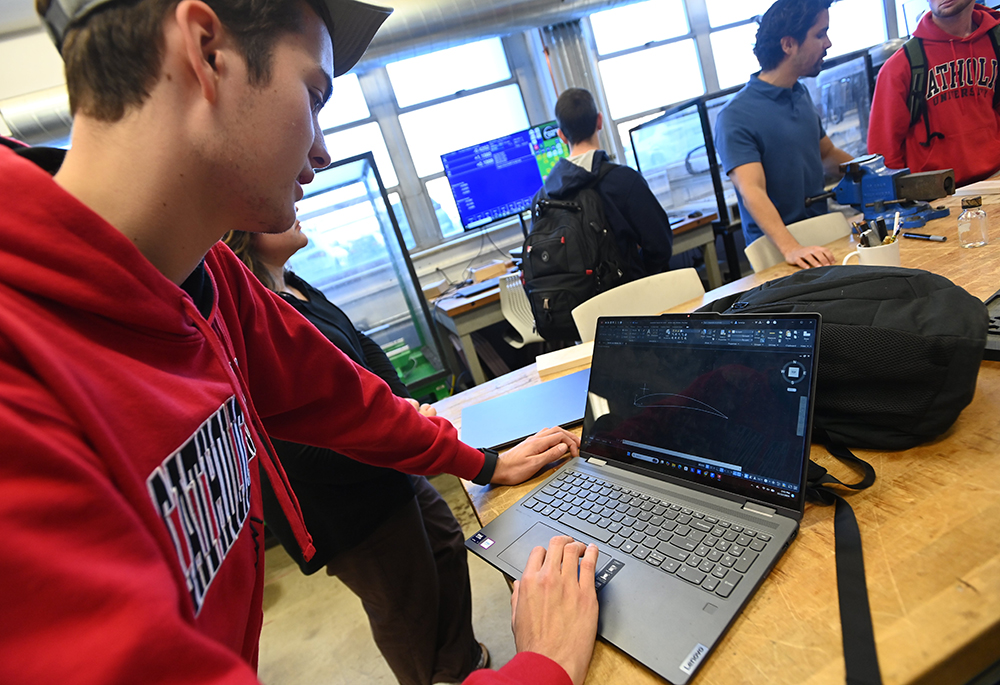
A 2024 file photo shows engineering students at The Catholic University of America in Washington, which has launched new bachelor and master degree programs in artificial intelligence in 2025. (OSV News/The Catholic University of America/Patrick Ryan)
"There's no question that AI has many good and useful purposes," Sullivan told NCR. "It really is everywhere — connected with your power grid, your electricity. I guarantee that there's AI software making determinations about how your electricity will work. And obviously, you can't open a word processing program like Google documents without it immediately sending an AI assistant to help complete your sentences."
Although AI can be extremely useful and a wonderful tool, Sullivan, among others, wonders if it will be used to make cold, calculating, amoral decisions that ignore the value and dignity of human life.
She told NCR that her undergraduate students are very worried about AI.
"They remind me that I've had an opportunity to develop a career and find my way in life. They're not so sure they will be able to do that. They feel that this technology is really disrupting their education and disrupting future job prospects," she said. "They're trying to figure out what kind of world they're going to be dealing with. They are a lot more skeptical that this technology is good than the average 35-40-year-old person in the workforce whom I might meet."
Their concerns are not unfounded. In an August New York Times column, two investment firm officers warned that AI could displace 18% of current U.S. jobs in the next five years. And other commentators have expressed concern that profits generated by AI could potentially be channeled very narrowly to enrich certain companies, investors and highly skilled workers.
Advertisement
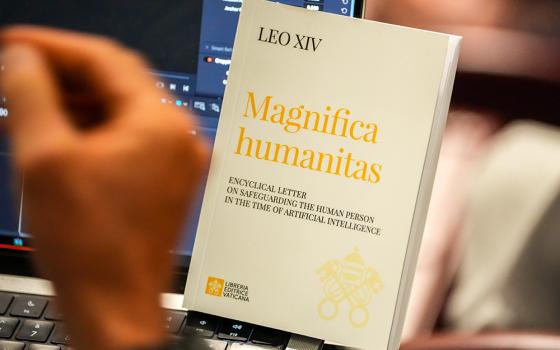
When asked about how impactful she thinks Pope Leo XIV's recent encyclical, Magnifica Humanitas, has been in addressing AI concerns, Sullivan responded enthusiastically: "It's been a blockbuster!"
She has been traveling a lot with the university's DELTA project, a program that takes a faith-based approach to AI, to help church leaders around the country deal with some of the major issues everyone is having with this new technology.
"In the Bay area in California, we work with major technology companies and at every single meeting, at least half of the engineers were at least familiar with the encyclical or had read and discussed parts of it!" Sullivan said.
The encyclical's subtitle clearly indicates the letter's purpose: "On Safeguarding the Human Person in the Time of Artificial Intelligence." Sullivan pointed out that "the intellectual resources of Pope Leo are incredible, and I think that one of the reasons why this has been so celebrated is that a lot of people realize that there are not too many world leaders who are capable of putting out an idea like that."
The OpenAI logo is seen in this June 11, 2026, illustration. (OSV News illustration/Reuters/Dado Ruvic)
But how are everyday Catholics supposed to make sense of these complex and global conversations about AI? Sullivan didn't hesitate to say that she didn't really understand what AI could mean until November of 2022. That was when OpenAI, an artificial intelligence company announced that it was releasing ChatGPT. It was an AI chatbot that could be used to answer questions, and write papers. It was one of the first AI tools to become available to the public.
"I remember sitting on my couch with my brother about a month later. It was Christmas time and I was working on my syllabus for my "God and the Good Life" class. My brother, who was then a law student, was laughing at me and saying: 'Your class is toast!' I said, 'What do you mean?' "
Meghan's brother explained that every homework assignment that she was writing for her college students could be plugged into ChatGPT. It could be done instantly for them with AI. And he showed her how easy it was to do. "I remember thinking," she added, "that this could write my dissertation and with just a bit of light editing!"
Today, Sullivan remains "guardedly optimistic" about what AI will mean down the road on campus, for churches and for the world. Notre Dame's Institute for Ethics and the Common Good has brought in over $60 million in grants in recent months to support research and projects focused on supporting ethics and humanistic concerns. Some of that funding helped create the DELTA framework and a website full of useful resources.
She said the university's teams are now reaching out and working with Christian communities across the U.S. on AI concerns. Projects are helping to reassure pastors and churches that human dignity has never been defined by productivity or compared to the superior speed with which AI can write a computer code.
The group's goal, and her own in the classroom, is to make the challenges linked with AI seem slightly less daunting.