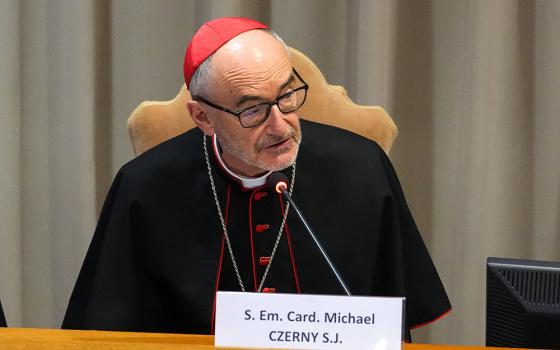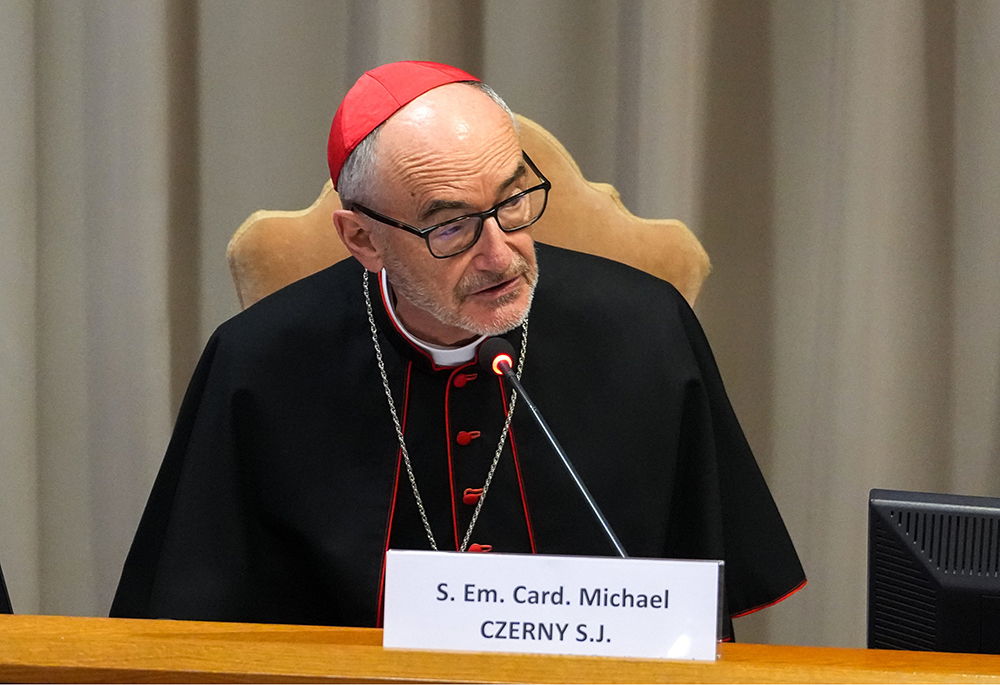
Cardinal Michael Czerny, then-prefect of the Dicastery for Promoting Integral Human Development, speaks at a presentation of Pope Leo XIV's first encyclical, "Magnifica Humanitas: On Safeguarding the Human Person in the Time of Artificial Intelligence," at the Synod Hall at the Vatican May 25, 2026. (CNS/Lola Gomez)

Join the Conversation
Send your thoughts to Letters to the Editor. Learn more
Pope Leo XIV's alma mater, Villanova University, has named the former head of the Vatican's social justice office, Cardinal Michael Czerny, as the inaugural recipient of a sustainability award honoring the pope's advocacy on caring for creation.
The Czech-Canadian cardinal led the Dicastery for Promoting Integral Human Development until Sept. 1, where he became one of the Vatican's most visible voices on climate change.
In 2022, he had called for an immediate end to the exploration and production of coal, oil and gas and said that all existing fossil fuel production must be phased out.
Under Czerny's leadership, the dicastery also launched the Laudato Si' Action Platform, an initiative designed to put into practice the principles of Pope Francis' 2015 encyclical on care for creation, "Laudato Si', on Care for Our Common Home."
Lorna Gold, executive director of the Laudato Si' Movement, said they could think of no one more fitting than Czerny to receive the award. In his role with the dicastery, Czerny worked closely with Laudato Si' Movement — a network of 900-plus Catholic organizations committed to responding to Francis' encyclical on ecology — particularly with the 2022 documentary "The Letter" and the Laudato Si' Action Platform.
"Cardinal Czerny has always brought a profound concern for the poor, the migrants, the margins — insisting that the vision of 'sustainability' in Catholic teaching must always answer both the cries of the poor and the earth," Gold told National Catholic Reporter.
Villanova wanted to name the award after its most famous alumnus, who graduated with a bachelor's degree in mathematics in 1977, since integral ecology is "something he personally has been very interested in, and has been for long before he's been pope," Augustinian Fr. Peter Donohue, university president, told NCR. "It's a message he's had for his whole ministry."
Advertisement
As pope, Leo has followed in the footsteps of Francis who make care for God's creation a central tenet of his pontificate, calling on world leaders to take seriously the risks posed by climate change and publicly praying for the conversion of those who resist climate action.
In a Mass celebrated "for the care of creation" in the papal gardens Sept. 1, Leo asked Catholics to recognize the ways in which they have been "unfaithful in safekeeping creation and caring for the dignity of each person."
The medal will be presented by Leo personally on Oct. 13 in a ceremony at the papal gardens in Castel Gandolfo, outside of Rome, during an international sustainability conference organized by Villanova.
Though awarded to a member of the clergy in its first year, the Pope Leo medal remains "wide open" to anyone who is deemed to fulfills its values, Donohue said, namely "a holistic vision of sustainability, integrating care for the environment, social justice, concern for vulnerable populations, and responsible stewardship of economic and natural resources." The medal will be awarded every two years.
Ecology "was an important thing within the university but we hadn't really done anything to take out what we have been discovering, or what we have been teaching and learning outside of the university," Donohue told NCR. "So the medal is a way of recognizing someone that we see as an individual who we see that will contribute, to make some change in the world. It was really to see who are the changemakers and recognize them."
At a Rome press conference announcing the award, Czerny was asked how the ecological principles it recognizes should inform the development of artificial intelligence.
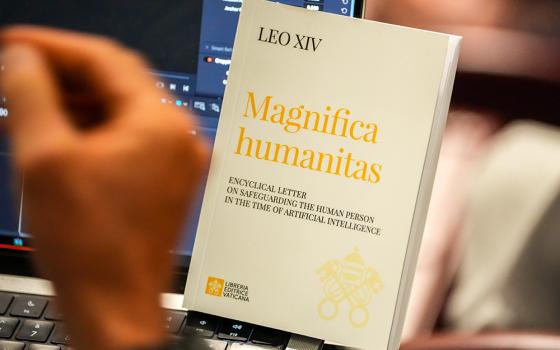
The cardinal pointed to Leo's AI encyclical, Magnifica Humanitas, which he said makes clear that "we cannot go on thinking, feeling and behaving as if this whole thing was beyond us."
"We could compare this with the Industrial Revolution, which I think began with people feeling that there was nothing that could be done, and which nevertheless developed important responses, some of them very actively sponsored or supported by the church," Czerny said. "Our hope would be that, similarly, in a very different world than the 19th century, that people would help one another, and that the church would help them to take appropriate responsibility for AI."
"We have made it. We want to use it; it's ours. We can't blame anybody else," he said.
The National Catholic Reporter's Rome Bureau is made possible in part by the generosity of Joan and Bob McGrath.