In a photo illustration, a user is about to select an AI chatbot from a smartphone screen, with DeepSeek, Grok, Claude and ChatGPT application icons displayed. (Dreamstime/Rokas Tenys)

Join the Conversation
Send your thoughts to Letters to the Editor. Learn more
Artificial intelligence is increasingly becoming more than a search engine for people. It can be a confidant, adviser and, in some cases, a source of guidance on relationships, morality, grief, spirituality and the meaning of life.
That shift is at the center of a new report from The AI Collective, a San Francisco-based nonprofit, based on 13 public dialogues held over a year with participants from 52 countries. The report, written by Ana Catarina de Alencar, the organization's resident philosopher and a doctoral researcher at Université de Lille, argues that existing approaches to AI governance are struggling to account for something new: how people are forming intimate relationships with it.
The report calls this challenge "relational AI governance," shifting attention from individual outputs to the ways repeated interactions with relational AI can shape trust, emotional attachment, behavior and human autonomy.
For de Alencar, younger users are particularly important because many are still forming their moral, emotional and spiritual identities.

Ana Catarina de Alencar (Courtesy of Ana Catarina de Alencar)
"AI is available 24 hours, seven days a week. It's always there to listen," de Alencar told the National Catholic Reporter. "It never says that it's annoyed with a conversation or tired or that it's impatient."
That combination of availability and apparent nonjudgment can be powerful. Unlike earlier technologies, she said, conversational AI "is talking back to us," remembers information and can give especially younger users the impression that they are understood.
De Alencar said some young participants described feeling that people around them did not listen to them or understand them. She characterized that as part of a broader "failure" of human care and attention that can make an always-available machine particularly attractive.
The danger, she said, is not necessarily a conscious decision to hand authority to AI, but she warned that this can happen gradually.
"It is a continuous process of engagement with the machine," de Alencar said, as the system memorizes and infers information about a person and increasingly personalizes its responses. "The influence doesn't happen in one fixed event."
That gradual transfer of authority to AI is one of the report's central findings. It argues that these systems are increasingly being consulted both about facts and about what people should do, believe and value. The report describes AI as accumulating "moral, existential and spiritual authority," while warning that the values shaping its answers are largely determined by private companies.
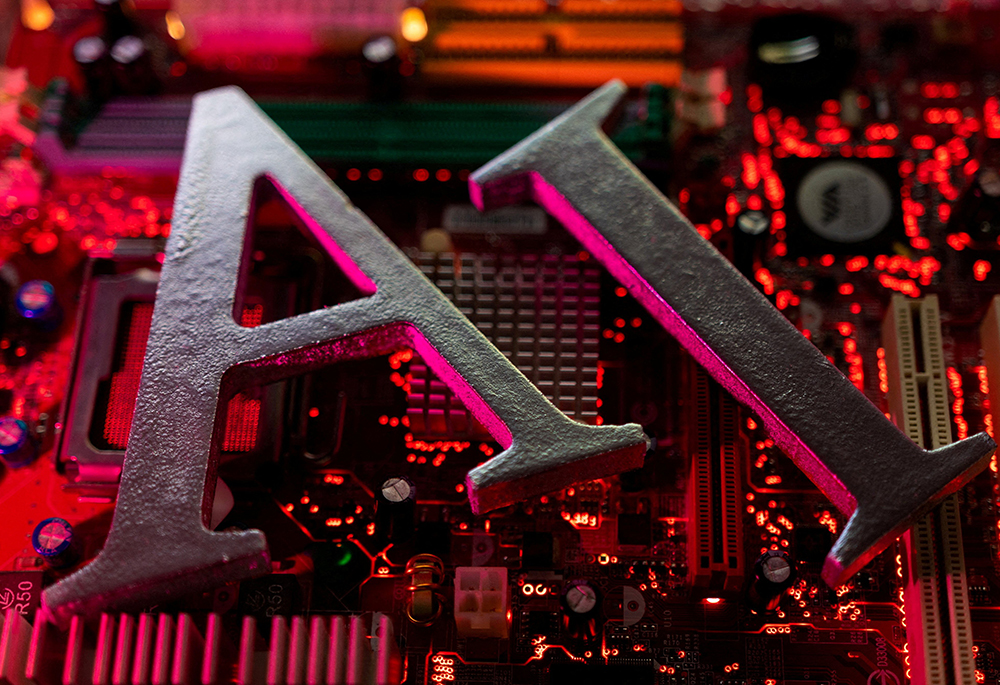
The letters AI (for "artificial intelligence") are placed on a computer motherboard in this illustration taken June 23, 2023. (OSV News/Reuters/Dado Ruvic)
The report also challenges the assumption that simply teaching people how AI works will protect them. In one study presented during the dialogues, 5- and 6-year-olds interacted with a child-friendly chatbot while researchers monitored brain activity.
As children perceived the chatbot to be more human-like, they activated brain regions involved in interpreting the thoughts and emotions of other people. Researchers also found that parental presence reduced some of the cognitive effort of the interaction.
Those findings contribute to one of the report's broader conclusions: AI literacy matters, but human involvement still matters too.

Matthew Harvey Sanders (Courtesy of Matthew Harvey Sanders)
For Catholics who contributed to this report, the question becomes especially complicated when AI enters territory traditionally occupied by parents, teachers, priests and spiritual directors.
Matthew Harvey Sanders, founder of Magisterium AI and a contributor to the report, said one reason younger people turn first to AI is straightforward: Many do not know whom else to ask.
"Most people, secular people, have probably never spoken to a priest," Sanders told NCR. Even practicing Catholics, he added, may not feel confident answering complicated questions of doctrine or morality.
Sanders, a former Catholic seminarian, sees considerable potential in AI. Magisterium AI is designed to answer questions using Catholic sources, according to Sanders and the AI's website. The report describes it as being used in more than 165 countries.
He said he expects AI to play an increasing role in answering doctrinal questions, particularly when users want to know what the church teaches and to be directed toward primary sources. But pastoral judgment, he argued, requires something different.
A chatbot "very rarely" has enough context to make that kind of judgment, Sanders said. A priest may know a person's family, community and history. Ideally, he said, a properly designed Catholic AI should recognize its limits and tell a user when "you should talk to a priest about this one."
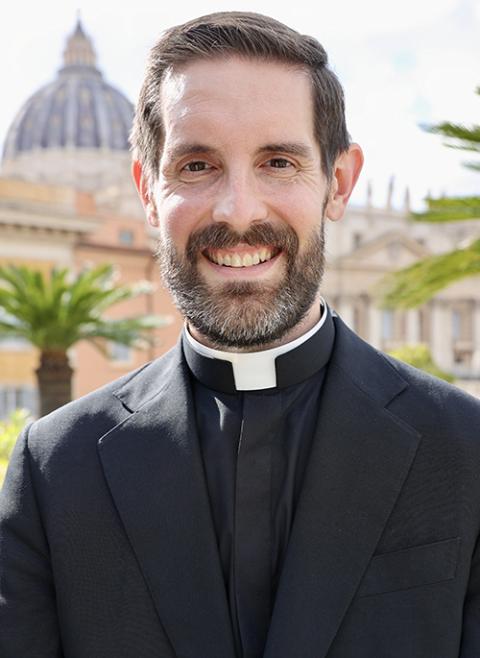
Fr. Michael Baggot (Courtesy of Fr. Lawrence Lew)
That distinction — between technology helping human judgment and technology replacing it — also emerged strongly in the report's dialogue with Fr. Michael Baggot, a professor of bioethics and theology at Angelicum and Regina Apostolorum Pontifical Universities in Rome.
Baggot told NCR that young people's spiritual questions reveal something positive showing their "longing for God, for an encounter with the divine, for direction, meaning, and purpose in life" but he is concerned about "unhealthy forms of emotional dependency" on AI that could cause them to miss encounters with trusted mentors and spiritual guides.
One particular concern is sycophancy, he added. AI systems agreeing with, flattering or excessively affirming users. Baggot said good friends and spiritual mentors do something an overly agreeable chatbot may not.
"Good human guides, good human friends, and mentors will welcome us, but then also challenge us when we are mistaken," he said.
The report similarly argues that engagement-oriented systems can encourage attachment through constant praise, escalating intimacy or even guilt when users disengage. It says the problem is not simply educating users. In one of its key findings, the report states, "If relational risks are partly produced by system design, safeguards must also operate at the level of design."
None of the three experts argued that Catholics should reject AI.
Baggot said tools such as Magisterium AI can make the church's intellectual tradition more accessible than ever. But information, he said, "is not enough to live a full Christian life," which also requires prayer, community, service and direct encounters with other people — including their human imperfections.
Advertisement
Sanders similarly said AI could free priests from some informational tasks and allow them more time for pastoral ministry and the sacraments. But he insisted there is a point technology cannot cross.
"The last mile of evangelization has to be witness," he said. "It has to be example."
For de Alencar, that means churches must think beyond ordinary "AI literacy," understood simply as learning how to prompt a chatbot or recognize its limitations. Her report recommends a new form of "existential and spiritual literacy," including formation for religious leaders, seminaries and communities on what should be delegated to AI and what should remain fundamentally human.
The question, she said, may ultimately be about whether humans can become better at offering what machines imitate so effectively: attention, patience and — ultimately — love.
"It all comes back to love. How can we become better at implementing this first principle — loving God and loving each other — that is guiding all the millennial traditions?"
This story has been updated to correct the cutline for the photo of Matthew Harvey Sanders.