(Dreamstime/Sdecoret)

Join the Conversation
Send your thoughts to Letters to the Editor. Learn more
As concern over the consequences of artificial intelligence becomes a central talking point in Silicon Valley and Washington alike, the head of the United States' largest federation of labor unions said workers cannot be excluded from conversations around how AI will affect their livelihoods.
"Right now, we have CEOs who want to play God to make decisions that affect hundreds of millions of working people without our input and consent," said Liz Shuler, president of the AFL-CIO. "We can choose a better path, with workers at the table, engaging in dialogue with stakeholders to shape a more hopeful and just future."
Shuler attended a mid-September Vatican conference on the role of organized labor in confronting emerging social and ecological challenges in the Americas. During the gathering, she argued that labor movements and the Catholic Church can work together to promote an approach to AI that protects workers who are threatened by the mass unemployment that could be one of the technology's effects.
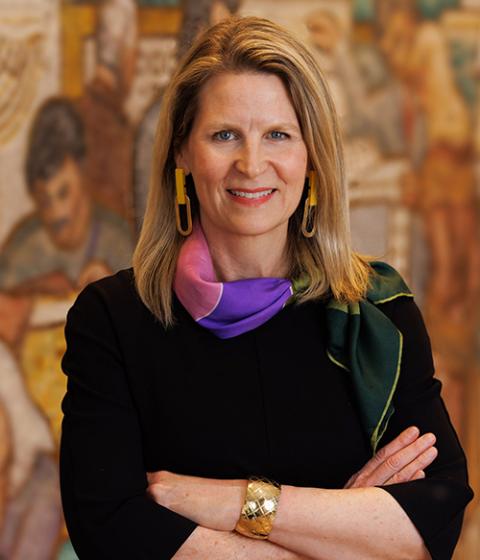
Liz Shuler (Courtesy of AFL-CIO)
"AI, to me, is the issue that is going to be the biggest challenge we've faced as a labor movement because of the threat to work," Shuler told National Catholic Reporter during the conference.
The AFL-CIO represents 15 million workers across the United States. Shuler said the church offers the labor movement both significant convening power and "validation that humanity has to be at the center" of the AI revolution.
"[With] the fact that there is no plan, that someone like Pope Leo is able to lead in this moment signals so much to the rest of the world who is not paying attention as much," she said.
Shuler praised the attention to labor in Pope Leo XIV's encyclical Magnifica Humanitas, which examines the place of humanity in the age of AI. The document "was like something we could have written," she said.
In the encyclical, Leo articulated the "legitimate fear of a significant and rapid contraction in available jobs that would create a chain reaction deeply impacting families, young people and local economies." He called for political, business and labor leaders to collaborate "in order to develop rapidly adequate shared regulations and protections."
Shuler pointed to recent agreements between labor organizations and Microsoft as examples of how businesses and labor can join forces to advance ethical considerations in the development and use of AI.
In 2023, the AFL-CIO and Microsoft established a partnership that included sharing information about AI development with labor leaders and creating a framework intended to protect workers' ability to organize. In September, Microsoft also reached an agreement with the American Federation of Teachers not to use teachers' or students' data to train its AI models.
Advertisement
Such partnerships, Shuler said, offer an alternative to an AI debate frequently framed around economic and geopolitical competition, and they could be a way for the church to advance its view of making AI human-centered.
"There's so much focus on this race to beat China and be competitive ... but the church is saying, 'That's great, but you also need to center the people who have no voice, the people who will be living on the edge of poverty because their jobs are done away with because of AI,' " she said. When it comes to the pope and the Vatican, "there really is no other voice, beside the labor movement, who is outspoken on this," she said.
Addressing conference participants Sept. 12, Leo warned of threats to humanity that emerge "wherever progress ceases to serve the person, where work loses its dignity, where entire communities are cast aside or where technology ends up deepening the divisions that it should be helping us to overcome."
"The value of any points of consensus that can be reached will not be measured solely by the number of people who endorse them," the pope said. "They will be recognized by the interests that they are able to protect and, in particular, by the impact that they have on the lives of those who have the least power to defend themselves."
Shuler said the stakes of the AI revolution are not limited to the loss of individual jobs, but rather extend to the concentration of economic and political power in the hands of a few technology executives. Yet, she added, the pope's voice offers an important counterbalance.
"If we don't do anything, seven billionaires — one trillionaire maybe — will be running our world," she said. "So it's a risky move to be speaking out in the way that he is. I think he's shown a lot of courage."
The National Catholic Reporter's Rome Bureau is made possible in part by the generosity of Joan and Bob McGrath.