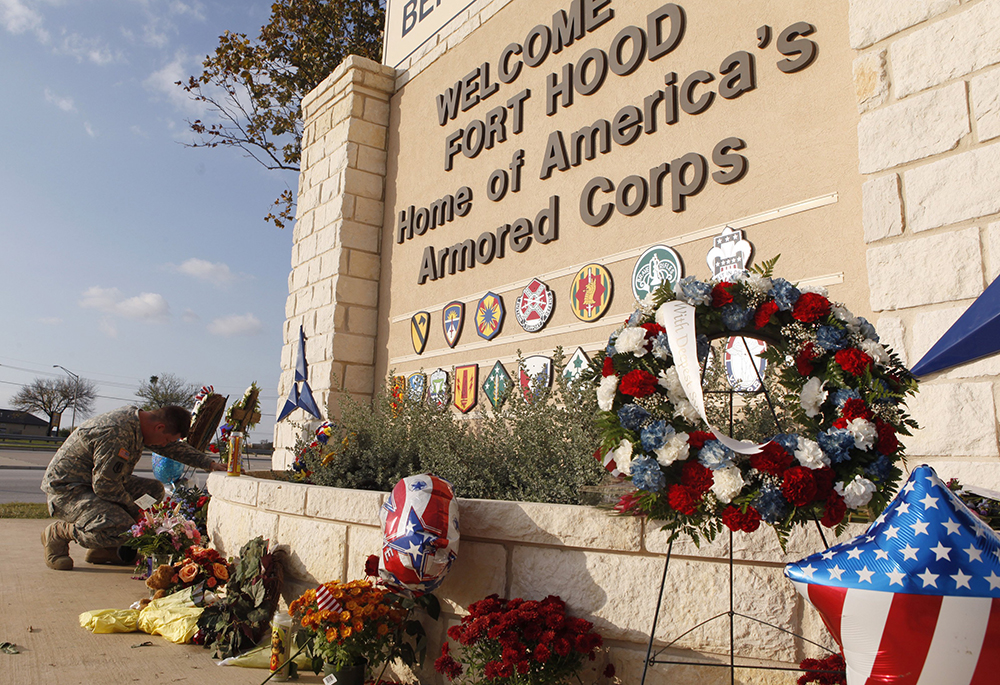
United States Army Specialist Robert Orcutt prays near a makeshift memorial for victims of the shootings at Fort Hood Army post in Fort Hood, Texas, Nov. 9, 2009. (OSV News/Reuters/Jessica Rinaldi)
by Carol Zimmermann
Join the Conversation
Send your thoughts to Letters to the Editor. Learn more
The president of the U.S. Conference of Catholic Bishops described the Pentagon's Oct. 8 announcement that it plans to livestream the firing squad execution of Nidal Malik Hasan, who shot and killed 13 people at a military base in Texas 17 years ago, "a barbaric promotion of a culture of death."
In a statement, Archbishop Paul S. Coakley of Oklahoma City said his reaction to this news was one of "shock and great sorrow." While noting that Hasan's actions cannot be condoned, he said the "public execution even of one who has done grave harm will only further undermine the moral fabric of our nation and be a blight on the conscience of its people."
The 2009 shooting rampage by Hasan, a former Army major and psychiatrist, wounded 32 people at the base where troops were preparing for deployment to Afghanistan. Hasan, who was shot by military police officers, uses a wheelchair, paralyzed from the chest down. A military court-martial convicted Hasan of 13 counts of premeditated murder and 32 counts of attempted murder and sentenced him to death in 2013. After Hasan's appeals had concluded, President Donald Trump approved his execution Oct. 2.
In an interview with the TV outlet Real America's Voice News, Oct. 8, Secretary of Defense Pete Hegseth said Hasan's execution would take place Dec. 3 at Fort Hood, the same military base where the shootings occurred and would be public "because people need to understand that there's serious consequences for these types of things." The Pentagon later confirmed it would be livestreamed in a statement to media outlets but said details would be finalized.
This will be the first military execution in more than 65 years, according to the Death Penalty Information Center, and the first public execution in the United States since the 1930s.
This spring, the Justice Department announced it would adopt firing squads and reauthorize a single-drug lethal injection protocol in death penalty executions on the same day that Pope Leo XIV publicly voiced his support to abolish capital punishment in the United States, reiterating the Catholic Church's teaching that the death penalty is "inadmissible."
Advertisement
In an interview in April, Sr. Helen Prejean, a Sister of St. Joseph and longtime anti death-penalty activist, said this about bringing back firing squads:
"There's no humane way to kill a human being. Look at all the methods they have. But it’s human beings, who are prone to error, that are behind all of these, whether you’re shooting somebody, if you’re lethally injecting people with drugs."
In Hasan's case, Krisanne Vaillancourt Murphy, executive director of Catholic Mobilizing Network, stressed that his actions could not be condoned but emphasized that the nation should not be "blinded by bloodlust" and called it "appalling that a public official" would permit this to be "a livestream arcade."
"The macabre spectacle proposed by Secretary Hegseth is not what our Lord asks of us — it will neither honor victims nor bring healing," she said, adding: "We undermine our own humanity when we treat another person's death as something to watch, celebrate, or use for entertainment. It is remiscient of the horrors of lynching in our nation’s past, and would be a grotesque display of hatred witnessed in the public executions of some authoritarian countries today."
Vaillancourt Murphy also called the timing of this announcement "particularly bleak" just a week after the botched execution of Christa Gail Pike in Tennessee and two days before the World Day Against the Death Penalty.
Political leaders from both sides also objected to plans to livestream the execution.
"Hasan should face the death penalty, but making his execution public and streaming it? Beyond disgusting,” Sen. Thom Tillis (R-N.C.), said on X. "Public executions are what oppressive dictatorships like Iran and Afghanistan do. It should not be happening in America."
Rep. Adam Smith (D-Wash.), the top Democrat on the House Armed Services Committee, said in a statement that making an execution available for public viewing "is disturbing and makes a mockery of our legal system."
"There is a reason why we treat the meting out of justice with the seriousness it demands. We are a democratic country and should take the rule of law seriously, not turn it into a spectacle," he said.
In 2013 when Hasan was sentenced, Archbishop Timothy M. Broglio of the Archdiocese for the Military Services said he should not have been given the death penalty.
"The church teaches that unjustified killing is wrong in all circumstances. That includes the death penalty," he said.