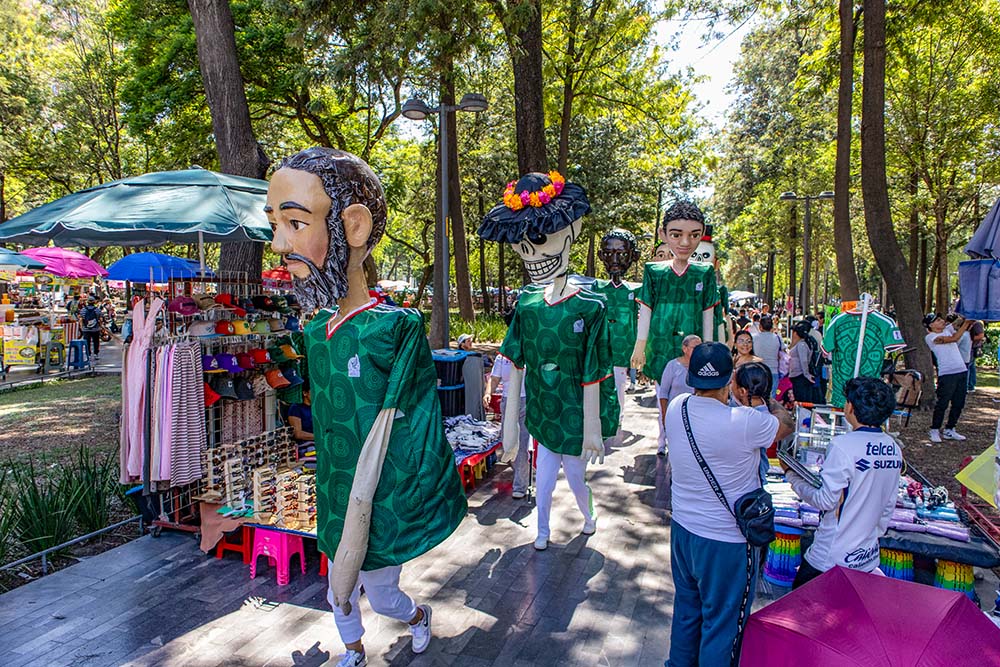
A street parade organized by the Mexican Ministry of Tourism celebrates the 2026 World Cup at Alameda Central in Mexico City. (Wikimedia Commons/ProtoplasmaKid)

Join the Conversation
Send your thoughts to Letters to the Editor. Learn more
As the FIFA World Cup opens on June 11 across the United States, Mexico and Canada, a group of Dominican friars, sisters and lay leaders is calling on Catholics to celebrate the tournament while also paying attention to the people who may be left behind by it.
In a joint appeal published in May, Dominican justice and peace promoters from the three host countries welcomed the World Cup as "a moment for sport" and "an opportunity for our common humanity," while warning about human trafficking, displacement, economic inequality, migration barriers and the exploitation that often accompany mega-sporting events.
The statement, titled "Hosting the World, Protecting the Vulnerable," comes as North America prepares to host the largest World Cup in history, with 48 teams, 104 matches and millions of expected visitors.
For the Chicago-based Dominican Fr. Brendan Curran, his order's North American regional co-promoter for justice and peace, the appeal is an attempt to broaden the conversation and should not be viewed as an attack on the tournament itself.
"We just felt this region has had a lot of tension in recent months," Curran told the National Catholic Reporter, pointing especially to migration debates and the treatment of immigrants. At the same time, he said, the World Cup offers a powerful alternative vision of human relationships.
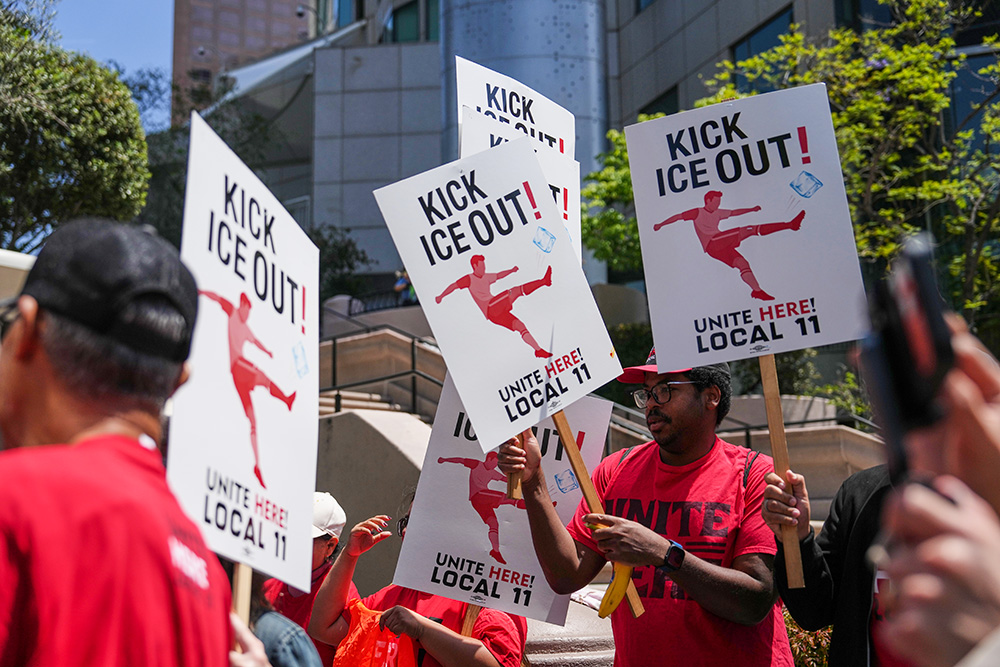
SoFi Stadium workers, belonging to union Local 11, picket outside of the FIFA Los Angeles World Cup 2026 Host Committee headquarters May 1, 2026, in Los Angeles. (AP/Jae C. Hong)
Curran argued that if countries can welcome athletes and delegations from around the world — including nations that have been enemies or rivals — they should also be capable of treating migrants and refugees with dignity.
"If we can move people and delegations to a World Cup pitch, even across enemy states who will settle wins and losses on the field, and then shake hands," he said, "why can't we treat the human movement of peoples" with the same spirit?
The Dominican statement highlights concerns about visa restrictions, particularly for fans from countries facing significant barriers to entry into the United States, even when athletes and officials receive exemptions.
Curran said Catholics should view the tournament as a lesson in hospitality.
"We urge Catholics to see that former or present opponents to U.S. policy are going to be peacefully received here in the United States, Mexico and Canada for their qualification rounds of advancing in the World Cup."
From Vancouver in Canada, Dominican Fr. Dieudonné Bigirimana brings a deeply personal perspective. The Rwandan-born priest was living in Rwanda during the 1994 genocide, which unfolded while the world was focused on that year's World Cup in the United States.

An official match ball of the FIFA World Football Championship 2026 sits on green grass in Toronto June 2, 2026. (Dreamstime/Photokvu)
When he was asked about that experience, Bigirimana said it was "like being rejected somehow."
For him, the lesson of 1994 remains relevant today. "The FIFA World Cup brings together the whole world, but it can make people forget those who are suffering."
In Canada, he worries particularly about homeless people and immigrants who may be viewed primarily as a security issue. "The immigrants oftentimes they are seen as a problem to be solved, not as people to be loved," he said.
Yet Bigirimana insisted the tournament should not be viewed only through a critical lens. "We should enjoy seeing the World Cup in the first place," he said. "Indeed we can smile again, indeed we can have joy again."
"The World Cup reminds us that beyond nations and teams, we are one human family, called to protect human dignity and work for justice for all," echoed Dominican Sr. Reg McKillip, the order's North American regional co-promoter for justice and peace, based in Madison, Wisconsin.
In Mexico, Dominican leaders are focused on a different set of concerns.
Dominican Fr. Gonzalo Ituarte Verduzco, promoter for justice and peace for the Dominican Province of Santiago and president of the Fray Francisco de Vitoria Human Rights Center, said preparations for the tournament have come at a cost for some communities.
Advertisement
"Because of the World Cup, the Mexican government began to build new avenues and new buildings," he said. "They have displaced many people. The people have lost their jobs."
According to Ituarte, authorities are trying to present a polished image of Mexico while pushing vulnerable people out of sight. "The priority is to give a good image to those who come to this event of the World Cup," he said.
The Dominican statement similarly warns that redevelopment projects around stadiums and transportation corridors may lead to displacement of low-income residents and informal workers. Ituarte also pointed to darker risks associated with major international events, including human trafficking and sexual exploitation.
"As we highlight during Super Bowls the importance of the dangers of human trafficking," Curran added, "with folks treating people like objects is an absolute offense against humanity."
Alberto Solís Castro, a Mexico City-based Dominican lay leader and director of the Fray Francisco de Vitoria Human Rights Center, said the World Cup arrives in Mexico amid a broader human rights crisis, pointing to hundreds of thousands of deaths and disappearances linked to drug cartels.
Solís Castro warned that large-scale economic activity surrounding the tournament could intensify criminal exploitation if authorities fail to address underlying problems. He stressed that the World Cup should not distract attention from families searching for disappeared loved ones.
"It will be very important that the Catholics and all people see these women, these very courageous women who are in a struggle to find their kids," he said. "They don't care who is winning the next game."