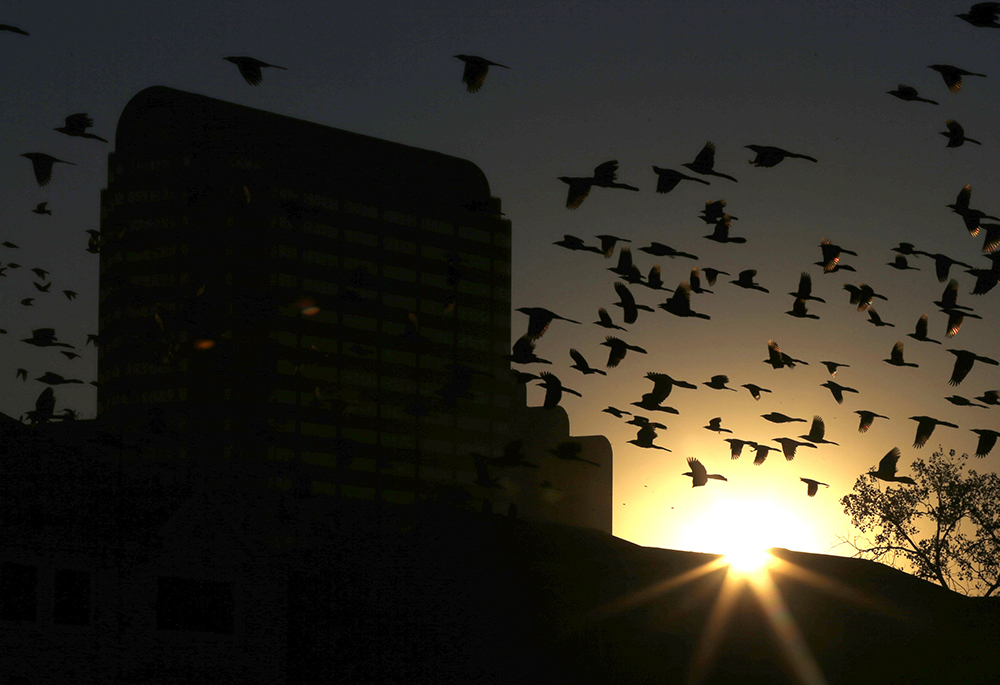
Birds congregate around office buildings as the sun sets on North Dallas, Dec. 17, 2013. One study found that more than 1 billion birds are killed annually in the U.S. in collisions with windows. (AP photo/LM Otero, File)

Join the Conversation
Send your thoughts to Letters to the Editor. Learn more
As the Catholic Church marks a special year commemorating the life of St. Francis of Assisi, the patron saint of ecology who preached to birds and befriended a wolf, a new institute hopes to inspire others to emulate today his radical kinship with all of God's creatures.
The St. Francis Institute for Animals launched in early March with a vision of mobilizing animal advocacy informed by Catholic social teaching to address the inhumane ways animals are treated by people in factory farms, laboratories and other settings.
"We know that as Catholics, we're called to care for God's creation, and that includes his creatures," said Kristin Dunn, founder of the institute. "Most people are not aware of the extent of preventable animal suffering, and so our goal is to connect church teachings on animals to the realities that animals are facing today, and with that, to empower people to take steps to make a difference."
To that end, the St. Francis Institute has compiled a mix of education and action resources for individuals and parishes. Its website offers a depository of teachings on animals from popes and theologians, alongside pages devoted to law, wildlife protection, animal sentience and adoption. In addition, it has created a free digital guide, "30-Day Journey: Living in Harmony with All Creatures," offering 20-minute daily reflections, readings and videos for deeper contemplation.
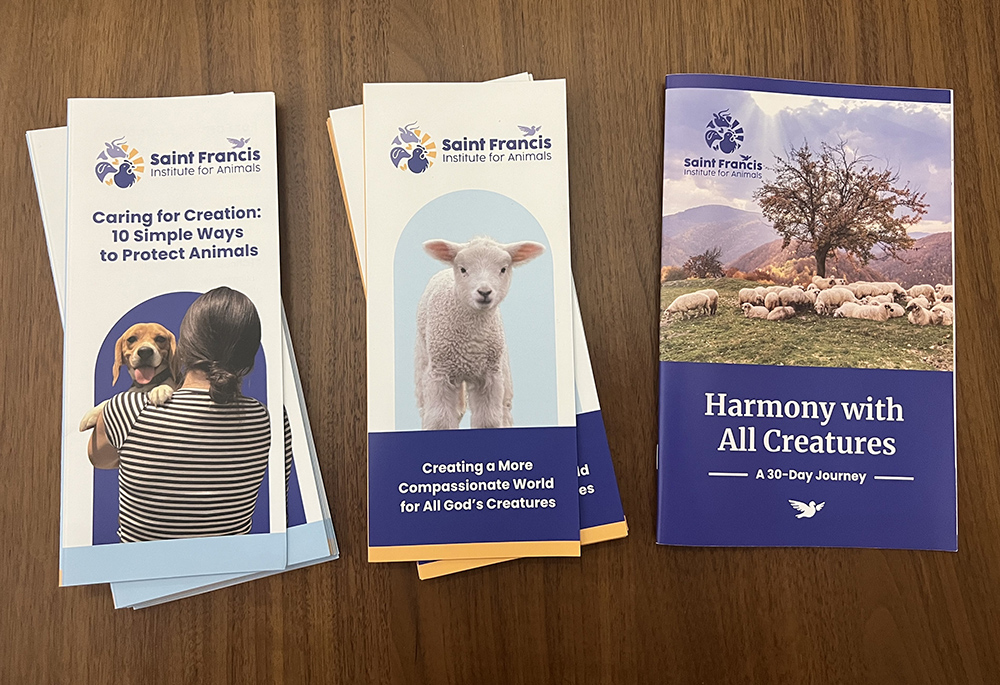
Two brochures and a printed version of St. Francis Institute for Animals' downloadable "30-Day Harmony with All Creatures Journey" are pictured. The institute will be sharing these resources with interested parishes. (Courtesy of St. Francis Institute for Animals)
Over time, the St. Francis Institute also seeks to partner with parishes to further raise awareness and demonstrate more compassionate relationships with all of God's creation. Possibilities include arranging animal expert talks, adding native plants on church grounds to provide animals food and shelter, and making plant-based meals a regular option at parish gatherings. Interested parishes can complete a form on the institute's website.
In a statement, noted theologian St. Joseph Sr. Elizabeth Johnson said the institute "is undertaking the vitally important work of promoting a Catholic approach to animal protection."
"Our main message is really that small actions can make a tremendous difference for animals," Dunn told EarthBeat.
'Animals are God's creatures'
With a background in nonprofits, Dunn, who lives in Austin, Texas, was compelled to form the institute from her passion for her dog Presley, her prior work with PETA and World Animal Protection and the feeling that much of Catholic teaching around animals has gone neglected or unnoticed.

Kristin Dunn, founder of St. Francis Institute for Animals (Courtesy of Kristin Dunn)
It was by mere chance the St. Francis Institute officially launched during the Jubilee Year for Francis of Assisi proclaimed in January by Pope Leo XIV, but the occasion has offered an opportunity to elevate the 13th-century saint's unique relationship with the whole of creation.
"Let us pray that, inspired by St. Francis, we might experience our interdependence with all creatures, who are loved by God and worthy of love and respect," Leo XIV said in a video message with his prayer intention for September, during the 2025 Season of Creation.
While many know Francis of Assisi through animal blessings at Mass and stories of his encounters with birds and fish, less attention is paid to the saint's view of all the created world as truly brothers and sisters each with its own agency that compelled his deep care for them.
The idea that animals and other nonhuman elements of creation hold intrinsic worth outside what value they may provide humanity has gained theological traction in the past half-century, said Jesuit Fr. Christopher Steck, a theologian at Georgetown University specializing in animal and environmental ethics who serves on the board of the St. Francis Institute.
Church teaching since the Second Vatican Council has brought "a lot of richness," he said, on the importance of caring for the natural world, including animals, and humans' role in that.
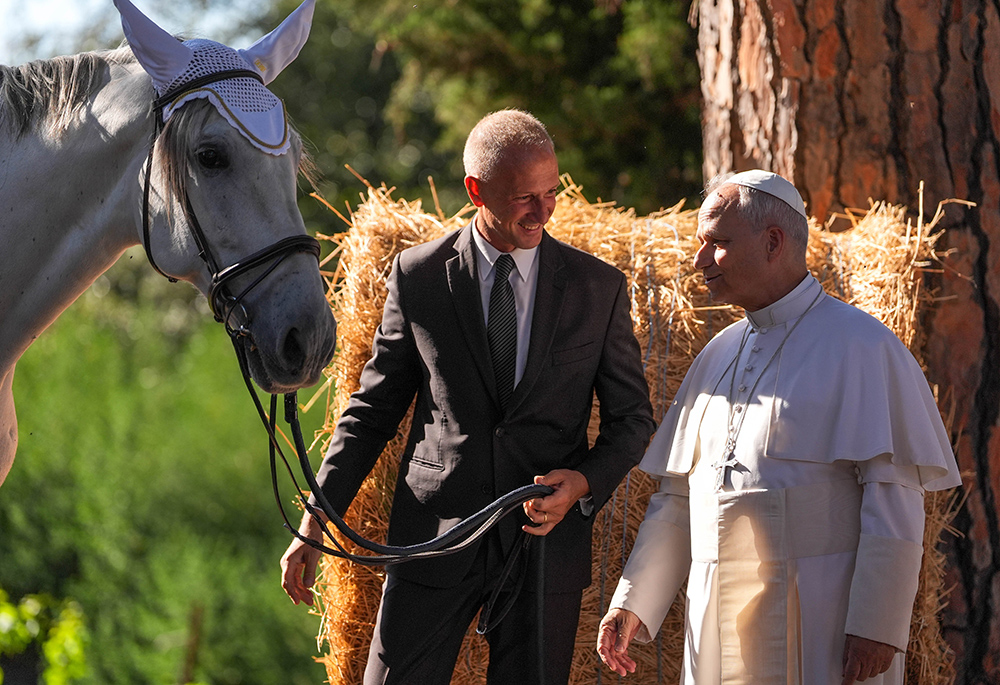
Pope Leo XIV looks at a horse as he greets an employee of the papal gardens in Castel Gandolfo, Italy, Sept. 5, 2025. The pope inaugurated Borgo Laudato Si' the same day, officially opening the historic papal residence as a center dedicated to the principles of care for creation and human dignity outlined in Pope Francis' encyclical Laudato Si'. (CNS/Lola Gomez)
"There's still a sense of a general responsibility for caring for the world, but how that translates into caring for animals has not really taken hold," said Steck, author of All God's Animals: A Catholic Theological Framework for Animal Ethics.
The Catechism of the Catholic Church states "Animals are God's creatures" and "By their mere existence they bless him and give him glory" — teachings reinforced by each of the past four popes, Steck said.
In his encyclical "Laudato Si', on Care for Our Common Home," Pope Francis wrote bluntly, "The ultimate purpose of other creatures is not to be found in us" and emphasized the catechism's teaching that "It is contrary to human dignity to cause animals to suffer or die needlessly."
"It's kind of obvious that if you're going to care for the natural world, that care should include not inflicting suffering on animals," Steck said. "But I don't know if that's where people are."
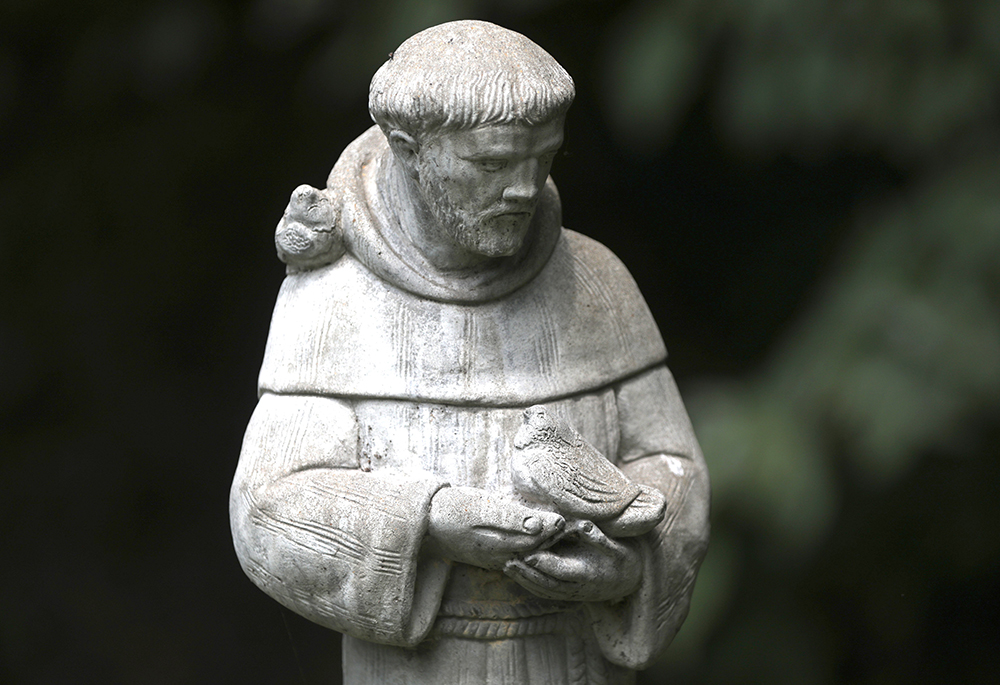
A statue of St. Francis of Assisi is pictured outside an animal hospital in Prince Fredrick, Maryland, July 22, 2021. His feast day is celebrated Oct. 4. (OSV News/Bob Roller)
What Catholics can do for animals
Looking at the life of a parish, Dunn pointed to several issues where Catholics can take simple steps to practice greater kinship with animals.
One is switching from the use of glue traps to catch rodents to more humane alternatives. Another deals with the estimated 1 billion birds who die each year in the U.S. by colliding with buildings.
Many of those deaths could be prevented, Dunn said, by turning off lights at night, installing bird-friendly glass or placing special decals on existing windows that help birds detect the glass. Churches with stained glass windows already help birds by limiting reflection.
"That's a really important area for people to take action on, and for parishes and schools to really look at and address, because they can save a lot of birds that way," she said.
Perhaps the biggest issue facing animals concerns factory farms.
Large-scale farms make up less than 6% of that nation's 1.9 million farms but account for nearly 80% of agricultural sales, according to the 2022 Census of Agriculture issued every five years by the U.S. Department of Agriculture.
In the past 35 years, the number of animals raised for food has doubled to about 10 billion, the majority of which are located on factory farms.
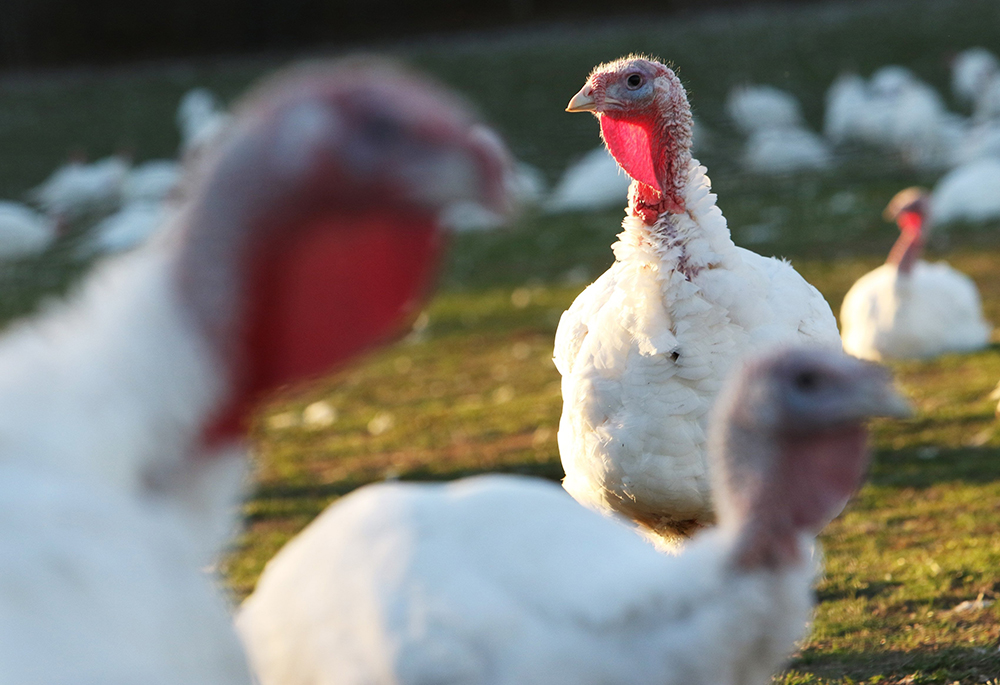
Free-range turkeys are seen Nov. 3, 2024, at Miloski's Poultry Farm in Calverton, New York. (OSV News/Gregory A. Shemitz)
Animal advocates have accused factory farms of unsafe conditions that often overpack animals in pens and employ some culling methods — like debeaking chickens, killing animals before maturity and inadvertently scalding them to death — that activists say cause needless suffering.
"When you learn how much these animals on factory farms are like our dogs and cats at home in all the ways that matter — how intelligent they are, how sensitive they are, how much they long to be free and practice the natural behaviors that God gave them — I think it just really changes things," said Dunn, who is vegan.
Steck said church teaching makes clear there are moral limits on how humans treat animals but has not explicitly addressed issues relating to factory farming. Three years before his papacy, Pope Benedict XVI said the "degrading of living creatures to a commodity" in some industrial farming practices "seems to me in fact to contradict the relationship of mutuality that comes across in the Bible."
Advertisement
"The abominable practices that are part of factory farming cannot be reconciled with that idea of being kind to animals," Steck said, suggesting that Catholics can eat meat but should avoid foods tied to factory farming.
Other actions the institute suggests entail expanding a meatless day or days each week throughout the year, making a vegan meal the default at events or compiling a parish plant-based recipe book.
Conversations about eating meat are not easy ones in the U.S., with the federal government recently recommending more red meat consumption in diets. But it's the kind of dialogue the St. Francis Institute for Animals seeks to initiate in parishes and families.
"[There's] so many compassionate Catholics out there who can really make such a tremendous difference," Dunn said. "And so I'm very excited that we have an opportunity to reach people with this message for all the animals. For farmed animals, for wild animals, for companion animals, for animals who are suffering wherever they may be."