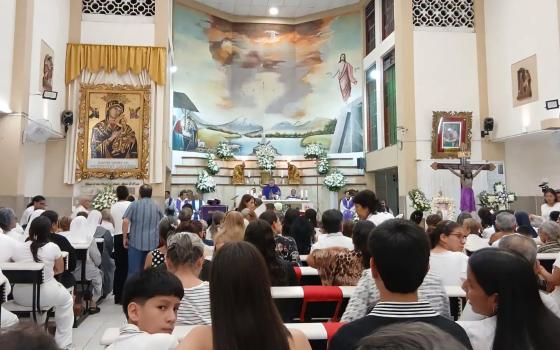
An iron cross recovered from Ground Zero in Lower Manhattan, New York, was presented to the Church of the Good Shepherd by the Port Authority Police Department to stand as a memorial to the victims of the Sept. 11, 2001, terrorist attacks. (NCR photo/Camillo Barone)

Join the Conversation
Send your thoughts to Letters to the Editor. Learn more
On the morning of Sept. 11, 2001, Fr. Kevin Madigan had just finished hearing confessions at St. Peter's Church in Lower Manhattan when his secretary told him that a plane had struck the World Trade Center.
At first, Madigan thought of an accident, perhaps something like the small aircraft that had crashed into the Empire State Building decades earlier.
Then he stepped outside.
"I saw how the flames were burning, and I realized this was a bigger plane," Madigan recalled. "And then when I saw the second plane hit, then I knew this was something a whole different dimension than I had thought about it initially."
Miles away, George Sears was beginning his first day of classes at the seminary.
Twenty-five years later, the two priests of the New York Archdiocese remember Sept. 11 from radically different vantage points: Madigan as a 55-year-old pastor trying to respond amid the catastrophe at the World Trade Center; Sears as a young seminarian who would learn that his uncle had died in the South Tower.
Their experiences also shaped different encounters with the quarter-century that followed. One priest watched Lower Manhattan rebuild while the other eventually became pastor of a parish still carrying the names of 22 neighborhood residents killed that day.
Madigan, now 80 and pastor of Our Lady of Good Counsel and St. Thomas More on Manhattan's Upper East Side, was pastor of St. Peter's, the Catholic church closest to the World Trade Center, in 2001.
Sept. 11 had begun, he remembered, as "a beautiful morning," the kind of September day when New Yorkers were returning from summer vacations and settling back into work.
After the planes struck, Madigan immediately took the sacred oils used for anointing the sick and wounded, and headed toward the towers.
He stood looking upward, unsure where he could be useful.
"I was just like, what do I do now?" he recalled in an interview with the National Catholic Reporter.

Fr. Kevin Madigan stands inside the Chapel of St. Joseph at St. Peter's Church in August 2002, after the chapel had recently been used as an office by the Federal Emergency Management Agency during recovery efforts at Ground Zero, where the World Trade Center towers fell Sept. 11, 2001. (CNS/Chris Sheridan)
At one point, a large plastic office water bottle came hurtling through the air above him and smashed against a building, drenching him. Soon afterward, he encountered a Fire Department chaplain and suggested they head toward a reported triage area near the Hudson River.
As they moved around the World Trade Center complex with police officers, word spread that a tower might collapse.
Madigan did not believe it. Then he saw it begin to fall.
He ran with the other priest and several police officers into a subway station. Dust and ash poured into the underground space.
"There were some people crying, screaming, because it looked like we would get asphyxiated by the ashes," he said.
When the dust began to settle, an officer switched on a flashlight and instructed the group to link arms. They walked along the subway platform and emerged several blocks north.
Madigan eventually walked to St. Vincent's Hospital to be examined before returning downtown that afternoon.
St. Peter's had meanwhile become an improvised refuge and place for the dead and wounded. Madigan said about 33 bodies were brought inside, including that of Franciscan Fr. Mychal Judge, the New York Fire Department chaplain who became one of the most recognizable victims of the attacks.
The wounded were brought to the church steps for transport to hospitals.
The neighborhood was evacuated and Madigan could not live there for about three weeks. Yet he and another priest returned daily. St. Peter's remained open for rescue and recovery workers who needed somewhere to rest. Madigan would stay as pastor for roughly another 11 years.
For Sears, Sept. 11 began in a classroom.
Now pastor of the Church of the Good Shepherd in Inwood, at the northern end of Manhattan, Sears had just entered a major seminary. He and his classmates had completed a retreat, and their first class was pastoral psychology.

Fr. George Sears, pastor at the Church of the Good Shepherd in Manhattan, New York, walks through the parish's "Garden of Eternal Life" in September 2026. The garden honors the 22 victims of the Sept. 11, 2001, terrorist attacks who were neighborhood residents, many also parishioners. (NCR photo/Camillo Barone)
About 15 minutes into class, the rector entered and asked the seminarians to pray because a plane had apparently struck one of the Twin Towers. They prayed and continued class.
Another 15 minutes passed before the rector returned and summoned everyone to the dining room, where they learned that two planes had hit the towers and that the country was under attack. Sears did not immediately think of his uncle, Carlos Cortes, a civil engineer working on the 96th floor in the South Tower. Only later did a family member leave him a message asking him to pray for Cortes and call home.
"I didn't realize that my uncle was affected by this until about two hours after," Sears said to NCR, pausing with tears in his eyes. "When I got it, it was devastating."
The seminarians wanted to travel downtown to help. Instead, their rector kept them at the seminary and brought them to the chapel to pray the rosary.
Sears said his uncle had allowed a colleague to take a crowded elevator after the first tower was struck, telling her he would take the next one. Within minutes, the second plane struck the South Tower.
Sears described Cortes as a warm and deeply generous man who had helped their family through difficult years and had become "like my second dad."
After 9/11, Sears' brother decided to join the Army and would later serve in Afghanistan and Iraq. Sears considered leaving seminary to enlist as well. "I felt powerless," he said.
A priest friend listened and then asked him why he had entered seminary in the first place. Sears answered that he believed God might be calling him to the priesthood.
"Why would this change that?" the priest asked. That question became pivotal for him, he said.
He came to believe that even legitimate efforts to restrain evil could not, by themselves, overcome it.

The "Garden of Eternal Life" at the Church of the Good Shepherd in Manhattan, New York, honors the 22 victims of the Sept. 11, 2001, terrorist attacks who were neighborhood residents, many also parishioners. (NCR photo/Camillo Barone)
"The only thing that overcomes evil ultimately is Christ," he said. "Do I really believe that the most important battle is the Gospel? And if it is, then I should be where I'm at right now."
Sears was ordained three years later and has now been a priest for 21 years.
His 9/11 experience, he said, pushed questions of forgiveness, justice, revenge and faith out of the abstract. "What does it mean to forgive somebody when they're dead?" Sears recalled asking himself. "What does it mean to pray for all the dead?"
The experience also forced him to examine his own faith and think about the kind of priest he wanted to be. "9/11 kind of forced me to think about my relationship with Christ, and what if I'm going to be a priest? Why and how can this vocation be an answer to this crazy evil?"
That question has acquired another dimension since Sears became pastor of Good Shepherd a year ago. A memorial garden at the Inwood parish honors 22 people from the neighborhood who died on Sept. 11. Most, Sears said, were parishioners, though the memorial includes neighborhood residents who were not Catholic.
It also puts him in contact with families whose grief has evolved but never entirely disappeared. "The first thing [I do] is to bear grief with them," Sears said.
He said he has learned not to assume that his own experience gives him the answer to theirs. His task as a priest, he said, is first to listen, not to use religion to make pain disappear, but to assure people they are not alone in it.
For him, the hope is that Good Shepherd's memorial garden will remain long after the people who personally remember Sept. 11 are gone, giving future generations a place to pray for the dead and their families.
For Madigan, the pastoral aftermath of Sept. 11 unfolded differently.
Advertisement
He did not describe the attacks as a crisis of faith or even as a life-changing experience. Only the following day, he said, did he recognize how deeply shocked he had been.
"I really don't think so," Madigan said when asked whether 9/11 had changed him. "I mean, I kept on doing what I'd always been doing and just sort of incorporated it into my life."
Much of his work afterward was practical: cleaning the parish, keeping it functioning and trying to preserve a community deeply destabilized by trauma and displacement.
Families with young children moved away. Some children had watched the attacks from their classrooms while knowing their parents worked at the World Trade Center. Other residents arrived because government subsidies temporarily lowered their housing costs, then left when the assistance expired. "It was kind of chaotic," Madigan said.
His greatest challenge was rebuilding "some kind of community of faith" in a part of Manhattan where people were constantly coming and going.
He said he remembers people flooding downtown hoping to help and New Yorkers standing outside offices and apartment buildings, offering cups of water to people walking north from the disaster zone. And he remembers something discovered inside St. Peter's after the attacks: an empty box that appeared to have held wedding rings, left before a statue of Christ.
Madigan said he had imagined that a couple, shaken by the sudden realization of life's fragility, had entered the church and married themselves before the statue.
"You don't know what's going to happen tomorrow," he said, "so you have to do it right now."
A quarter-century later, what most strikes Madigan is the contrast between the solidarity he witnessed then and the divisions he sees today. "There was no sense of revenge or no sense of hostility. It was just how we work together to support the families of those who perished. Now of course there's all this polarization, hatred, anger. It's such a different world altogether."