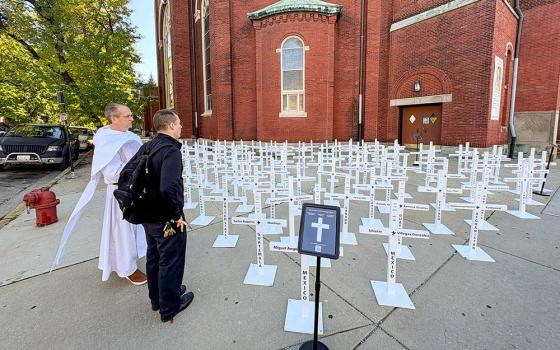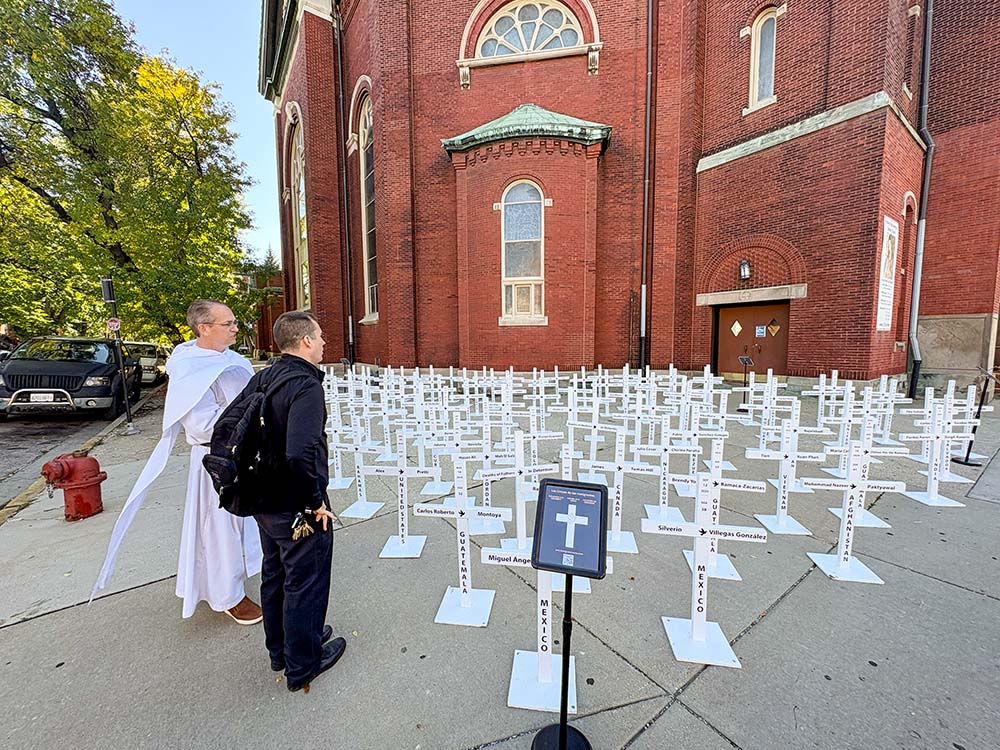
Dominican Fr. Brendan Curran, of Priests for Justice for Immigrants, and Fr. Thomas Boharic, pastor of Mother of the Americas Parish, stand by the traveling installation of immigrant crosses outside the church in Chicago's Little Village neighborhood, Oct. 3, 2026. (NCR photo/Camillo Barone)

Join the Conversation
Send your thoughts to Letters to the Editor. Learn more
More than 100 white wooden crosses stand in solemn rows outside Chicago churches, bearing the names, ages and countries of origin of immigrants who died in U.S. immigration custody or during enforcement operations. Among them are names of people from Mexico, Guatemala, Venezuela, Nigeria, Cuba and other countries. Some died in their 20s or 30s, while others were elderly.
The installation, called "The Immigrant Crosses," is a traveling memorial created by Chicago Catholic priests, religious sisters and brothers, in collaboration with local labor unions. Launched Sept. 24 at Holy Name Cathedral, it has begun moving among parishes and Catholic institutions across the Chicago area, inviting communities to confront the human cost of immigration enforcement.
For Dominican Fr. Brendan Curran, of Priests for Justice for Immigrants, the initiative emerged from a pressing question.
"After going through a historically bad year, how can we draw much more assertively and intentionally our Catholic community in ordinary parishes to really seriously reflect on the care for immigrants?" Curran asked. The idea took shape about three months ago, during conversations between Priests for Justice for Immigrants and Sisters and Brothers of Immigrants, two Chicago-area networks with more than two decades of advocacy.
Curran said he drew inspiration from the AIDS Memorial Quilt, which helped humanize those lost to the epidemic, and from the tradition of placing makeshift crosses along the U.S.-Mexico border to commemorate migrants who died attempting the journey.
"It's been a historic symbol of the migrant struggle and the migrant human toll that, in many ways, happens without us even knowing people's names," he told the National Catholic Reporter.
According to the organizers, the memorial commemorates more than 100 people whose deaths in immigration custody or during enforcement actions have been publicly documented since January 2020. Organizers use records compiled by the ICEFall Tracker, which collects data on Immigration and Customs Enforcement.
"The cross for us is a sign of liberation that transforms even death into new life," Curran explained.
'A labor of faith and love'
Transforming that vision into a traveling memorial required carpenters, painters and laborers willing to donate their skills. Don Villar, secretary-treasurer of the Chicago Federation of Labor, said that when Curran approached him, he reached out to the Labor Council for Latin American Advancement and local unions to ask if workers were willing to help with making the crosses.
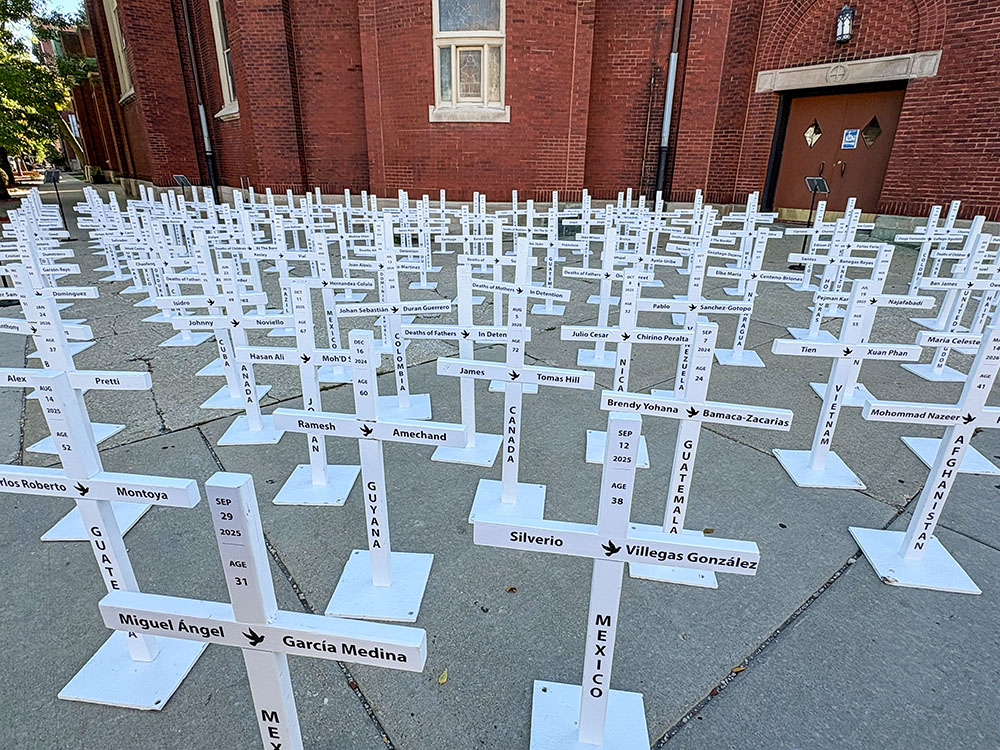
The traveling installation of the immigrant crosses is displayed outside the Mother of the Americas Parish in Chicago's Little Village neighborhood, Oct. 3, 2026. (NCR photo/Camillo Barone)
Union carpenters constructed the crosses with sturdy bases designed to withstand wind. Painters applied multiple coats to protect them against Chicago's harsh winter weather, and union volunteers also are helping transport the installation between locations.
The work took approximately two weeks, Villar said, describing it as "a labor of faith and love."
Many of those involved were themselves immigrants or children of immigrants, lending personal significance to the project. "I'm also an immigrant, so when I look out at these crosses and see the names and see the countries where they're from, you realize the impact of this," Villar said.
A neighborhood still living with fear
After its inauguration at Holy Name Cathedral and a stop at Catholic Theological Union, the memorial arrived at Mother of the Americas Parish in Little Village, a predominantly Mexican neighborhood affected by immigration enforcement operations.
The crosses also appeared at Our Lady of Tepeyac High School, where the installation carried particular significance for students and families.
"Last year at this time, our students, families and neighbors experienced unimaginable fear as ICE agents entered our Little Village community, our stores, our streets and homes," school president Meghan Murray said.
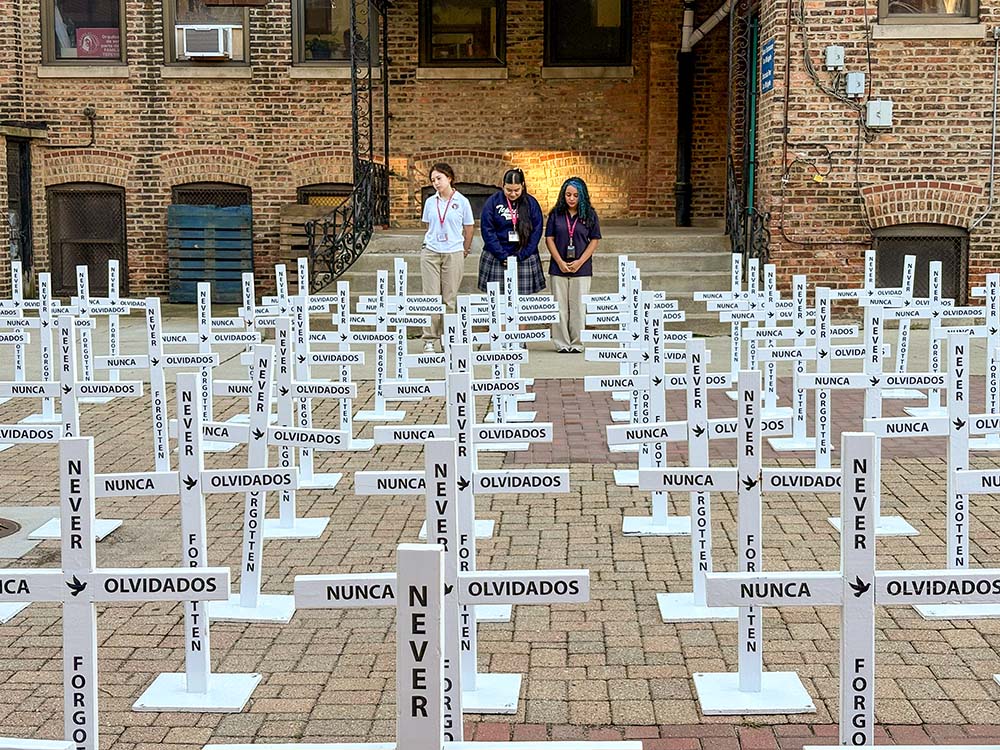
The traveling installation of immigrant crosses is seen at Our Lady of Tepeyac High School in Chicago's Little Village neighborhood, Oct. 4, 2026. (Courtesy of Meghan Murray)
Murray praised the "extraordinary courage, strength and solidarity" of local families and neighbors, while remembering those who died or have been separated from loved ones.
Fr. Thomas Boharic, pastor of Mother of the Americas, which is the parish of the high school, said the visual impact of the memorial was striking even for him. "Even myself, I'm in shock. I'm ashamed to say I didn't know the magnitude and even all the countries where people were from," he told NCR while standing in front of the installation.
Boharic said immigration enforcement has affected his parish directly, with parishioners detained in operations occurring just streets away from the church. Although the intensity of the raids has changed since last year, their consequences remain deeply felt, he said.
"After Mass, people are asking me to pray for somebody who's been detained, or a family member who's been deported," he said.
From Little Village to the South Side
On Oct. 11, the crosses reached St. Sabina Catholic Church on Chicago's South Side, a historically African American parish led by Fr. Michael Pfleger, a longtime civil rights activist and a prominent national Catholic voice in the field.
Advertisement
For Pfleger, the installation recalled an earlier initiative when his Black parishioners carried crosses along Michigan Avenue to remember victims of Chicago gun violence.
"These are lives. These are not statistics. These are lives of human beings," he said.
His parish has long provided assistance to migrants, including food, clothing, transportation cards and hot meals for newly arrived immigrants temporarily sheltered in police stations. Pfleger said he became particularly concerned about tensions between Black and Latino communities as public debate intensified over resources for migrants.
"They created this wedge between the Black and Hispanic community," he said, criticizing political leaders for allowing divisions to deepen. His response has been to emphasize a shared humanity, particularly among marginalized communities.
"Anybody who's homeless is an issue. Anybody who's hungry is an issue. Anybody who's being demonized is an issue. Anybody who's being locked up unjustly is an issue," he said.
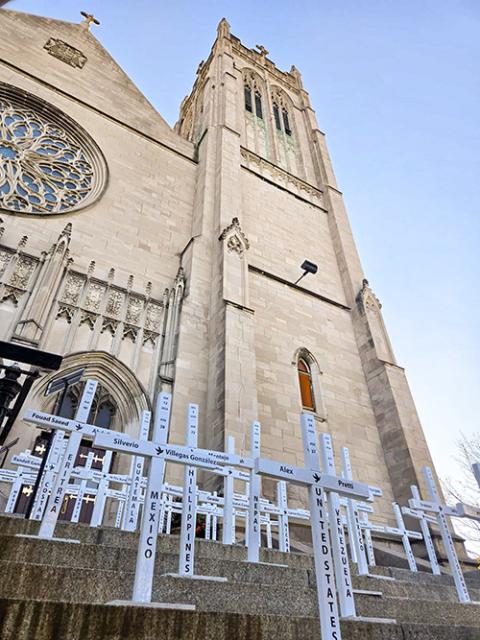
The traveling installation of the immigrant crosses is seen outside St. Sabina Church on the South Side of Chicago, Oct. 11, 2026. (Courtesy of Michael Pfleger)
St. Sabina's commitment to peace and justice was on display during a July 5 Mass presided by Pfleger, held as the United States celebrated the 250th anniversary of its independence. In a symbolic act of repentance, Pfleger washed the feet of about a dozen people representing communities he believes have been mistreated or marginalized in American society.
Among them were an elderly woman, a veteran, a Venezuelan immigrant, an Iranian and a member of the LGBTQ community. He apologized to them for what he described as the nation's failures, including its treatment of immigrants and the consequences of war.
The gesture drew sharply contrasting reactions. Pfleger recalled that many parishioners were moved to tears during the ceremony, while he received a wave of hostile messages over the following two days, particularly over his decision to wash the feet of the Venezuelan immigrant, the Iranian and the LGBTQ community member.
"If the church does not become the prophetic and bold voice, then there's no reason for the church," Pfleger said.
A memorial that keeps moving
The crosses are scheduled to continue traveling through Chicago-area parishes into November, with additional visits planned during winter in the Diocese of Joliet, Illinois, and other visits extending into Lent.
Curran said he hopes and thinks the initiative will eventually reach communities nationally. He sees the emerging Catholic response to immigration enforcement as a defining test of the church's moral witness in the United States.
"This is a very, very bleak moment right now, and it calls for historically important moments of response of faith and action," he said.
For now, the rows of white crosses continue their journey from church to church, each bearing a name that organizers refuse to let disappear into anonymity. On the backs of each cross is a message in English and Spanish that captures the purpose of the memorial: "Never forgotten. Nunca olvidados."