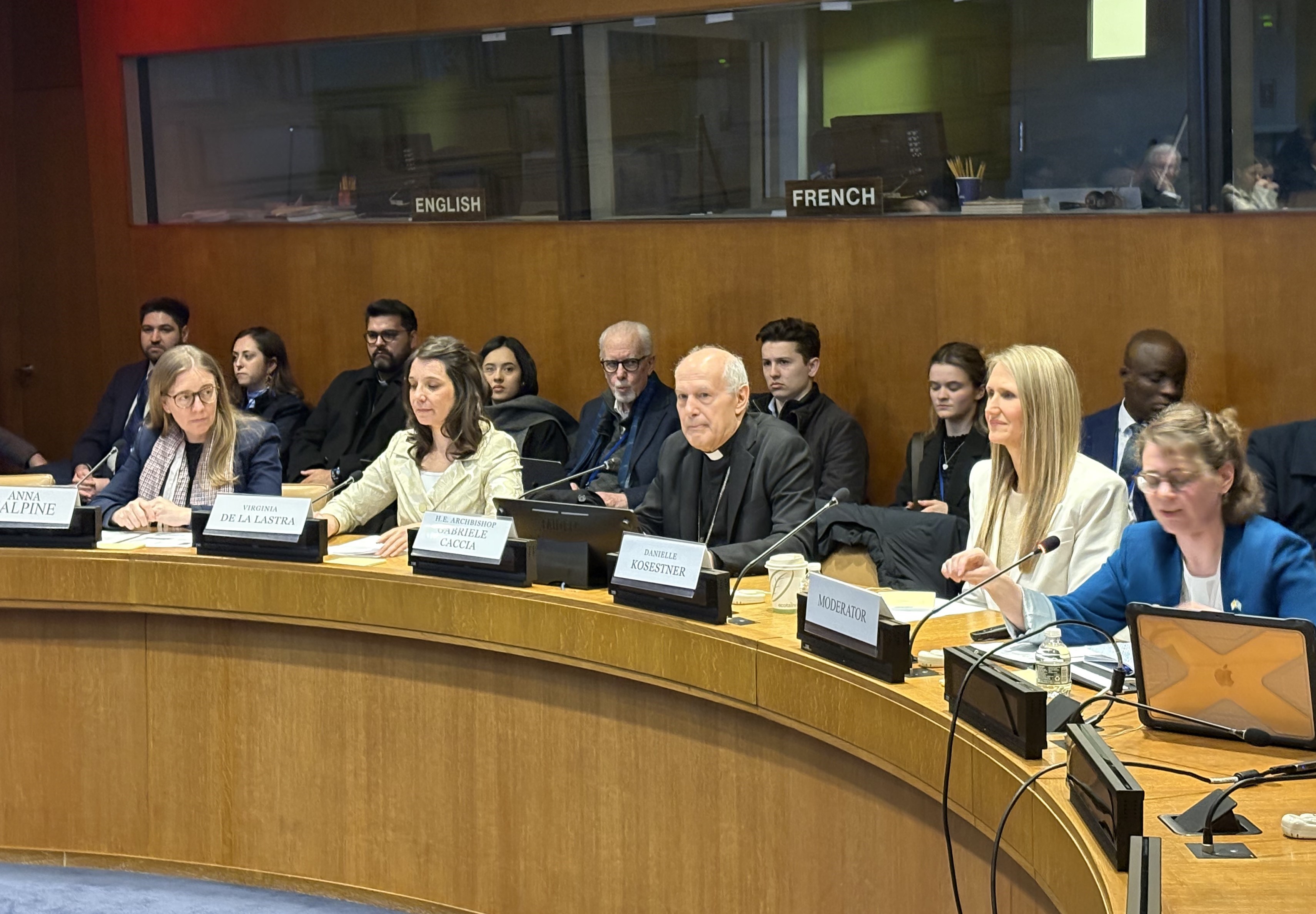
Archbishop Gabriele Caccia, the Vatican's permanent observer at the United Nations and newly appointed nuncio to the U.S. (center) speaks at a U.N. side event on women's health care March 18. He is surrounded by representatives from the Fertility Education and Medical Management Foundation and the Reproductive Health Research Institute. (NCR photo/Camillo Barone)

Join the Conversation
Send your thoughts to Letters to the Editor. Learn more
In a side room at United Nations headquarters in New York, during the annual session of the Commission on the Status of Women, a small panel convened under a title that suggested a technical discussion: "Beyond band-aids: Innovation to improve women's healthcare."
The note circulated to participants was direct. "For far too long, women's health has been under-researched and lacked sufficient investment," it read, pointing to "an over-reliance on a few interventions primarily for symptom management rather than getting to the root of hormonal imbalances."
The event was organized by the Permanent Observer Mission of the Holy See to the United Nations and co-sponsored by the Fertility Education and Medical Management Foundation, a U.S.-based group promoting fertility awareness and hormonal health approaches. It brought together diplomats, clinicians and advocates.
Archbishop Gabriele Caccia, the Holy See's permanent observer and newly appointed nuncio to the U.S., opened the session by placing the discussion within a broader framework. "Health is both an outcome of and an enabler for integral human development," he said. "It facilitates education, work, and participation in family and community life."
He then described what he sees as structural deficiencies in women's health care. "Far too often women and girls lack access to medical care and have needs which are not met," he said, citing "discriminatory attitudes," lack of resources and weak health systems. Even where care exists, he added, "many doctors are unable to treat them."
'When a health care system systematically fails to diagnose half the population because it treats their symptoms as inconveniences to be suppressed, this is not just a medical failure. This is a structural injustice.'
—Virginia de la Lastra
Caccia's remarks focused on discriminatory patterns in medical research and practice.
He said women's health concerns are not always "given due consideration" and are often studied with research and testing based on men.
He acknowledged recent efforts to correct the imbalance, but said that "gaps persist."
The archbishop singled out what he described as "the overreliance on hormonal contraceptives as a treatment," saying that "contraception at best provides symptom management for endocrine disorders — a 'band-aid' solution to much deeper problems."
Caccia's language reflects a longstanding position of the Catholic Church, which has consistently opposed artificial contraception on doctrinal grounds. At the United Nations, however, its interventions have increasingly been framed in terms of access, equity and medical practice rather than just moral argument.
Over the past two decades, the Holy See's diplomatic engagement has shifted in emphasis.
While it has maintained opposition to abortion and artificial contraception in multilateral negotiations, the Vatican has expanded its participation in debates on global health, poverty and sustainable development. Under Pope Francis, its representatives frequently linked health care to broader social and economic structures, arguing for what Vatican documents describe as "integral" approaches.
At forums such as the Commission on the Status of Women, the Holy See Mission has focused on maternal health, access to services and the social determinants of care. Its interventions have also increasingly engaged with technical language, including lay voices on epidemiology and health systems.
The March 18 U.N. event on women's health care reflects that trajectory: a move toward contesting prevailing medical models from within the framework of global health discussions.
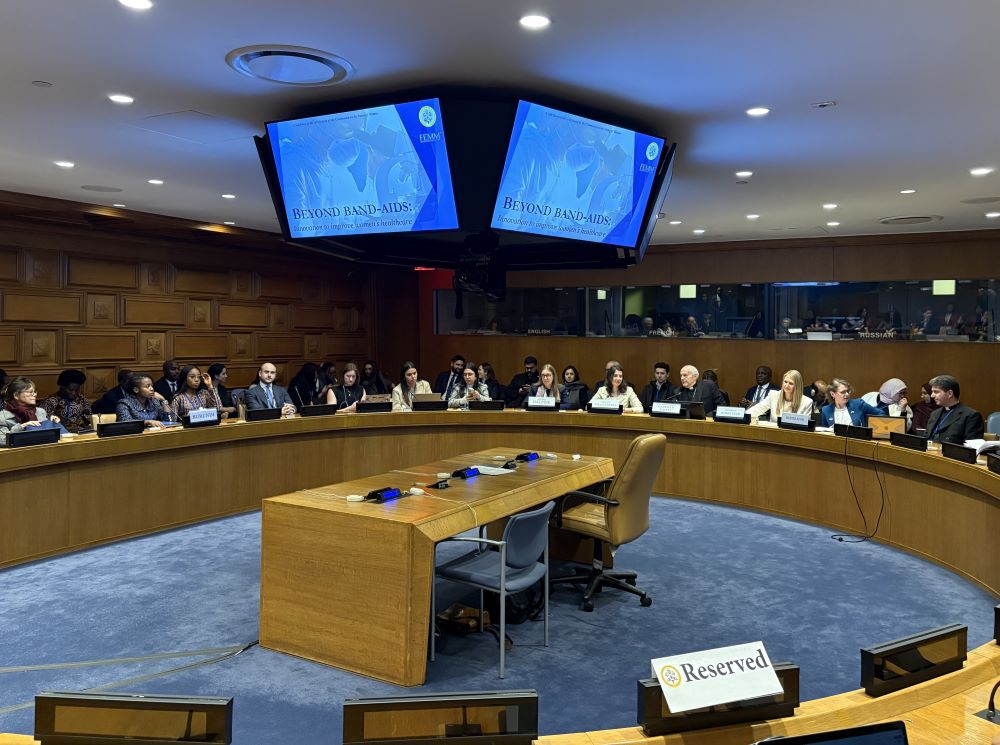
The Permanent Observer Mission of the Holy See to the U.N. organized a March 18 session called "Beyond band-aids: Innovation to improve women's healthcare." It was co-sponsored by the Fertility Education and Medical Management Foundation. (NCR photo/Camillo Barone)
The newest partner organization of the Holy See Mission, the Fertility Education and Medical Management Foundation, operates at that intersection. Founded in the U.S., it promotes fertility awareness education, cycle tracking and medical protocols aimed at identifying underlying hormonal conditions. Its affiliated research body, the Reproductive Health Research Institute, conducts studies on endocrine disorders, including polycystic ovarian syndrome, or PCOS.
Critics of such approaches argue that fertility awareness-based models are often associated with religious or ideological positions on contraception. Supporters present them as complementary or corrective to existing clinical practice, particularly in cases where diagnosis is delayed and where contraception causes physical and mental harm to women.
Anna Halpine, chief executive of the fertility education group, spoke after Caccia in front of a livestreamed audience and group of about 100, who were mostly women. "Despite this longstanding focus on women's health, women around the world still experience significant gaps," she said. "This is not just self-perception. Research and data back up this reality."
She pointed out that "on average, clinical care lags 17 years behind known research," and that "advances in knowledge to improve diagnosis, treatment and health care outcomes take almost one generation to reach women clinically."
She also said that access to diagnosis is uneven. "On average, it takes a woman eight years to get a diagnosis." The delay, she said, is longer in rural or underserved areas.
The model for the fertility education group, she said, combines education, digital tools and clinical networks. Its app, available in multiple languages, provides users with monthly cycle tracking and individualized feedback.
She described cases from different regions, including a user in Nigeria who identified a hormonal irregularity through the app and later received treatment. She also pointed to training programs in Africa and Latin America and to the introduction of curriculum materials for adolescents.
Advertisement
The most detailed clinical argument came from Virginia de la Lastra, a researcher with the Reproductive Health Research Institute, who described a particular study.
She spoke about a teenager named Isabella experiencing symptoms — irregular cycles, acne, weight gain — who consulted multiple specialists over several years. Each consultation involved partial treatment but no diagnosis.
"The chart looks normal," de la Lastra said. "Everyone looks on. But Isabella does not move on."
Eventually, she said, a more extensive evaluation identifies insulin resistance associated with PCOS, a chronic hormonal disorder that can cause irregular menstrual periods and infertility.. Treatment followed and Isabella's symptoms improved.
The example illustrated what de la Lastra described as a broader pattern. She said that standard practice often prioritizes regulating visible symptoms rather than identifying underlying causes.
De la Lastra pointed out that 1 in 5 women have PCOS. She also cited research indicating these women also experience high rates of associated mental health conditions.
"When a health care system systematically fails to diagnose half the population because it treats their symptoms as inconveniences to be suppressed, this is not just a medical failure. This is a structural injustice," she said.
She also returned to the issue of time lag. "There is a well-documented gap of 17 years between what research discovers and when it reaches the average health care provider," she said. "So even the women who are hurt are being treated with tools that are almost 20 years behind the science."
De la Lastra suggested a way forward that would involve educating patients and changing treatment methods. "Cycle charting patterns, biomarkers visible to any woman who knows what to look for, these are not problems to be managed — they are information to be understood," she said. "And when a woman understands that information, she becomes an active participant in her own health care."
The U.N. event did not include opposing views and no representatives of other medical or public health organizations spoke during the session. The positions presented align with ongoing debates in global health over the role of hormonal contraception, diagnostic practices and patient education.
The Vatican emphasis has shifted over time from direct opposition to artificial contraception to broader reframing of its use. In the case of women's health, that has meant focusing on research gaps, access to diagnosis and what speakers at the event repeatedly described as an overreliance on symptom-based treatments.
Within United Nations processes, those debates are typically mediated through negotiated language in international resolutions and outcome documents. Side events such as this one operate outside that framework, only providing space for states and organizations to publicly advance specific perspectives and exchange opinions.
For the Holy See, such forums have become a regular feature of its engagement. While its formal status at the U.N. limits its voting power, it uses side events, statements and coalition-building to influence discussions, particularly on issues related to life, family and health.