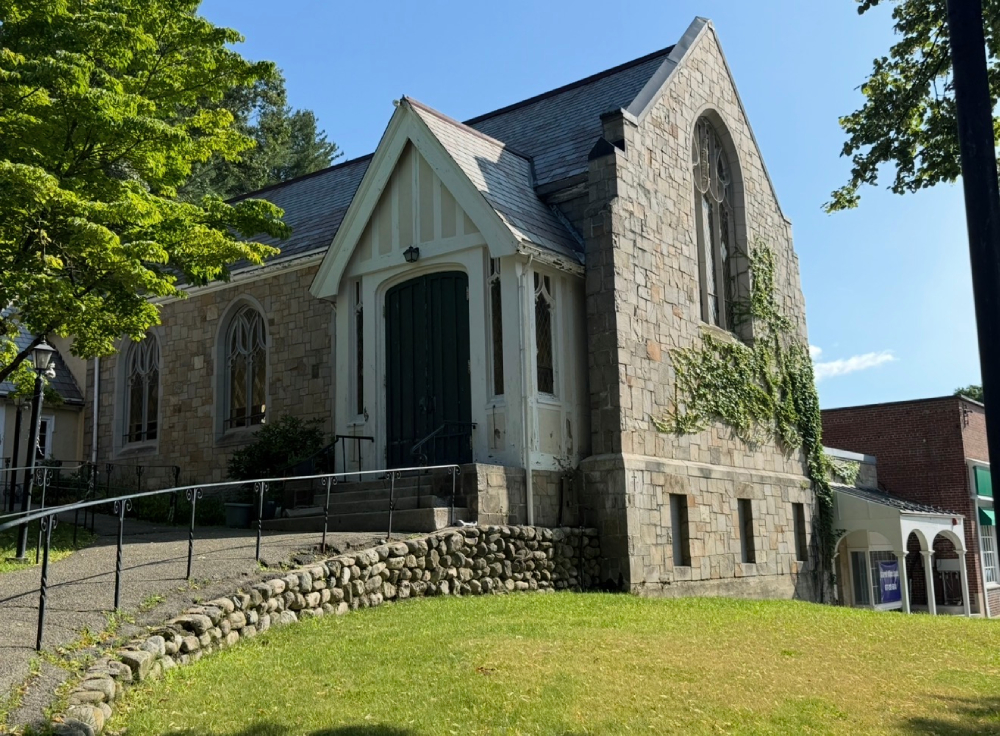
St. Catherine of Siena Church in Weston, Massachusetts. A former Episcopal church built in 1917, the Society of St. Pius X purchased the building in 2023 and is renovating the sanctuary. (NCR photo/Brian Fraga).
by Brian Fraga
Staff Reporter
Join the Conversation
Send your thoughts to Letters to the Editor. Learn more
Wearing a green fiddleback vestment, the type often worn by clergy before the Second Vatican Council, the priest walked into the cramped makeshift chapel at St. Catherine of Siena Church in Weston, a small Massachusetts town located 12 miles west of Boston.
The congregation of about 60 worshippers, many of them holding black leatherbound pre-Vatican II missals, followed along as the priest, facing the altar, recited prayers in Latin. The mixture of older parishioners and couples with young children listened as the priest later delivered a homily reflecting on the parable of the corrupt but shrewd manager from Luke 16.
In the hallway outside the chapel, the parish gift shop sold novena Mass cards, sacramentals and books on spirituality.
The faithful received communion while kneeling and later recited the prayer to St. Michael the Archangel following the July 19 liturgy at St. Catherine of Siena Church, which is affiliated with the Society of St. Pius X, the international traditionalist Catholic organization that earlier this month the Vatican declared to be in schism.
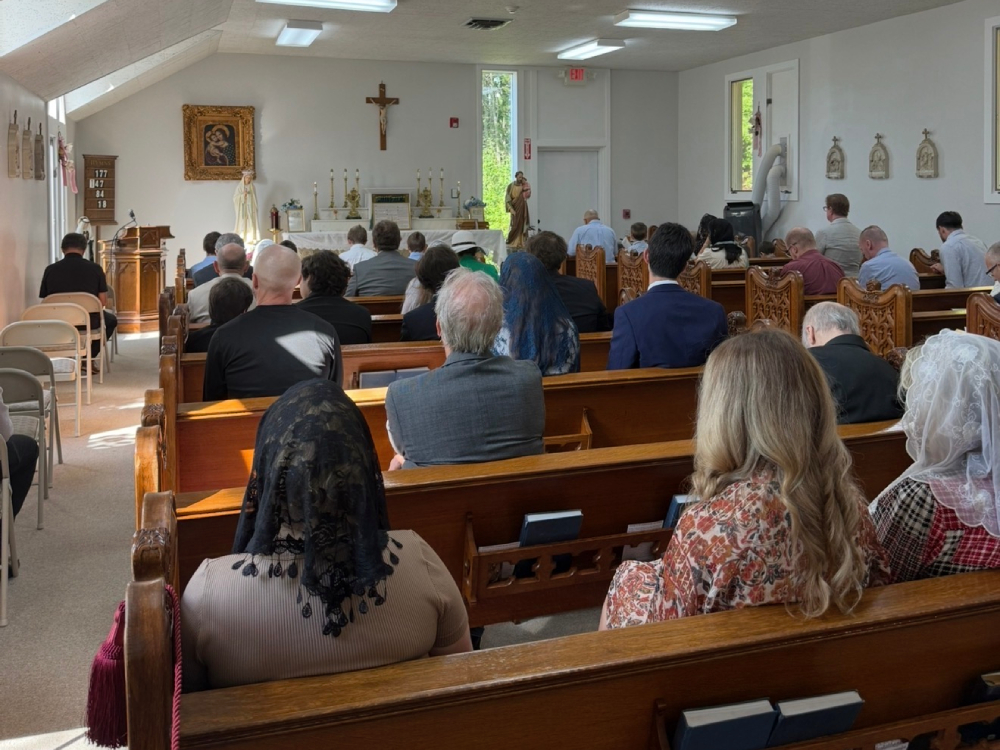
Congregants look on before Mass July 19 at St. Catherine of Siena Church in Weston, Massachusetts. (NCR photo/Brian Fraga)
The mass itself was held in the parish hall. The main sanctuary, a former Episcopal church built in 1917 and then used by a community of Christian Scientists until it was sold to SSPX in 2023, is currently under construction. According to a fundraising campaign linked to from the church's website, the church has raised more than $53,000 toward the building's restoration.
Despite the warning from the Holy See that those who adhere formally to the society are themselves schismatic and excommunicated, a handful of parishioners at St. Catherine of Siena expressed defiance when approached for their thoughts after the liturgy.
"I think the Holy Father and the prelates that advise him fear the growth of the SSPX," said Robert Erickson, a teacher and educational advisor who has been attending SSPX Masses since he began frequenting the group's underground liturgies while living in China.
"It is the SSPX that seems the focus of a lot of antipathy within the walls of the Vatican. Why is that?" Erickson told the National Catholic Reporter.
Another worshipper said that he did not believe the excommunications were real.
"I'd say if you look at the canon law the case is pretty clear that the excommunications are completely invalid," said Benjamin Wenzel who attended the SSPX Mass with his wife and their young children.
The church itself is sending a similar message.
On its voicemail, callers are greeted with a computer-generated voice stating, "the lay faithful are not excommunicated for attending an SSPX chapel."
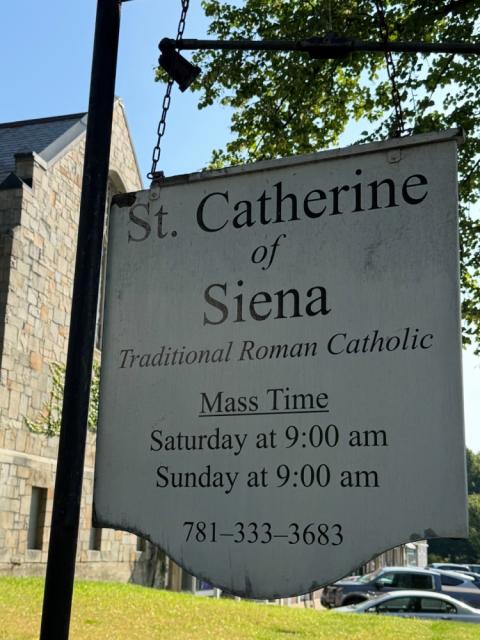
A sign greets people at the entrance of St. Catherine of Siena Church in Weston, Massachusetts. The church is affiliated with the Society of St. Pius X. (NCR photo/Brian Fraga)
That may technically be true, as the schism applies to SSPX bishops and priests, and laity who "adhere" to the schismatic group.
The voicemail message continues, "The church has clarified that attendance does not incur penalties. Priests are validly ordained in the sacraments, including Mass, confession, and marriage are valid. Our focus is to help souls know, love, and serve our Lord Jesus Christ through the traditional liturgy, faithful Catholic doctrine, frequent reception of the sacraments, and a life of prayer."
Wenzel, 30, who described himself as a lifelong traditional Catholic, told NCR that recent headlines about the SSPX are "pretty scary," but he said it's "a very different story" when one understands canon law and is an actual member of the community.
"So, from a faithful perspective, which is something that apparently the people at the Vatican who are actually offering these decrees do not understand, then I'd say it's pretty cut and dry," he said.
Matt Soares, a former SSPX seminarian, struck a sober tone.
Speaking in Portuguese, Soares said he and fellow SSPX members were at peace with the Vatican's recent declarations as he referenced "the clear situation of crisis in the church."
"I believe that the most prudent thing is to be silent at the moment and observe what the facts show us, what the modern church shows us. I believe that this will be very self-explanatory," Soares told NCR.
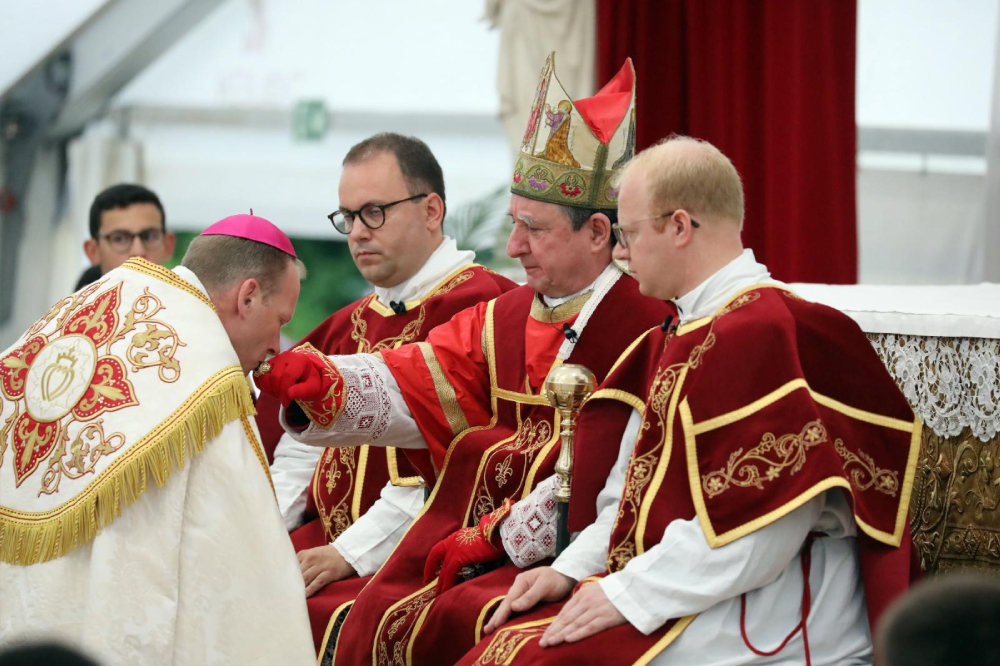
Newly consecrated Society of St. Pius X Bishop Michael Goldade, an American, is seen kissing the ring of Bishop Alfonso de Galarreta during an SSPX liturgical celebration July 1, 2026, in Écône, Switzerland. The two bishops, along with with Bishop Bernard Fellay of SSPX and three other newly consecrated bishops were excommunicated by the Vatican July 2, as the consecration lacked the mandate of the pope and was decreed to be schismatic. (OSV News/CPP)
Tensions between the Vatican and the SSPX came to a head earlier this month when the SSPX ordained four bishops in Écône, Switzerland, without a papal mandate on July 1.
The next day, Pope Leo XIV excommunicated the new bishops, as well as two who participated in the consecrations. The Vatican decree also declared SSPX priests to be schismatic, and therefore excommunicated, and invalidated some of the sacraments they administer.
The Vatican also warned the faithful to stop attending SSPX Masses, decreeing that "those who adhere formally" to the society are in a state of schism and excommunication. The sanctions don't apply to Catholics who attend those Masses for liturgical reasons, or for those who go but accept the pope's authority and teaching.
Several bishops in the U.S. have echoed the Holy See's warnings and urged the SSPX faithful to attend parishes in communion with Rome.
"To embrace the unity called for by Christ is to remain attached to the vine and to be in communion with Pope Leo XIV and the hierarchy of the Catholic Church," San Antonio Archbishop Gustavo García-Siller wrote to his archdiocese.
Bridgeport, Connecticut, Bishop Frank Caggiano wrote in a prepared statement. "What the Church now asks is straightforward: knowing the situation as it now stands, the faithful of the Catholic Church can no longer take part in the liturgies of the Society, for to do so knowingly would be to share in a separation from the Successor of Peter."
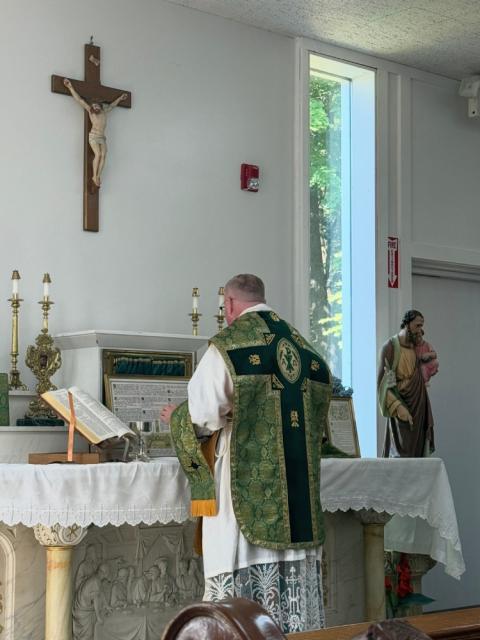
An SSPX priest wearing a green fiddleback vestment, the type often worn by clergy before the Second Vatican Council, celebrates Mass July 19 for the community of St. Catherine of Siena Church in Weston, Massachusetts. (NCR photo/Brian Fraga)
And on July 17, Charlotte Bishop Michael Martin released a public letter encouraging the SSPX faithful to reconcile with the church and warning Catholics against attending SSPX Masses.
But in the Boston archdiocese, where the Weston SSPX chapel is located, Archbishop Richard Henning is "deliberating on when and how he will communicate with his priests regarding" the SSPX, said Terrence Donilon, spokesman for the Boston Archdiocese.
SSPX faithful who are attached to the pre-Vatican II Latin Mass have options that are in communion with Rome, such as attending liturgies celebrated by the Priestly Fraternity of St. Peter, which was founded by priests who left the SSPX.
But for SSPX faithful such as Wenzel, the matter goes beyond liturgical preferences.
"It's not smells and bells. There is a true crisis in the church, specifically when it comes to modernism, which is just pervasive and that you really see kind of creeping in at Vatican II and onward," he said. "So my standpoint, the reason that my family and I attend, is because we believe there is a crisis in the church, and the SSPX is the only one that's actually willing to even mention that let alone actually address that."
Erickson, who said he attended the post-Vatican II Mass for decades before joining the SSPX, told NCR that he has studied church history, including the Second Vatican Council and the differences that he sees between the post-conciliar and pre-conciliar churches. He said he is not bothered by the Vatican's decree that says SSPX faithful like him are excommunicated.
Advertisement
"It doesn't concern me in terms of my personal salvation and as I work toward it," said Erickson, who described the present situation as "very unfortunate."
"I wish the Holy Father would have allowed the consecrations and that we could all be one church without borders or divisions," he said. "It's tragic but I think the church will endure it. It's all in God's hands. I have faith and confidence in the future."
As for the present, Erickson said he believes the Catholic Church has entered "an epic moment in world history."
"I really believe we are in a new epoch and it's time to make a choice," he said. "And my decision is to be a member of the SSPX."