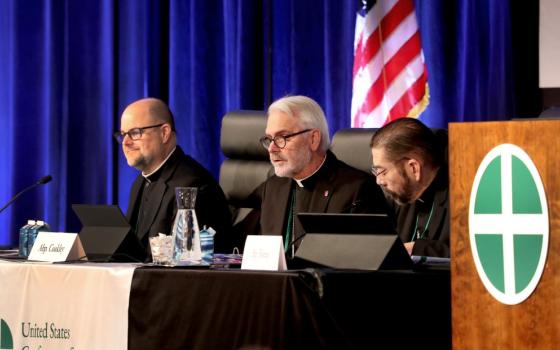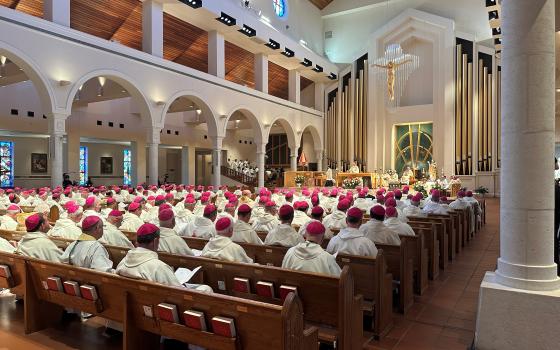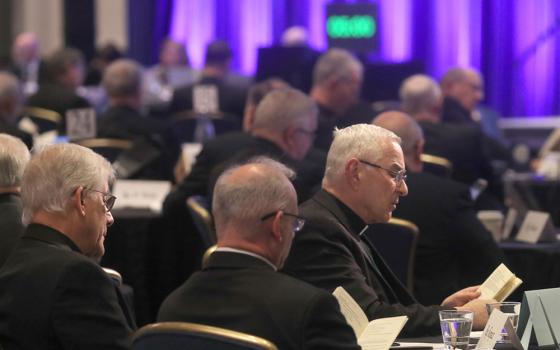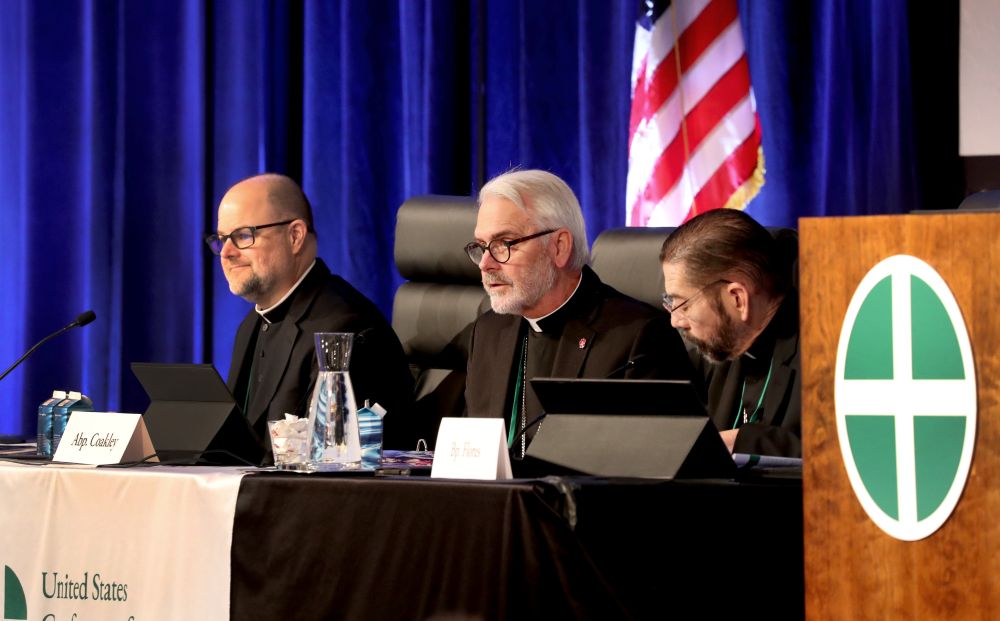
Archbishop Paul Coakley of Oklahoma City, president of the U.S. Conference of Catholic Bishops, center, speaks during a Nov. 17, 2026, session of the fall general assembly of the USCCB in Baltimore. Also pictured are Msgr. Michael Fuller, the USCCB's general secretary, and Bishop Daniel Flores of Brownsville, Texas, who is USCCB vice president. (OSV News/Bob Roller)
by Brian Fraga
Staff Reporter
Join the Conversation
Send your thoughts to Letters to the Editor. Learn more
Two weeks after the Nov. 3 midterm elections that ushered in a "Blue Tsunami," the nation's Catholic bishops said they are ready to work with Democrats who will control the next Congress.
"Working with whoever is in the White House, with whoever has the majority on Capitol Hill, we're here to help shape public policies according to our Catholic social teaching and advancing the common good, respecting the human dignity of every person," said Oklahoma City Archbishop Paul Coakley.
Coakley, the president of the U.S. Conference of Catholic Bishops, told reporters Nov. 17 during the conference's fall plenary assembly in Baltimore that the bishops can find common ground with "virtually anybody on the Hill who is willing to work with us."
"We're willing to work with them," Coakley said.
Bishop Daniel Flores of Brownsville, Texas, and vice president of the conference, noted that the bishops in Texas have "a long history" of working with governors with whom they do not always agree with politically.
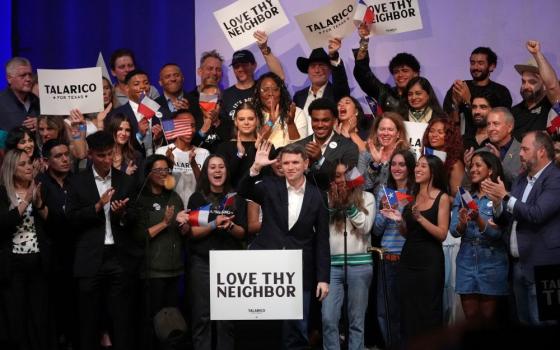
In the midterms, Gina Hinojosa, a Democrat, defeated incumbent Texas Gov. Greg Abbott, a conservative Republican who had served as governor since 2015. Democrats also gained control of the state's House of Representatives for the first time in more than two decades.
During his tenure, Abbott at times clashed with the state's Catholic bishops over his hardline stance on immigration.
"There are things with the previous administration that we could support and there were things we [couldn't] and that's because as Catholics, our perspective on human dignity and life doesn't fit neatly into either party," Flores said.
"We look certainly to opportunities in the new administration and legislature, but we have to sort those out," Flores added. "We have to discern it, but we also have to listen to what the agenda and the priorities are moving forward. But we're always open to conversation. And I think that's true nationwide."
The sweeping nature of the Democrats' resounding Election Day victories surprised some political analysts as the party won congressional seats in Republican strongholds such as Texas, Kansas, Iowa and South Carolina. Analysts attributed the election results to widespread voter dissatisfaction with President Donald Trump, a Republican whose job approval ratings fell below 30% in the weeks leading to the midterms.
Overall, Catholics in the United States remain divided. Catholic voters split roughly even between Republican and Democratic candidates for the U.S. House, according to the Associated Press' Voter Poll, a survey of more than 100,000 midterm voters.
The midterm election results raised questions among some observers as to how the bishops conference, which for years has prioritized abortion as the "preeminent" issue in its political advocacy, will navigate the new landscape in Washington D.C.
Jesuit Fr. Tom Reese, a journalist who has covered the bishops conference for decades, told National Catholic Reporter that the bishops will "have to face reality" and work with Democrats.
"That means they can no longer treat pro-choice Democrats like they're carriers of the plague," Reese said. "And they have to stop banning pro-choice Democrats from Catholic colleges and refusing them Communion. Otherwise, why would these folks talk to the bishops?"
Advertisement
In his Nov. 17 presidential address to the bishops, Coakley said the nation had just emerged from "a difficult and often contentious election cycle which yielded, if not surprising, undeniably consequential results."
"No matter the results, I want to congratulate those elected and encourage them to work together promoting the common good and protecting the human dignity of every person," Coakley said. In the weeks leading up to the midterms he had urged Catholic voters to prioritize faith before political ideology.
Coakley also referenced Pope Leo XIV casting a mail-in ballot in the midterms. The Chicago-born pontiff submitted a mail-in ballot in Illinois in keeping with his "long-standing practice of civic participation," the Holy See Press Office said.
"What a blessing it is, to be able, as Pope Leo did, to cast our ballots and exercise this fundamental right as citizens of this great nation," Coakley said.
The plenary assembly comes one year after the bishops conference issued a rare "special message" on immigration, decrying "the vilification of immigrants" and the "indiscriminate mass deportation" policy put in effect by the Trump administration.
Flores told reporters that those concerns "continue to be real."
"We're concerned about the de facto mass deportation policy and we're concerned about the treatment and especially about due process, that persons, by virtue of being persons, should have the opportunity to defend themselves and have legal counsel through a migration system which can be quite complicated," Flores said.
Coakley, who met with Trump and administration officials at the White House in January, said the U.S. bishops had secured "a partial win" with the administration "partially" delivering on a pledge to alleviate the backlog of religious worker visas.
"We will continue to advocate and negotiate. We will continue to do what we can do to meet with whoever will meet with us," said Coakley, who added: "There's a lot more work that can be done and must be done."