(Unsplash/Ben Hessler)

Join the Conversation
Send your thoughts to Letters to the Editor. Learn more
On a cold January day in 2013, Robert Bernu sat across from his son, David, in a restaurant. He still remembers that moment clearly.
"Dad, I need you to know that I'm confident I blew last semester and probably failed at least a couple of my classes," David began. Then came the sentence that, Bernu said, shattered years of denial: "I also need you to know, Dad, that I had set a date to kill myself, and I don't know why I'm alive."
That exchange, Bernu told roughly 120 National Catholic Reporter members from 25 countries during a Zoom talk April 30, marked the beginning of a long and disorienting journey into understanding addiction — what he described as a "cunning, baffling and powerful" disease.
Speaking candidly and often emotionally, Bernu wove together personal experience, clinical knowledge and spiritual reflection in a presentation that sought to help families better understand substance use disorder and their own role in responding to it.
In the immediate aftermath of that 2013 conversation, Bernu — who has worked for nearly a decade at the Hazelden Betty Ford Foundation's Family Program at its Center City and Plymouth locations in Minnesota — said he reacted as many parents might: trying to stay composed while internally unraveling. He recalled feeling "cold and scared," even as he slipped into what he said was a familiar role of projecting control. Drawing on a reflection from Thomas Merton, he said he had long lived in a mode of "self-impersonation," appearing confident while suppressing fear and vulnerability.
After leaving his son that day, Bernu said he went home, locked himself in his bedroom and broke down.
"I just collapsed to my knees and I wept," he said. "Not a tear that I shed in that moment had anything to do with me." Instead, he said, his grief was rooted in seeing "what a precious, beautiful, smart, funny, kind, loving, handsome young man that my son was and is," and realizing how deeply lost David had become.
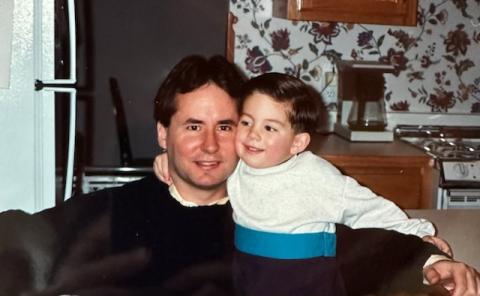
Robert Bernu and his son David in 1993 (Courtesy of Robert Bernu)
That moment also reawakened earlier experiences in Bernu's life, including childhood trauma tied to his mother's mental illness. "I had come to believe when I was a little boy, that eventually everything does fall apart," he said, adding that this belief made it difficult to imagine a hopeful outcome for his son.
Despite his fears, Bernu initially approached the situation as a problem to solve. When he asked his son, "Son, do you want my help?" and received a "yes," he felt both relief and a renewed sense of purpose.
His son entered treatment, though not without resistance. Bernu recalled that after an earlier attempt, David had told him, "I will never do it again. I hated treatment." Yet when Bernu again raised the possibility, his son agreed — a moment Bernu said surprised him.
A more significant shift came later, during that second treatment period, when Bernu began to reconsider his own role. A colleague challenged him directly: "Bob, he's old enough, he can do it. It's up to him. Let go. He's got this." The advice, Bernu said, "hit [him] between the eyes."
The next day, he told his son, "I don't treat you like a man, I treat you like a little boy," and committed to stepping back. He offered temporary financial support but made clear it would not be indefinite, explaining, "I'm going to step down so you can step up and be the man that I know you are."
That decision marked a turning point, though Bernu said he did not expect it to succeed. Instead, his son began to build a sustained recovery. "For the last 12 years, my son has lived this amazing life of recovery," Bernu said, describing milestones that included completing college, establishing a career and repairing broken relationships.
Central to that transformation, he said, was something he called "the music of recovery."
Borrowing the phrase from a treatment center director, Bernu explained the distinction between intellectual understanding and personal awakening. "You know the words of recovery, but we want you to hear the music," he said.
"Our love isn't enough. Our good intentions, our great ideas, aren't enough," he said. "Our loved one needs to hear the music of recovery for themselves."
Alongside his personal story, Bernu offered a framework for understanding addiction clinically. He described it as "chronic, progressive, and sometimes fatal," emphasizing that it is not curable and often worsens without treatment. He also noted that a significant majority of individuals seeking treatment have co-occurring mental health conditions.
Bernu emphasized that addiction involves changes in brain function, particularly in areas responsible for decision-making and impulse control. While individuals may choose to begin using substances, he said, "they never chose to become addicted to it."
During the discussion, he also highlighted the role of genetics and environment, noting that family history, early exposure, trauma and social context all contribute to risk.
Advertisement
In the question-and-answer portion, Bernu addressed the challenges families face when a loved one is abstaining from substances but not actively engaged in recovery. Such individuals, he said, may remain "restless, irritable and discontented," a state sometimes described as "white knuckling." This, he added, can be "as miserable to live with as it is when they're drinking."
Bernu also spoke about enabling, defining it as "what I'm doing for another what they could and should be doing for themselves." He acknowledged the difficulty of navigating that boundary, noting that what feels like help can sometimes sustain the addiction.
Underlying much of his message was a shift in perspective: from trying to control another person's behavior to focusing on one's own growth. Citing the Austrian psychiatrist Viktor Frankl, he said, "When we can no longer change a situation, we're challenged to change ourselves."
For Bernu, that meant investing in his own mental, physical and spiritual health. He described pursuing therapy, engaging in community support and deepening his Catholic religious practice, including daily Mass and prayer.
His Catholic faith, he said, offered both structure and consolation. "The 'Lord, have mercy' prayers were so alive for me for two or three years," he said, describing a period of sustained emotional strain.
He closed by returning to a theme of hope, drawing on the Christian narrative of suffering and Resurrection.
"I thought my son's addiction meant a lifetime of Good Friday," he said. "I'm so grateful to say that if you're in a great Good Friday today, I want you to know — and hopefully my story can encourage you and help you see it — that Easter is possible."