(Unsplash/Rapha Wilde)

by Daniel P. Horan
Join the Conversation
Send your thoughts to Letters to the Editor. Learn more
Today, it is clear that we live in an attention economy, where our time and focus is a commodity that is highly valuable, competitively sought after, and ultimately nonrenewable. Unlike the nearly infinite potential to accrue financial capital (just look at Elon Musk and his newly minted trillionaire status), every person on Earth is allocated the same amount of time: 24 hours per day. Period.
What we choose to do with that time is generally left up to us to decide. And more people are opting to use their limited time on social-media scrolling, online shopping or, tragically in my view, online betting, spending not only their money but also their attention in record amounts.
This is not only an economic, cultural, political and broadly social problem, but it is also a spiritual challenge. It is increasingly difficult for people, including spiritual seekers, to create for themselves the conditions for the possibility of reflection on the divine.
God has not changed. The Holy Spirit continues to draw near to creation. And Jesus Christ is, as the New Testament reminds us, "the same yesterday, and today, and forever" (Hebrews 13:8). But our contexts and the media landscapes we inhabit have changed dramatically over the decades and centuries, which I believe has contributed to the decline and current stasis when it comes to religiosity in the modern world.
Despite the recent headlines that suggest some increase in affective religiosity and interest in religious belonging among young adults, especially young men, the long-term data suggest otherwise. These analyses suggest that after decades of dramatic decline in religious belonging, the numbers have held fairly level for a while.
God whispers in a world that shouts at us incessantly.
And even those few who are committed churchgoers and religious adherents — I certainly include myself in this category — the near-constant distraction that smartphones and social-media platforms provide today threatens their spiritual flourishing and prayer lives, too.
To put the challenge bluntly, if somewhat awkwardly: God cannot compete in this attention economy when we have largely surrendered our limited temporal resources to algorithms designed to keep our attention in an exclusive and addictive way. For God whispers in a world that shouts at us incessantly, distracting us and luring us away from both the quotidian concerns of daily life and the numinously transcendent mystery that is our loving Creator.
I began thinking about this spiritual challenge in a new way last year after I read the journalist Chris Hayes' excellent 2025 book, The Sirens' Call: How Attention Became the World's Most Endangered Resource. Hayes writes compellingly about how human attention has become the key commodity of our time, analogous to the way labor became the defining commodity during the Industrial Revolution.
Like other economies, the attention economy functions according to the law of supply and demand. We each have a very limited supply of attention, governed as it is by time, but that which is competition for our limited attention is virtually infinite given the state of technology today and "content" fighting for our eyes, ears and minds.
Just as labor was deployed and controlled for profit and power at the turn of the 19th century, so too our attention is being extracted for the benefit of the few who convert it to increase shareholder value and translate it into cultural and political power in an increasingly polarized society.
Advertisement
Admittedly, while Hayes does not substantially develop the spiritual implications of his analysis of the attention economy, he does make passing references to philosophers like Soren Kierkegaard, who warned of the deep-seated temptation humans have to distract themselves in the face of boredom and in an effort to avoid self-examination.
What Hayes does do well is provide a keen assessment of the "signs of the times," holding a mirror up to all of us in an effort to call us away from the distractions that many, if not most, of us have merely surrendered to without critical reflection or moral evaluation.
This brings me back to God and the decline, or at least the stagnation, of religious belonging today. While some worship communities may try to compete in this attention economy with rock music, cafés or smoothie bars, flashy online presence, or social-media influencing, I don't think that authentic Christian life and community will ever win in this marketplace.
To do so, whether as an online personality "seeking to spread the Gospel over social media" or a professional minister trying to "get the kids interested in church," ultimately means departing from the modality by which God has consistently revealed Godself and doing something altogether unrelated. Too often, it seems to me, the medium — including the social-media personality — becomes the message and stops short of aiding spiritual seekers in improving the conditions for the possibility of recognizing divine encounter and then reflecting on it in community.
We discover God in the silence, which requires stepping away from the apps and the noise and the online platforms, and not trying to use those media as some kind of a shortcut.
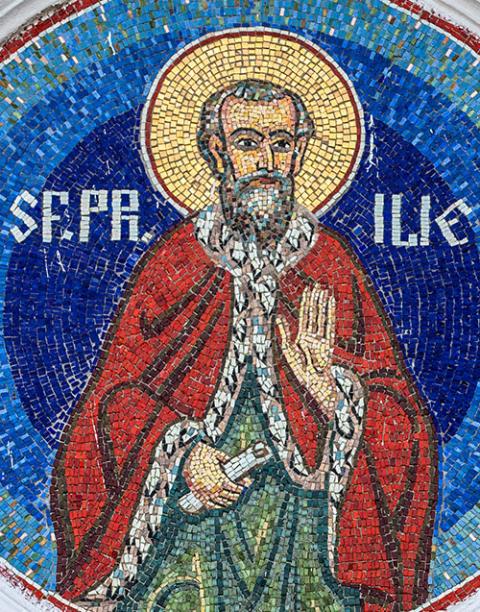
Mosaic of the prophet Elijah at the Tiganesti monastery in Romania (Dreamstime/Wirestock)
Perhaps the most famous instance of this is found in the First Book of Kings, when the prophet Elijah is called to meet God on Mount Horeb. The well-known passage reads:
Now there was a great wind, so strong that it was splitting mountains and breaking rocks in pieces before the Lord, but the Lord was not in the wind, and after the wind an earthquake, but the Lord was not in the earthquake, and after the earthquake a fire, but the Lord was not in the fire, and after the fire a sound of sheer silence. When Elijah heard it, he wrapped his face in his mantle and went out and stood at the entrance of the cave (1 Kings 19:11-13).
In addition to the obvious takeaway of this narrative, that God is found in the silence and not the spectacular and bombastic events of nature or humanity, there is a beautifully simple methodology presented to all those who seek God today.
The first step is that we have to position ourselves in the right place, spatially but also mentally, to recognize the presence of God in our midst.
Second, we have to focus our attention as Elijah did, not just to register the most fantastic or loudest display around us, but also to discern what is and is not important as we attune ourselves in the quest for God.
Third, when we allow ourselves to rest in silence, setting aside the distractions and noise in which God will not be found, we then create the condition for recognizing the divine presence in the quiet whisper that God speaks to humanity.
This is how God continues to reveal the divine self today, not with violent displays of power and might, not with explosive performances and loud noises, not with viral videos or millions of "likes," but with the quiet invitation to relationship that was first expressed at our creation and continues every day of our lives, if only we made the space and time to be attentive to it.
At the end of The Sirens' Call, Hayes challenges readers to "reclaim" their minds from the marketplace of the attention economy through collective efforts like increased governmental regulation and protections, especially for children. But he also invites individuals to pursue alternative contexts and media, particularly slower or analog media, which may help us to regain some control over our attention.
I would also add to his list the importance of silence, meditation and prayer, which require us to ditch the apps and the platforms in order to "be still and know ... God" (Psalm 46). As long as we let ourselves be saturated with and overwhelmed by the attention economy, we will never be able to hear God's silent whisper, which is drowned out by the shouts of our commodified world.