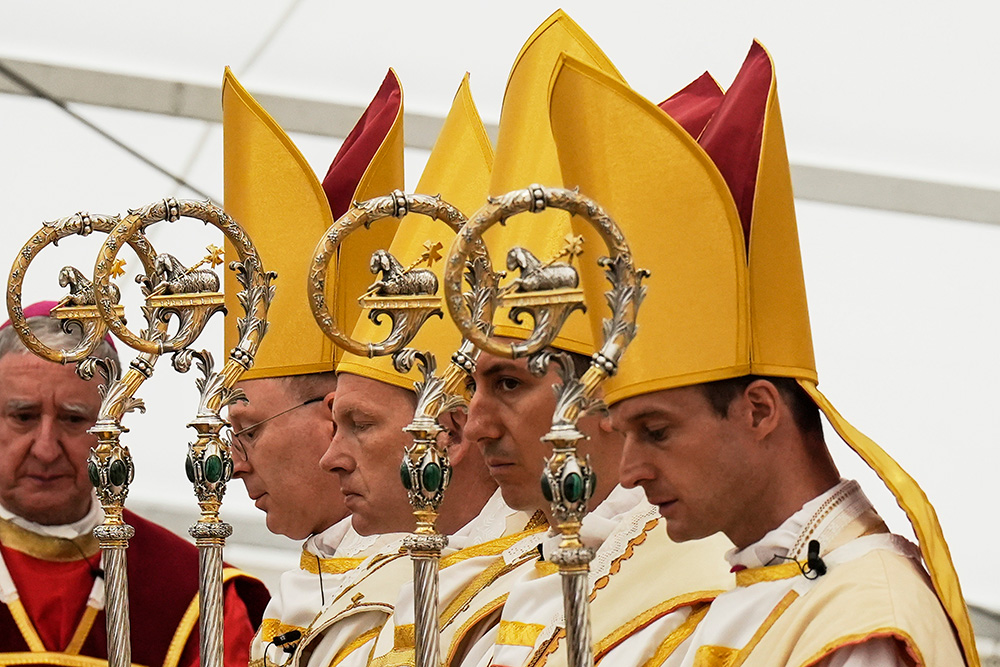
Newly consecrated Society of St. Pius X bishops, from left, Pascal Schreiber, Michael Goldade, Michel Poinsinet de Sivry and Marc Hanappier pray at the end of their consecration ceremony in a tent set up outside the Society of St. Pius X seminary in Écône, Switzerland, July 1, 2026. (AP/Baz Ratner)

Join the Conversation
Send your thoughts to Letters to the Editor. Learn more
Despite the pleas of Pope Leo XIV and years of negotiations seeking a reconciliation, the Society of St. Pius X consecrated four new bishops on July 1 at their seminary in Écône, Switzerland. By so doing, the participants incurred upon themselves an excommunication latae sententiae as clarified by the Vatican the next day. The excommunication extends to all clergy of the society and to the laity who formally adhere to the schismatic group.
In his letter begging them not to go through with the consecrations, Leo advised them that doing so would constitute a "sin of extreme gravity." Indeed it is.
We Catholics come in all shapes and sizes. There are conservative Catholics and liberal Catholics, observant Catholics and lapsed Catholics, wealthy Catholics and poor Catholics, Austrian Catholics and Zimbabwean Catholics. There is room for everybody within the church's embrace. Except those who refuse the embrace.
It is not difficult to entertain sympathy for those who were attached to the old, pre-Vatican II rite and did not like the new Mass. It is easy to sympathize with young people today who find something transcendent in the old rite, the sense of continuity with the ages, the otherworldliness of a liturgy in a language no one speaks. Sympathy, too, for those young people who grow up in a traditionalist family and for whom the old rite is what they know.
We need have no sympathy for the men who permitted themselves to be consecrated nor those who performed the ritual in Écône. They should know better.
The contortion of the faith by which the society lives was made obvious when, as the ritual demanded, the presider asked if the men to be consecrated had an apostolic mandate. It is kind of funny that they did not just delete the question but of course, for this group, admitting any change in the rite is a big no-no. And so the question was posed.
The answer was telling. "From the Second Vatican Council to the present day, the authorities of the church have been animated by a spirit that is contrary to that of the faith and have been acting against holy tradition," came the reply. "Therefore before God we consider it a sacred duty toward the holy church, toward souls, to proceed with the consecration of bishops who are entirely faithful to her holy tradition and to her constant magisterium."
Advertisement
The pre-Vatican II "constant magisterium" certainly includes the decrees of the First Vatican Council. In that council's Dogmatic Constitution on the Church, Pastor Aeternus, the council taught: "We teach and declare that, according to the gospel evidence, a primacy of jurisdiction over the whole church of God was immediately and directly promised to the blessed apostle Peter and conferred on him by Christ the lord." It explained, also, that "we teach and declare that, by divine ordinance, the Roman church possesses a pre-eminence of ordinary power over every other church, and that this jurisdictional power of the Roman pontiff is both episcopal and immediate."
None of this is unclear. There are no asterisks noting exceptions to the rule, no "sometimes" or "in certain cases" or "usually." The rejection of this teaching evidences the myopia of the group: They and they alone know the truth. Ironically, the Society of St. Pius X also evidences an acute case of cafeteria Catholicism.
These teachings of Vatican I only confirmed what had been long standing practice in the church: No bishop could be lawfully consecrated without an apostolic mandate from the pope. This was one of the principal issues upon which the Emperor Napoleon broke with Pope Pius VII, so it is not like Rome hasn't been to this Gallican party before. Still, the roots of the current schism lie not with the Bonapartists of French history, but with the Royalists, those who opposed everything in republican France and demanded a return to the status quo ante 1789.
These Royalists opposed the 1801 Concordat between the French empire and the Holy See. They rejected Pope Leo XIII's call for a "Ralliement" in the 1890s, that is, Leo's call to rally to the Third Republic and for French people to abandon devotion to monarchy. And, in the 1920s, the Royalists resisted Pope Pius XI's condemnation of the Action Française, a proto-fascist group urging the restoration of the monarchy. This is the ideological lineage of the Society of St. Pius X.
A key part of each rejection was the tolerance of Jews by the French Republic. Antisemitism has been one of the defining characteristics of the Society of St. Pius X since its founder, Archbishop Marcel Lefebvre rejected the Second Vatican Council's historic decree condemning antisemitism, Nostra Aetate.
Lefebvre and his followers also rejected Vatican II's decree on religious liberty, Dignitatis Humanae. Although the church understands the source of religious freedom differently from the way liberalism does, the Society of St. Pius X rejects both understandings. They are the first post-liberals, unwilling or unable to see that respect for the conscience rights of all is the mark of a humane, decent culture and, importantly, a precursor of genuine evangelization.
More than the old rite is at stake. It appears the Vatican has finally lost patience with these antisemitic, post-liberal, cafeteria and now former Catholics. The decree from the Dicastery for the Doctrine of the Faith was called an "explanatory note," but it should be given a formal title: Ave atque Vale. Hail and Farewell.