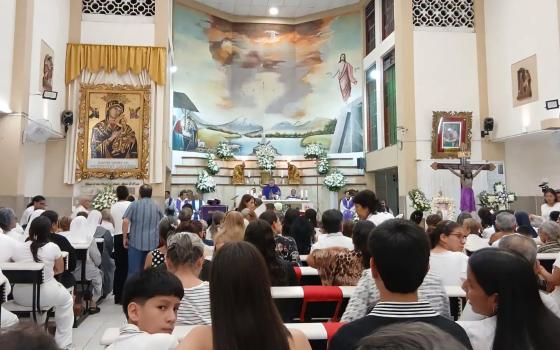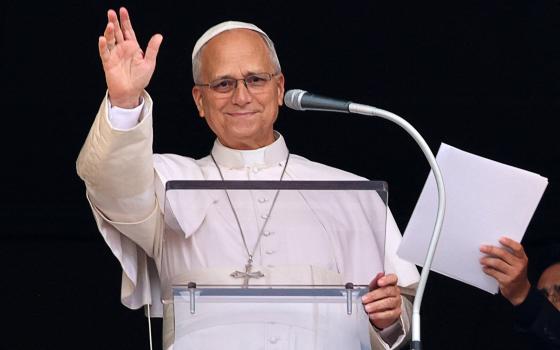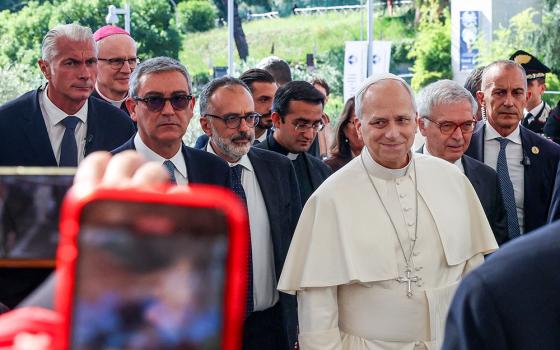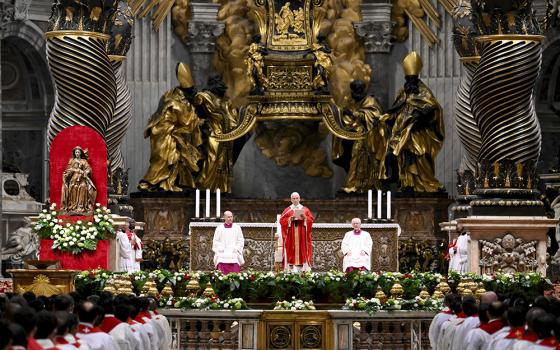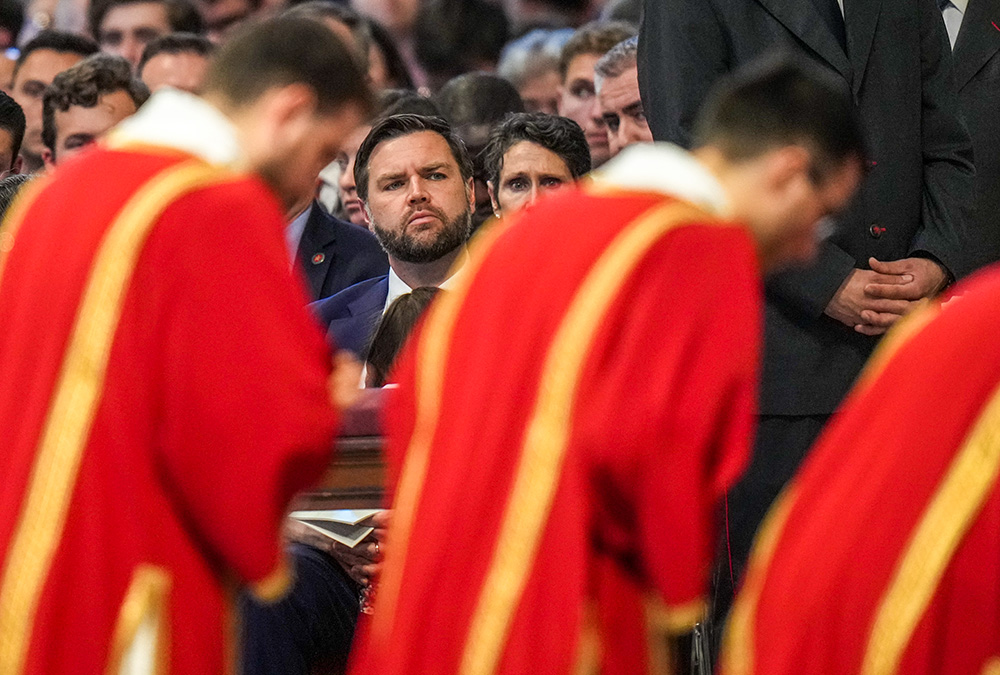
U.S. Vice President JD Vance attends a Good Friday service in St. Peter's Basilica at the Vatican April 18, 2025. (AP/Alessandra Tarantino)

by Michael J. O'Loughlin
NCR executive editor
Join the Conversation
Send your thoughts to Letters to the Editor. Learn more
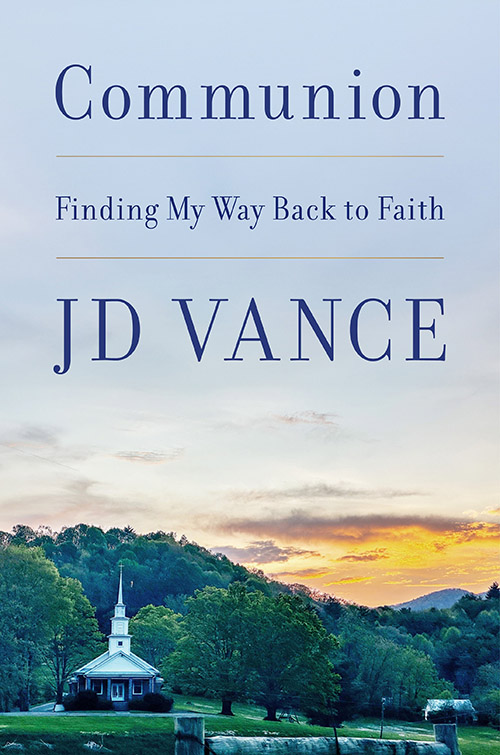
One of the more striking scenes in Vice President JD Vance's new book, Communion: Finding My Way Back to Faith, takes place in 2019, inside the cathedral in Burgundy, France, an experience that he credits with prompting him to take the final step toward becoming Catholic.
Vance is on a family trip with his wife, Usha, and their young son Ewan. Usha leaves them for a moment, giving Vance the impression that he and his son are the only people inside the cathedral. As Vance admires the architecture and the stained glass, he is overcome with a sense of the sublime — but also a feeling of angst.
"I couldn't stop thinking about the emptiness of the cathedral and what it said about Europe's cultural decline and Christianity's slow evaporation from the continent," he writes. "No people were here in this space besides me and my sleeping son. But God was."
God was and, as it turned out, somebody else.
Vance noticed a middle-aged woman emerge from one of the side chapels. "She looked to be an African immigrant, and she smiled politely at our toddler before leaving the cathedral. She had been there the whole time, praying quietly in a chapel. I hadn't been alone, after all," Vance writes.
He doesn't engage much further with this experience, other than to acknowledge that perhaps God was winking at him that day. "Don't be so melodramatic, God seemed to say to me."
This scene is emblematic of the book as a whole, with Vance offering a window into why he decided to become Catholic but stopping short of exploring how his newfound faith affects his worldview or prompts him to encounter seemingly ordinary events through a lens of faith.
His is a private journey — Vance writes repeatedly about how he believes his faith makes him a better father and husband and helped recalibrate his personal goals away from professional success and toward familial harmony. But Catholicism encompasses more than the personal.
How does Vance's Catholic faith affect how he carries out his duties in the Trump administration? We don't know.
Communion feels like two books, a standard memoir that sets the stage for higher office paired at times uncomfortably with a recounting of his faith life that seems to exist to serve the first purpose. A book from the "most senior Catholic in the United States government," as Vance puts it, should include some insight into how his faith affects his political beliefs and actions.
Vance does offer a helpful glimpse into the phenomenon of conservative young men turning to the Catholic Church to help make sense of, or seek refuge from, the challenges of modern life.
"One of the things I admire about my own church is the fundamental questions of doctrine change very rarely, and then only after a long and arduous process involving many ecclesiastical authorities," Vance writes. "This makes Catholicism feel more stable, which appeals to a number of young converts I've spoken to who are overwhelmed by the chaos of modern life and who crave a deeper sense of communion with others — but also with the traditions of their faith."
Elsewhere, Vance says he was "drawn to the hierarchy and the sense of authority in Catholicism."
But the book feels frustratingly incomplete, with Vance's take on Catholicism confined merely to the personal, private aspects of his life, a perplexing take given how often Vance laments the perceived relegation of Christianity out of the public square.
This is a strange omission, because Vance in several places acknowledges that Christianity must affect how we treat others and how we operate in the public square.
"We are not merely private moral actors but also public ones," he writes. "We are spouses and parents and workers and community members and neighbors." Yes, and Vance is also a vice president, part of an administration whose corruption has been described as "epic" and whose treatment of migrants has been described as "contrary to basic human dignity."
Advertisement
How does Vance's Catholic faith affect how he carries out his duties in the Trump administration? We don't know.
"Sometimes it's easier to keep our faith in a box," Vance writes. "It's less inconvenient that way."
In Communion, it seems Vance is choosing convenience over engagement with what his faith demands in light of complex moral and political issues. Vance's faith journey comes off as private, detached from the historic events he helps to shape. That wall Vance has created seems to have implications for how he lives his faith as well.
"It's not my job to weigh in on what the Catholic Church says about a particular liturgical question," he writes, seemingly unaware of the church's exhortation for the laity to be involved in the full life of the church. "And I wouldn't expect the Pope or a Lutheran minister to tell me who I should hire as chief of staff or police my tone."
When others challenge Vance to consider the tension that exists for Catholics in public life — including U.S. bishops, Vatican cardinals and even the pope — Vance suggests that his faith should stay in the private realm.
He recalls his 2025 meeting in Rome with the Vatican's secretary of state, Cardinal Pietro Parolin. Vance calls the meeting "unsettling." He said he expected the Vatican to bring up the Trump administration's mistreatment of migrants, but he left the meeting wondering, "What did they take issue with, exactly?"
"Here I was, the most senior Catholic in the United States government, and the Vatican seemed unwilling to move its moral guidance past the point of trite platitudes," he writes. Vance seems disappointed he wasn't invited to debate U.S. immigration policy with an Italian cardinal.
Criticism from Pope Francis toward Donald Trump and Vance were preferable, he writes.
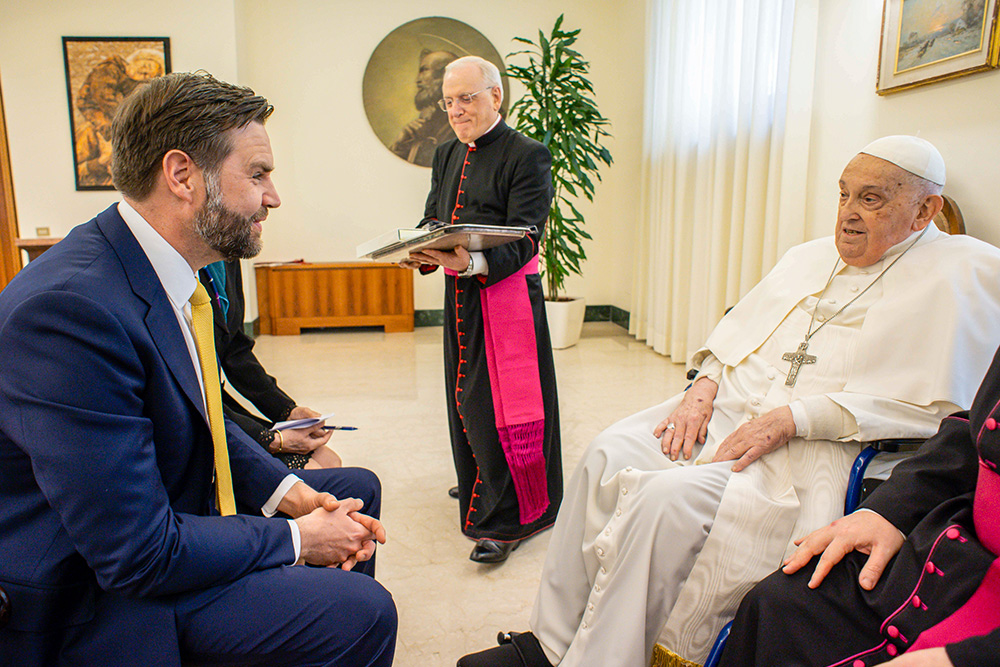
Pope Francis meets briefly with U.S. Vice President JD Vance in the papal residence, the Domus Sanctae Marthae, at the Vatican April 20, 2025. (CNS/Vatican Media)
"Whatever our disagreements on policy, he had helped keep me focused on the Church's social teachings," Vance writes. Vance and Francis met briefly on Easter Sunday that year, and Vance writes that the meeting "reminded me that Christianity is not merely a private faith." While Christianity requires certain theological beliefs, "it is also a faith through action, modeled on the life of Christ, that requires good deeds, love, and service."
But Vance doesn't reflect on what "action, modeled on the life of Christ," means in political life, especially when the actions of the administration he serves are at odds with church teaching. Take his section on immigration, an issue that prompted an extraordinary letter from U.S. bishops alarmed at the Trump administration's tactics.
"Immigration is a particularly thorny version of a challenge I encounter every day in my job: how to take an accepted moral principle and apply it to the real world as a Christian leader," he writes. He said he wanted more guidance, not less, but dismissed the guidance he received from Parolin ("trite"), from Francis ("disagree") and from U.S. bishops ("platitudes").
Ultimately, Communion feels like a missed opportunity to explore how powerful Catholic political leaders try to integrate their faith into their work and lives.
Vance praises Catholicism's role in standing up for workers and bringing people together, but the book lacks any deep consideration of how his faith calls him to love his neighbor. As Vance should know, neighbor in the Catholic sense includes not just those in one's family and personal orbit, but also neighbors in a larger sense, including those who, perhaps like the woman in the cathedral that day, come from places struggling economically or politically, but who are filled with life and hopes and dreams.
Had Vance reflected more deeply on what his faith teaches about how we are called to love God and our neighbor in the context of his unique role in our current political moment, Communion may have offered something more.