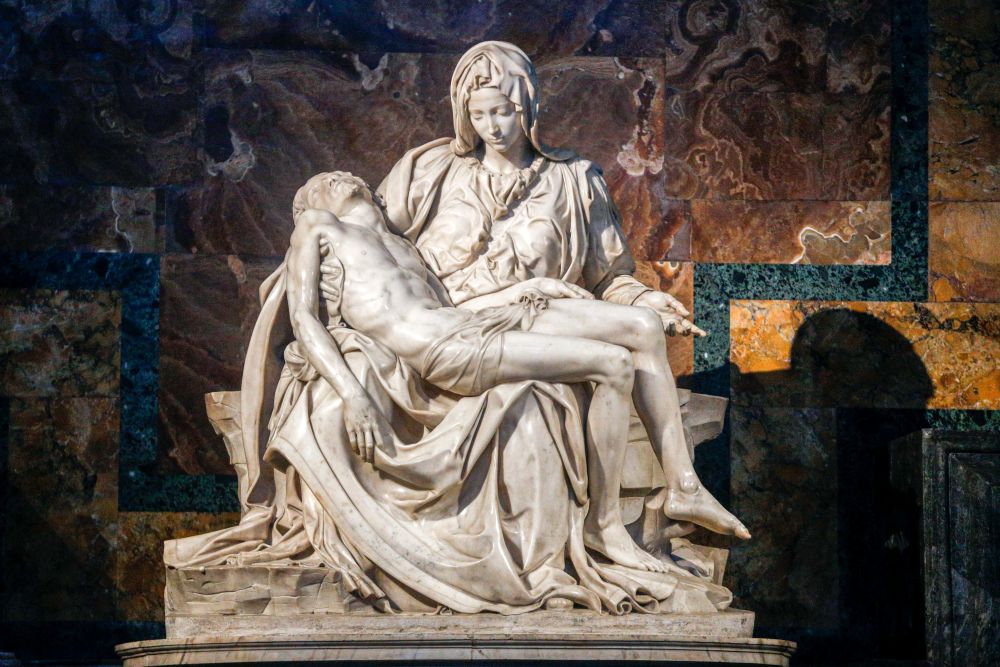
In 1972, a man took a hammer to Michelangelo's Pietà in St. Peter's Basilica, breaking the Renaissance sculpture into at least 100 pieces. A team repaired the sculpture, which is now protected by bulletproof and shatterproof glass. (CNS/Lola Gomez)

by Vanessa R. Corcoran
Join the Conversation
Send your thoughts to Letters to the Editor. Learn more
Residents of the small town of Medjugorje, Bosnia, home to a Marian shrine that has attracted 30-40 million pilgrims since 1981, woke up on July 28 to discover that a statue of the Virgin Mary was defaced in an overnight attack.
On the pedestal of the statue of Mary were the words "devil in a skirt," and part of the shrine was set ablaze. Mary's face and hands were covered with black paint. Responding to the vandalism, the parish issued a statement that it was ready to welcome worshippers so it could "once again be a place of prayer and encounter with the Lord through the intercession of the Queen of Peace." A Polish man was later detained for his involvement.
Unfortunately, this recent act of violence against Mary is not an isolated incident. Attacks on paintings and statues of the Virgin Mary have a long and complicated history.
Many of our miracle collections that date to the Middle Ages tell stories of robbers and vandals attacking or stealing Marian icons. One of the more notable occurred in Poland in 1430, when a group of robbers entered the Jasna Góra Monastery and twice slashed the face of the Black Madonna of Częstochowa. The venerated icon was later restored (though the gashes are still visible on Mary's cheek), and still attracts millions of pilgrims a year.
Violent attacks on Marian art reached a 16th century nadir in the wake of the Reformation. In 1524, a wooden statue of the Virgin Mary from the Riga Cathedral in Latvia was put on trial: a crowd of Protestants accused the statue of being a witch. Because it floated, the mob declared it guilty of witchcraft and burned the statue of Mary at the stake.
Alongside English reformers who raised their concerns about Marian devotion in a series of polemical tracts, popular condemnation reached new heights of violence in the summer of 1538.
On the order of Thomas Cromwell, the adviser to England's King Henry VIII during the English Reformation, a series of Mary statues — deemed to be "the devil's instrument" — were set on fire in the summer of 1538. One record noted, "the Image of Our Lady of Walsingham was taken and burnt along with her other 'sisters.' " The state-ordered destruction of Marian shrines across England reshaped the devotional landscape permanently.
Advertisement
But these episodes were not isolated to the distant past. Most famously, in 1972, a man took a hammer to Michelangelo's Pietà in St. Peter's Basilica. Striking the priceless marble 15 times, Laszlo Toth yelled "I am Jesus Christ," breaking the Renaissance sculpture into at least 100 pieces. It took months for a team of 10 to repair the Pietà, which is now protected by bulletproof and shatterproof glass.
When Chris Ofili's "The Holy Virgin Mary" mixed media painting was displayed at the Brooklyn Museum in 1999, it generated controversy because elephant dung was an integral part of the design. Then Mayor Rudy Giuliani called it "disgusting" and threatened to cut off funding for the museum. Though the image remained on display behind plexiglass, it was damaged when a man smeared white paint over the canvas.
When Austrian sculpture Esther Strauss' "Crowning," a statue of Mary giving birth to Jesus, was displayed in the cathedral Austrian city of Linz in 2024, the physicality of the childbirth position generated controversy. Some viewed the realistic depiction of Mary's open legs to be too graphic, even blasphemous. This outrage reached a fever pitch when someone eventually decapitated Mary.
When news broke that several members of the IDF were seen putting a cigarette in the mouth of a Mary statue in a Lebanese village in May, the viral image caused an outcry. The soldiers were sentenced to two weeks in a military prison.
For centuries, attacks on female religious imagery have continued (outpacing vandalism against images of Jesus), and have typically been orchestrated by men. As a Marian scholar, I have read no small number of misogynistic attacks on Mary that either decry her significant influence in the church or oversimplify her existence.
Martin Luther characterized Mary as an ordinary hausfrau: "She seeks not any glory, but goes about her meals and her usual household duties, milking the cows, cooking the meals, washing pots and kettles, sweeping out the rooms, and performing the work of a maidservant or housemother in lowly and despised tasks." Lutheran Bishop Johannes Wigand (1523-1587) went so far as to note in a sermon that Mary was a "weak, stupid human being, just like other people."
Just as these 16th century attacks sound harsh to a modern audience, the term "devil in a skirt" that the vandal scrawled on the statue of Mary in Medjugorje inscribed a similar misogynistic message onto the female religious form. When I teach my undergraduate history seminar called "Mary Through the Ages" at Georgetown University, I tell my students that as they root through historical texts, they'll encounter numerous examples of misogyny against Mary. While they instinctively think of these as outdated notions, the recent attack in Medjugorje shows that this trend still persists today.