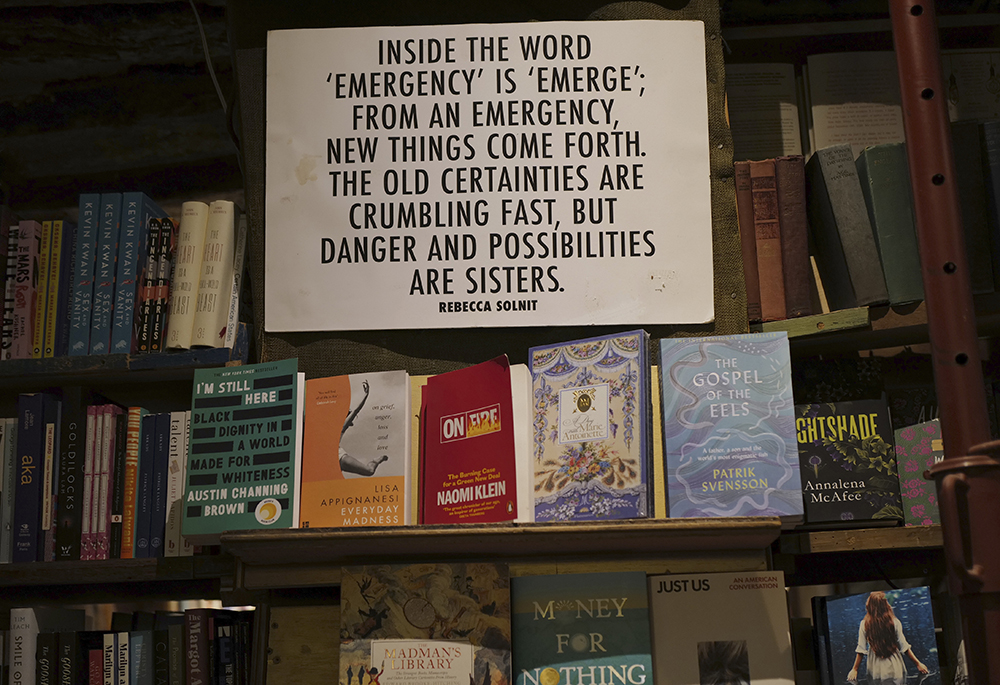
A panel on "Emergency" by Rebecca Solnit hangs on the book shelves of the English and American literature Shakespeare and Co. bookstore, in Paris, France, Nov. 05, 2020. (AP photo/Francois Mori)

by Jason Berry
Join the Conversation
Send your thoughts to Letters to the Editor. Learn more
Few writers become public intellectuals in the national lens, weighing the hardest issues in the context of history and values. Heather Cox Richardson, Henry Louis Gates Jr., David Brooks and Bill McKibben come to mind, prolific thinkers whose works have wide reach.
Just outside that sphere hovers The Guardian columnist Rebecca Solnit, a Bay Area writer whose more than 25 books assess politics, pop culture, literature, city life, Native American spirituality, Ireland, George Orwell, feminism and climate change. Solnit is on an odyssey driven by a search for justice and human decency.
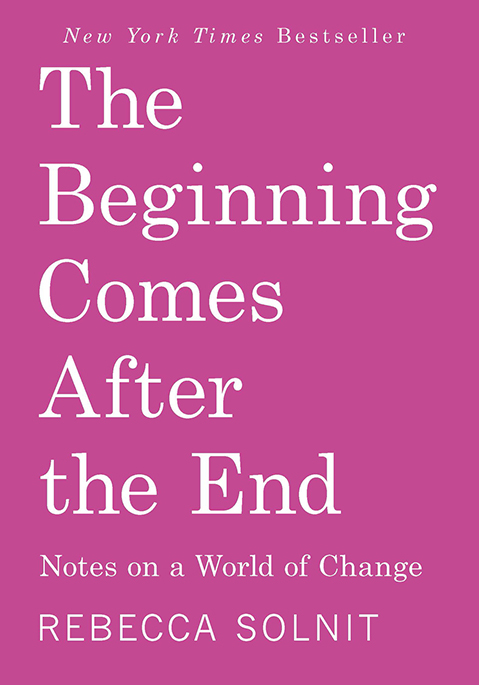
Sonit's new book, The Beginning Comes After the End: Notes on a World of Change, probes the scale of change through a trek into moral darkness that ends, surprisingly, in a song of hope.
First, she scorns Silicon Valley oligarchs who "egg on the destruction of the world while seeking to shelter themselves and only themselves and their families from it. … Our psyches are where they go strip-mining, but they savage the natural world, too."
And yet, she notes: "A new world is being born."
Solnit cites the late Fr. Thomas Berry [no relation to this writer], an environmental theologian who wrote in 1978: "We are in trouble just now because we do not have a good story. We are in between stories."
Solnit deems the old narrative of Eurocentric colonialism and patriarchal Christianity "the top-down story, the story of conquest and domination as progress." Think Trump: ICE: Venezuela: Iran. She writes:
What Berry called the old story was a wall of noise shouting out yet older stories. Often, some of the genuinely new stories reinforce ancient cosmologies — notably the biological science offering a view of nature that accords well with many of the premodern stories describing a more symbiotic, interconnected, sentient world that was and is often a more egalitarian one.
Without naming him, Solnit echoes Pope Francis' ecology encyclical, Laudato Si' in writing: "That everything is connected to everything else is fundamental to environmental science, and in a healthy ecosystem there's a poetry to how the many parts of the system interact to mutual benefit." Along these lines, she also cites Rachel Carson's Silent Spring, the 1962 treatise advocating a "whole closely knit fabric of life" that inspired the environmental movement and provoked petrochemical potentates dripping tracks of hazardous waste to attack the book.
Advertisement
On interconnectedness — humanity and nature in common cause — she finds Dr. Martin Luther King Jr. writing in 1963 from the Birmingham jail: "We are caught in an inescapable network of mutuality, tied in a single garment of destiny." She quotes from King's sermon "On Being a Good Neighbor" that, six decades later, seems prophetic: "Through our scientific and technological genius, we have made of this world a neighborhood and yet we have not had the ethical commitment to make of it a brotherhood."
For Solnit, the civil rights movement and feminism have driven an ethos of human rights. Against that baseline, she writes of the "far-right" (neofascist) resurgence in America and abroad as the old story of domination and conquest, blind to the wars and starvation that have driven migrants from so many countries to nominally democratic lands. A Western ideology of isolation collided with the 2020 Covid-19 pandemic. Solnit writes:
Many denied or bent the facts to suit their ideologies. One result in the United States was that, while the pandemic initially hit multiracial urban areas in Democratic states hardest, by the time a vaccine was developed and widely deployed, fatalities were far higher in conservative, white-majority parts of the country. People died for their views; others died as a result of their views. … Authoritarians from Stalin to Trump see the authority of truth and fact, as manifested in history, science and journalism, as competing with their own power. They seek to corrupt and vanquish them in order to make reality itself something they command.
She then ponders the backlash — one could point to Trump's escalating attacks on the press even since the book's March publication. "I'm against prophecies when they pretend that the future has already been decided or is already knowable," she writes. "But I wonder if the backlash is a supernova. When some stars die, they don't dwindle at first; they explode in size and release staggering amounts of light and energy."
She opines with a version of an Antonio Gramsci passage: "The old world is dying. The new one is slow in appearing. In this light and shadow, monsters arise."
Consider that supernova metaphor: Where the energy goes after that great explosion is about where we are today. If polling holds true, and a blue wave of Democrats regains control of Congress, the response to the backlash will be an epic drama of trying to repair a brittle democracy corrupted by the power of lies beyond anyone's imagination; trying to bring some of the monsters to justice.
"You can take rights away, but you can't so easily take ideas away, including people's belief in their own rights and the rights of people they care about," continues Solnit. "Contemporary right-wing authoritarianism is waging a war against the future, against the world being created and in many ways already well established, through what were once radical ideas of universal human rights and equality, across race and gender, ideas about our inseparability from nature that never died in the margins but were denied in the centers of power."
Finding the new story out of this decadent narrative of supreme rulers punishing the just and plundering the earth is one tall order. Solnit concludes not with a blueprint or agenda directives, and that may disappoint some readers; but the varied sources she draws upon, from Native American sages, Christian visionaries and Buddhist scholars, bestir her to voice a moral oratorio. She writes:
I see promising signs — seeds — in how so many young people regard both their own gender and sexual orientation as fluid, or just not needing definition, in a rising generation used to coexistence with people of other races and religion and origins, in the confidence of young women in their own rights in ways my generation lacked, in the widespread awareness of the real history of the Americas and the presence of Indigenous people and nations, in a growing attachment to the natural world and wild places, in an ethic of kindness toward animals, in a sense that capitalism is both cruel and destructive and there are other, better ways to arrange things.
There's a lot to unpack in Solnit's aria of hope, primarily whether capitalism is doomed to cruelty or has the capacity to rebuild a human scale. That is a preoccupation of popes Leo and Francis. Solnit's insistence on hope leaves one hungry to read more on interconnectedness, and purification after tyranny.