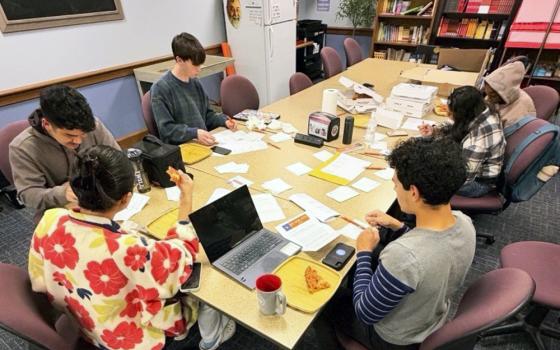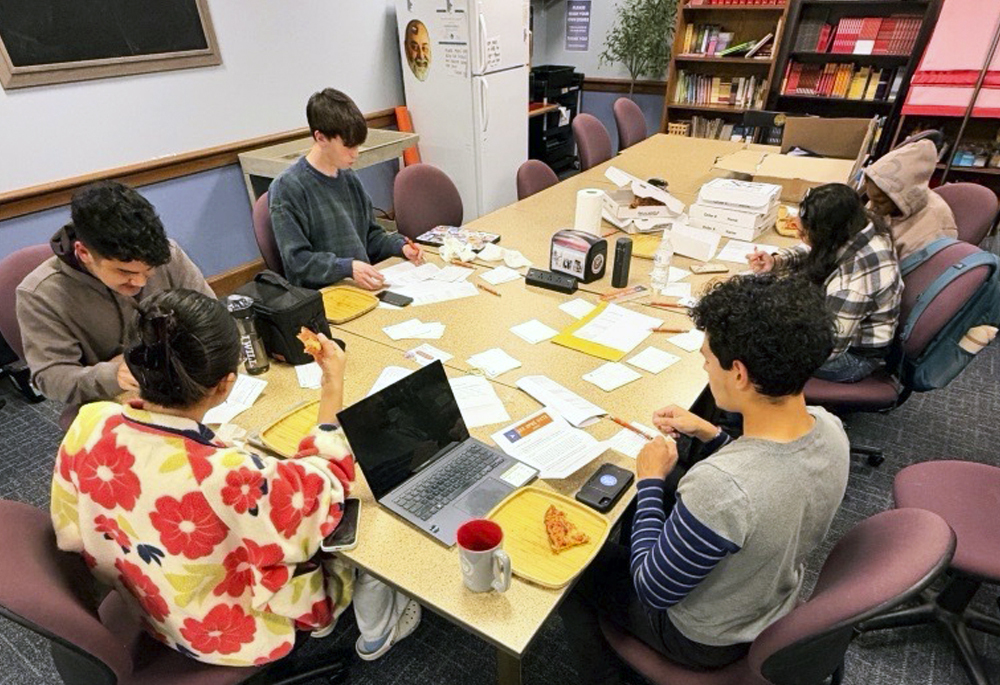
Students attend a postcard writing party hosted by Sr. Carol Coston fellows Chase Tuller and Anthony Miranda at John Carroll University in Cleveland, October 2026. (Courtesy of Chase Tuller and Anthony Miranda)

Join the Conversation
Send your thoughts to Letters to the Editor. Learn more
At Loyola University New Orleans, Amiyuh Tobias has had a simple way of starting conversations about democracy: a table, some snacks and a QR code.
Students passing by checked their voter registration or began registering themselves. They could also talk about what is keeping them up at night.
Increasingly, Tobias said, those conversations have been about finding a job after graduation, paying rent, securing health insurance and protecting LGBTQ rights, particularly those of transgender students. But as the Nov. 3 midterm elections approach, Tobias said she is also hearing something hopeful that she did not hear so much during the 2024 presidential race: a belief that voting might actually make a difference.
"I remember so many students telling me that their votes don't matter, that they feel very hopeless," said Tobias, an English writing student who also organized voter registration efforts in 2024. "This time around, there's a lot more fire."
From Louisiana to California, young organizers at six Catholic universities described a similar tension, ranging from deep anxiety about the country's direction to a growing desire to participate. These students are members of the Sister Carol Coston, OP Fellowship, a paid student leadership program run by the Network Advocates for Catholic Social Justice. This fall, their work has focused on See. Love. Vote., Network's nonpartisan voter engagement campaign, which draws on Catholic social teaching to connect concern for neighbors with civic participation.
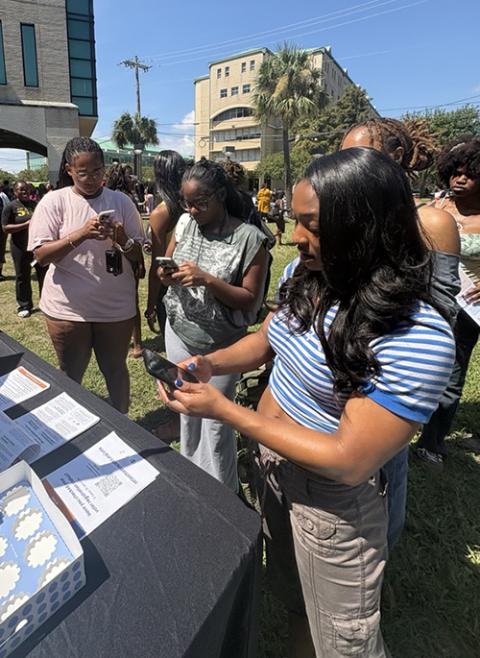
Sr. Carol Coston fellow Erica Walden registers her peers to vote at Xavier University of Louisiana in New Orleans, September 2026. (Courtesy of Erica Walden)
For the fellows, the greatest obstacle is the feeling that politics offers no answer to the problems shaping their daily lives.
At John Carroll University in Ohio, Chase Tuller, 22, said he hears it from students asking why they should bother voting in a midterm election. "The term apathy is one that I feel that I'm seeing a lot of," said Tuller, a political science senior. His response is to bring the discussion back to decisions affecting their futures, he said.
"Young people see the cost of living continuing to go up every single day and they feel like they're losing their chance at the American dream," he said. Housing, groceries, tuition and medical bills are not separate concerns, in his view, but parts of a single question, which is often whether young adults can afford an independent life.
That concern cuts across campuses. In New Orleans, Tobias hears from students without health coverage and others fearful about employment after graduation. At DePaul University in Chicago, astrophysics student Leslie Gracia, 25, said she hears about immigration concerns among students with immigrant family backgrounds, along with worries about housing and healthcare. Some also raise environmental concerns about water consumption and the construction of artificial intelligence data centers.
In New York City, Brooke Johnson, a Manhattan University junior studying political science and criminology, has helped organize voter registration drives, a ballot-research gathering and a nonpartisan letter-writing event with support from the campus group Jasper Votes. Students writing messages to other voters said the issues of homelessness, food insecurity and pollution were the most concerning for them at the local level.
Rather than appealing to party loyalties, Johnson said, they were "showing people why they vote and encouraging others to do the same." The idea is to make civic participation feel connected to streets and neighborhoods students personally know rather than just distant arguments in Washington.
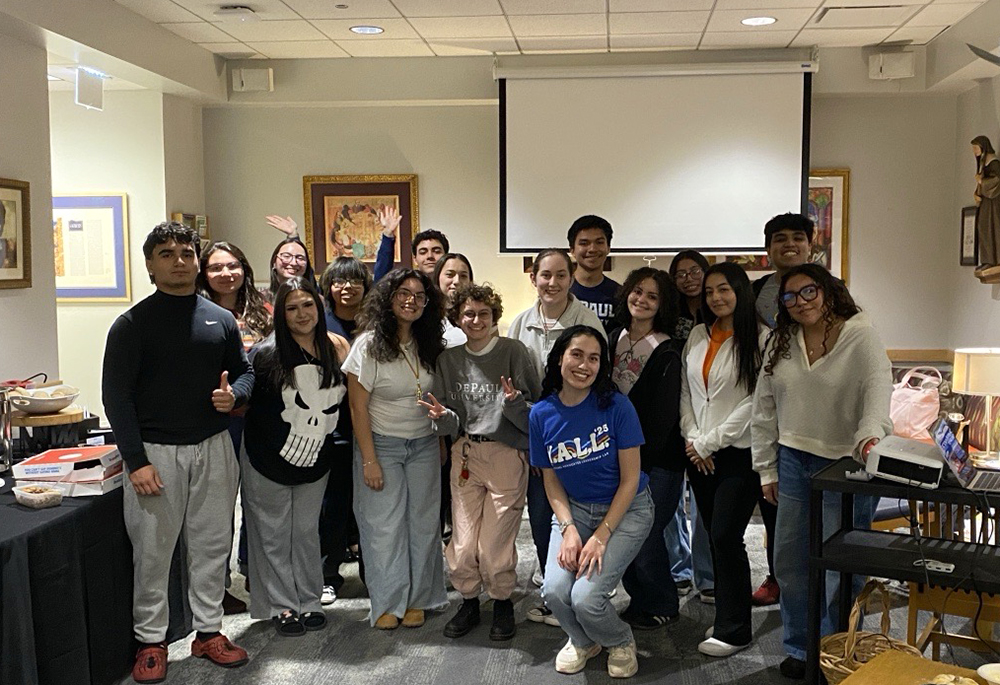
Leslie Gracia, fourth from right, kneeling, and DePaul University students in Chicago pose at a ballot research party in October 2026. (Courtesy of Leslie Gracia)
For Mia Isabel Lazo, 20, at Mount Saint Mary's University in Los Angeles, that task involved reaching students whose experiences of economic hardship could hardly be more different. Some come from sheltered, relatively comfortable backgrounds and have never felt compelled to engage. Others, she said, have experienced housing instability or poverty and grew up in households where parents were too busy working to model regular voting.
"How do I not only communicate that it's important and that your vote does matter, but that voting matters at all to two very different kinds of groups?" Lazo asked.
The urgency of rising prices is beginning to bridge that divide, she believes. Even classmates who once felt insulated from politics are now confronting the cost of gas, food and everyday responsibilities. Lazo has watched some students who resisted election conversations in 2024 begin posting about voting on social media and urging others to participate.
Yet social media creates challenges of its own. At Barry University in Miami, Steven Perez, 20, a finance and sports management student, said one of the most pressing problems is finding information young voters can trust. With news arriving through social feeds and AI-generated material complicating what looks authentic, he said he has been encouraging peers to consult multiple outlets to research candidates and sign up for updates from elected officials.
"If you just scroll on social media and look at the current news, you're only gonna get a drop of a painting," Perez said. At his voter registration table, he has met first-year students who are interested in voting but do not know how to register, as well as international students who are not eligible to vote in U.S. elections.
Advertisement
Practical assistance matters, too. Gracia has hosted events where students research candidates and make a plan for voting. Compared with previous election seasons, she said, more students now stop to verify their registration instead of simply assuming it is active. "People have been checking, and they're more excited and more engaged compared to the last years that I've done it," she told NCR.
The change is not universal. Johnson said politics can remain "scary and intimidating" for students whose coming of age was marked by the pandemic, the tumultuous 2020 election and the Jan. 6, 2021, insurrection at the Capitol. Lazo likewise said she sees lingering paralysis after the last presidential election.
Faith does not erase political differences, some of the fellows interviewed emphasized. Tuller, who is Christian, said he sees participation in the political process as an extension of the obligation to love one's neighbors.
Meg Olson, Network's grassroots mobilization director, said the students at Catholic colleges also held discussions about Catholic economic teaching, asking what a just economy would look like for their communities and issues about housing, immigration and affordability, including healthcare, repeatedly surfaced.
Olson recently attended a postcard-writing gathering at the Presentation Sisters' motherhouse in Dubuque, Iowa, where college students sat alongside sisters to encourage other voters. Across Network's broader campaign, faith-based and secular partners have organized similar events and mailed tens of thousands of postcards. For Olson, those intergenerational encounters are a reminder that voting can be both a personal decision and a shared responsibility.
"The call to participation is really what's gonna save us in this moment," she said.
This article is supported by The Bertlesen Fund for Excellence in Catholic Journalism.