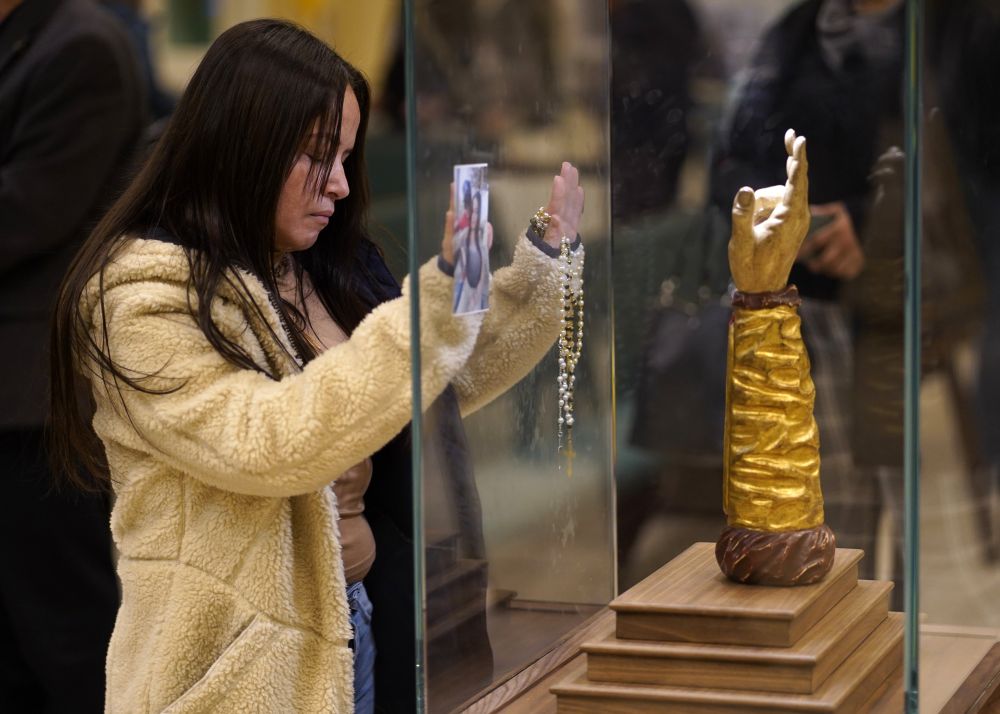
A woman prays in front of a glass-encased reliquary containing a bone from the arm of St. Jude the Apostle at St. Jude Church in Mastic Beach, N.Y., Nov. 27, 2023. (OSV News/Gregory A. Shemitz)

by Emma Cieslik
Join the Conversation
Send your thoughts to Letters to the Editor. Learn more
Catholicism is strange, argues W. Tyler Allen, but that's far from derogatory.
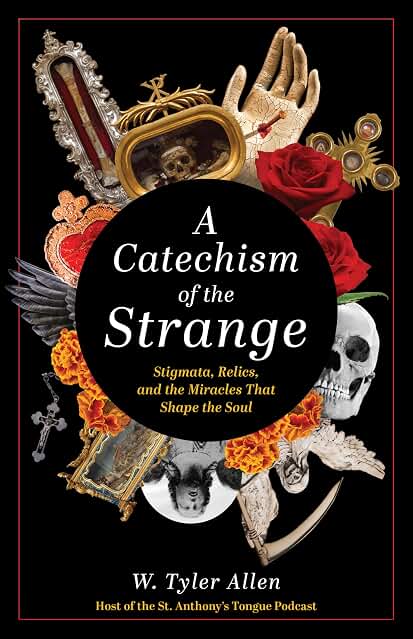
For Allen, "strange" is the only word expansive enough to capture the mystical elements of this faith. With stigmata and relics, and incorrupt saints and bleeding hosts, our faith is grounded in wonder. Amid a growing evangelization of Catholicism, Allen reclaims the unknowable in his new book, A Catechism of the Strange: Stigmata, Relics, and the Miracles That Shape the Soul.
Having been an altar server throughout his childhood, Allen recalls the goosebumps he felt every time he rang the bells during the consecration. He didn't know why he felt them or what they meant — nor the meaning of the Mass itself, really — but this touch of the mystical stayed with him, even when he left the church for a time as a young adult.
"I ended up kind of leaving the faith, losing interest, because no one told me that the goosebumps mattered," Allen told the National Catholic Reporter in an interview.
Years later, the proverbial goosebumps would lead him back. "I came back to the faith through what you could call a mystical experience. It was a series of dreams, in which my departed relatives were feeding me the Eucharist, and I'd wake up just crying," he said.
Unable to ignore the dreams, Allen started praying the rosary and began discovering other Catholic traditions that lit a spark inside him. In 2020, he started a podcast called "Saint Anthony's Tongue" to share the wondrous parts of Catholicism with others.
A Catechism of the Strange, published by Loyola Press, widens his reach and intentionally deepens Catholics' interest and fascination in the "strange." The book's 12 chapters each feature a theological lesson and direct examples from saints and blesseds to illustrate the bigger theological framework of theosis, or communion with God through our bodies.
"These things are not just sideshow attractions," Allen explained. "They're not just cool little things that make Catholicism creepy and fun. They all point back to the soul. The stigmata points to redemptive suffering. The relics point to theosis, and all of them point back to Christ."
In the history of Catholic saints there are experiences of visions, glowing skin, bilocation and more oddities. But people are often hesitant to dig deeper, fearful of being misunderstood and accused, especially as at least one far-right Protestant leader calls for banning Marian processions and other explicitly Catholic traditions. As Karen Park recently wrote for this publication, some far-right Catholics are reducing Catholicism to philosophical discussions in order to pacify Protestant criticism and assimilate Catholicism into mainstream American Christianity.
"Right now, in our society, we are very good with the true [transcendental], which is the mind, the intellect, and many people are afraid to go beyond that," Allen observed. "That's kind of why I feel that in Roman Catholicism, we love the weird stuff, but we don't really talk about it because no one really discusses theological meaning, but it's important because it leads us into wonder. It leads us to get out of our head and into the heart."
Advertisement
"Strange Catholicism is transcendental," Allen wrote in A Catechism. "It invites us into a higher plane of union with the Divine, and in our flattened, overly rational world, we need it now more than ever. In a culture obsessed with explanation, the strange is a doorway back into wonder. It reminds us that not everything holy can be diagrammed or domesticated."
"We do need to have pride in that [strange] part of our culture," Allen said in our interview, "[but] you have to understand what it means beyond just arguing it, beyond defending it."
For Allen, this involves learning the theological meaning and significance behind traditions like hierognosis (recognition of blessed objects), guardian angels and transverberation (pierced heart). His work implores us to see these traditions as living evidence of the Holy Spirit — of God, taking up residence in a human body.
A Catechism of the Strange reminds us of what sets Catholicism apart, and a call to return to our embodied faith.
"He [God] chose a body that sweated," Allen argued, "a body that bled, a body that cried and did all the other things a body can do. In that regard, God, in a way, sanctified the body. A body is important and not just because it's a body, but a body also does things. It feeds the hungry. It consoles the lonely so on and so forth. So we should not shy away from our body, so we should not shy away from our body."
As much as things like relics and incorrupt remains both enchant and disturb Catholics and non-Catholics alike, the tradition has simple roots: the belief that the Holy Spirit can inhabit the human body. Allen contends that when we recognize that our bodies can hold God, it changes our understanding of our faith, our mission and ourselves.
"You may never have the stigmata. You probably don't want the stigmata," Allen said, "but we also know that the stigmata is mirroring Christ's sacrifice. It is mirroring Christ's pain that he felt when he sacrificed Himself for the world, so you can also make sacrifices. You might not bilocate, but you can definitely be somewhere in person for someone, you mirror Christ that way, so really, it's about our hands-on role of our faith."
Amid a growing denial of an embodied faith and evangelization of Catholicism, amid a hesitancy and discomfort claiming and exploring the "stranger" parts of our faith, Allen's Catechism of the Strange reminds that these things do not distract from the Gospel witness — they deepen it.