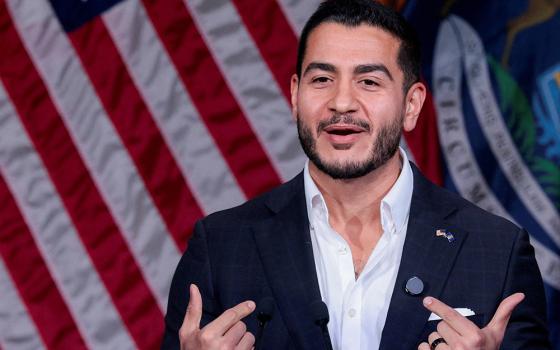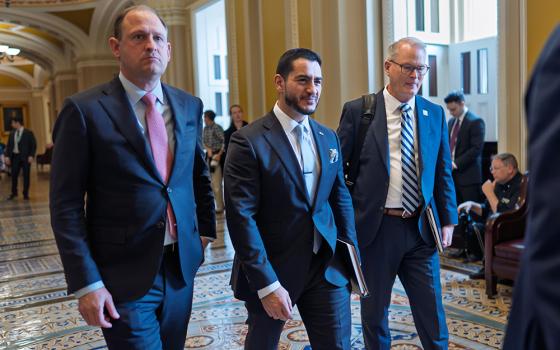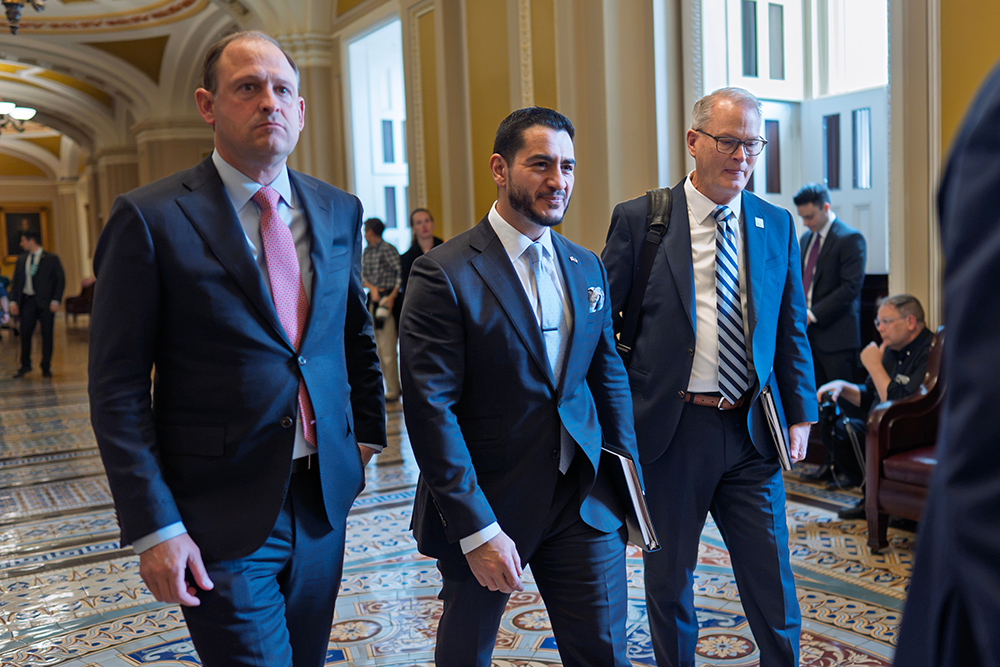
Sen.-elect Abdul El-Sayed, D-Mich., center, is flanked by Sen.-elect Andy Barr, R-Ky., left, and Sen.-elect Adam Hamilton, D-Kan., as newly-elected senators arrive for orientation following the sweeping victory by Democrats in the midterm elections, at the Capitol in Washington Nov. 9, 2026. (AP Photo/J. Scott Applewhite)

Join the Conversation
Send your thoughts to Letters to the Editor. Learn more
If it is true that the Democrats face a variety of challenges now that they will control both houses of Congress, and it is, then the Republican Party faces an even more difficult challenge in the next two years: How do they distance themselves from President Donald Trump while he is still living in the White House?
Trump demonstrated his power with the Republican base during the primaries when almost every candidate he endorsed won the party's nomination. Even in Texas, where everyone knew that incumbent Sen. John Cornyn could win reelection in a walk, Trump's decision to back the deeply flawed Ken Paxton handed the nomination to Paxton. That decision also put the Lone Star senate seat in play and, come November, in the Democratic column.
There is no reason to think that Trump's hold on the base will diminish unless fellow Republicans challenge it. None of the potential successors to the president — not Vice President JD Vance, nor Secretary of State Marco Rubio, nor outgoing Florida Gov. Ron DeSantis — has Trump's ability to connect with alienated parts of the electorate and channel their anger. None of them has his easy manner in front of the cameras. None of them has demonstrated his fundraising prowess. If this becomes a clash of personalities, Trump will quash any challenge to his power over the party like a bug under his foot.
The Republican Party, however, once stood for principles. It was founded in 1854 to combat the extension of slavery. From the end of the Civil War through World War II, the Republican Party became identified with the moneyed interest and laissez-faire economics, with Theodore Roosevelt's unlikely presidency offering a short-lived reformist deviation from the rule. In the 1920s, isolationism entered the GOP's creed. After World War II, Dwight Eisenhower led the party to accept the social programs of the New Deal and to shed its isolationism. Ronald Reagan brought the party to laissez-faire economics while deploring libertarianism in the culture.
Advertisement
In the past 45 years, both here and throughout the Western democracies, the neo-liberal economics installed as government policy by Reagan and Margaret Thatcher hollowed out the middle class and decimated the working class, creating an authoritarian, nationalistic and nasty backlash that Trump rode to power. Similar discontent swept Viktor Orban into power in Hungary, led the United Kingdom to leave the European Union, and prospered the political careers of Giorgia Meloni in Italy, Marine Le Pen in France and Ulrich Siegmund in Saxony-Anhalt. Orban lost power earlier this year and the UK is regretting Brexit, but Le Pen is leading the polls for the presidency of France, Meloni is very popular and it is far from clear that the mainstream political parties can stop the ascent of the AfD in Germany.
Trumpism is less of an ideology than it is a mood. Jason Blakely, in his book Lost in Ideology: Interpreting Modern Political Life, which I reviewed here and here, explained that ideologies are porous, and they blend into each other. Can the Republicans pull together a reasonably coherent identity from their principled past?
In foreign affairs, there are only two choices: isolationism or engagement. Vance will champion the former and Rubio the latter. I fear that an "American First" isolationism might have greater currency with the Republican primary electorate.
On domestic policy, it was a bit surprising to see Republican Sen. Ron Johnson criticize the Trump administration for corruption. He is not wrong on the merits, and an anti-corruption message found its way into almost all Democratic messaging this year. Still, poking Trump on something that is personal, not just a policy difference, risks a large, and vicious, pushback.
The other theme of almost all Democratic messaging this year, progressive and centrist alike, was a populist, anti-billionaire theme. It will be interesting to see if any Republicans pull a Teddy Roosevelt and support limiting the power of the oligarchs through higher taxes and anti-trust actions. The most consistent theme of the Republicans since Reagan has been opposition to taxes, but as the need to save Social Security becomes clamant, look for Republicans in states with large numbers of retirees, especially Florida, to get on board.
The biggest challenge for the post-Trump GOP will be finding a candidate who connects with working-class voters as he did. Trump channeled their anger and anxieties, but ignored the need for policies that help blue-collar workers. Even his tariffs were driven by pique, not principle. The Republican Party needs to figure out how to hold on to working-class voters if it is to have any hope of regaining a working majority.
The Democrats have their work cut out for them, to be sure. But the Republicans have the unenviable task of crafting a post-Trump vision while Trump himself is still around.
Editor's note: You are reading a selection from Michael Sean Winters' weekly newsletter. To get the full edition — including the "In the News" link roundup — delivered 24 hours before it appears online, sign up here!