

Russ Choma is an investigative reporter in the Washington, D.C., bureau of Mother Jones magazine. He covers climate, money-in-politics and influence. He was previously a reporter at Open Secrets, the nonpartisan money-in-politics tracking website. Russ started his career as a newspaper reporter in New Hampshire.

NGC 602, a young star cluster in the Small Magellanic Cloud in an image from NASA's James Webb Space Telescope (Flickr/ESA/Webb)

by Mary M. McGlone
Join the Conversation
Send your thoughts to Letters to the Editor. Learn more
Don't you love the pictures we're getting from the James Webb telescope? We might consider them pinhole glimpses of God's view of the universe. Then, when we see how miniscule Earth appears in the grand scheme of things, God's love for this little world of ours is beyond comprehension.
Two citations from John invite us into the paradoxical mystery of God and our world. In John 3:16, we hear, "God so loved the world." And in John 18:36, Jesus says that his kingdom is not of this world. Is this a contradiction?
Philosophers of the New Testament era believed that the world was organized around polemos, which basically refers to power plays. When we look around, it seems that they were right. Kingdoms, nations, classes, teams and even siblings too often base their identity on winning in contests or conflicts.
That's the world Jesus was talking about when he responded to Pilate about his kingdom. In the world of polemos, Jesus would not have gone down without a fight. But domination was not his way. Never!
What, then, are we celebrating when we call Jesus "the king of the universe"?
To start with, we can consult Daniel, a prophet whose message many see as referring to Jesus. In today's first reading, Daniel sees one like a "Son of man" (a genuine human being) appearing before God to receive "dominion, glory, and kingship." What do those look like in a kingdom not of this world?
How did Jesus demonstrate dominion? We get a glimpse of his dominion through the signs/miracles that he performed. The Gospel of Mark tells us that after winning a battle of wits with the tempter in the desert, Jesus' first public act was to heal a man with an unclean spirit (Mark 1:21-28). Every "sign" that Jesus performed followed that pattern. He faced the demons afflicting his people and expelled them, attributing every miracle to the faith of the recipients.
We might say that when Jesus exercised dominion over evil, it was generally by awakening people's faith. His dominion was invitational — he couldn't help anyone who didn't want to be helped.
What about Jesus' glory? In John's Gospel, Jesus' glory reflects the greatness of God. Jesus insists that his is the glory of the one who sent him. Yet, his glory is obvious only to those who believe in him (John 1:12, 14; 8:50).
If we asked John about how he saw Jesus as king, he would say, "Read my Gospel." In his opening chapter, when Nathaniel called him the King of the Jews, Jesus replied that he had seen nothing yet — much bigger revelations were in store (John 1:49-51).
Later, when people wanted to make him king, Jesus fled from them because their hope centered on their stomachs, not their hearts (John 6).
Advertisement
According to John, Jesus' definitive revelation of his unworldly kingship happened in the events of his passion and resurrection. Jesus the King rode into Jerusalem on a donkey, not on a ruler's horse. When Pilate asked him if he were the king of the Jews, Jesus' answer was consistent with all he had said and done: "I am a king in a way you may never understand."
Our selection from Hebrews sums up Jesus' kingship with the opening line: "Jesus Christ is the faithful witness." Jesus, the son of man, offers incredulous human beings a faithful reflection of God's own power; he presents an image that is most certainly not of this polemical world.
Jesus said, "If my kingdom did belong to this world, my servants would be fighting for me." This leaves us with the question, "What are we, his servants, supposed to do instead of playing by the rules of this world?"
If we want to participate in Christ's unworldly kingdom, we need but follow the leader. Christ is the genuine human being, the son of humanity, because he is the image of his all-loving creator. He leads by attraction, never by imposition. Faith and love are the sole reasons for seeking to participate in his reign.
In his reigning among us, Christ offers a share of his glory, a glory that we can begin to comprehend and experience only in faith. It is unintelligible to those who choose to remain outside.
Christ the King invites us, not into an otherworldly experience, but into a transforming alternative to the world of polemics. Today's feast poses one demanding question to us: "Do we want to bet our lives on the kingdom of God?" It's an all or nothing choice.
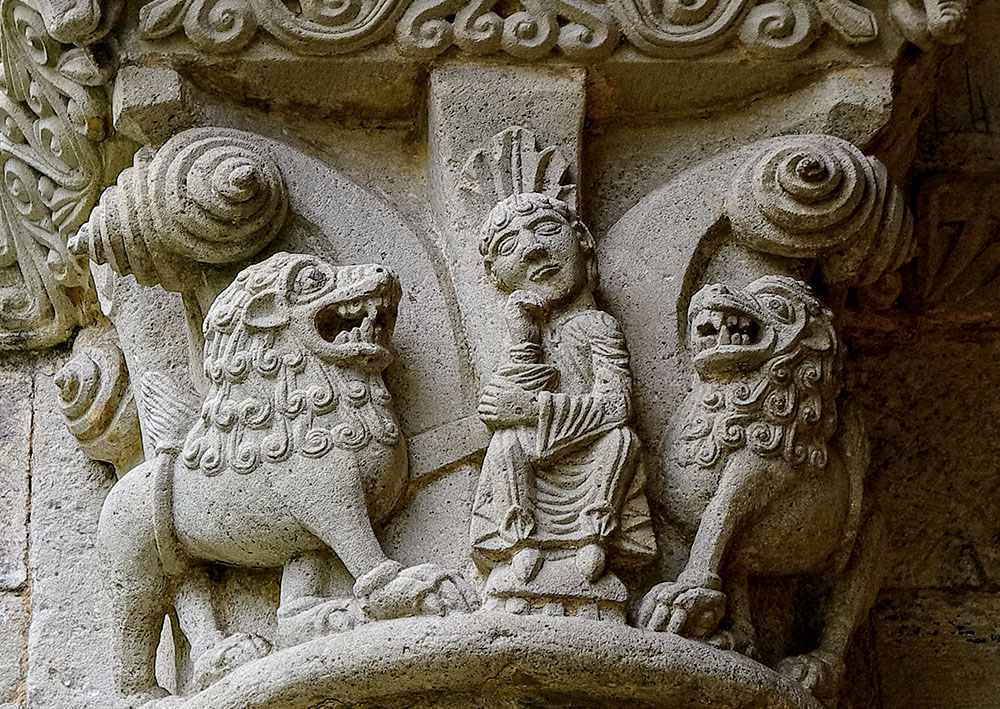
Daniel in the lion's den, depicted in stone at Sauve Majeure Abbey in La Sauve, Gironde, France (JLPC/Wikimedia Commons/CC BY-SA 3.0)
by Mary M. McGlone
Join the Conversation
Send your thoughts to Letters to the Editor. Learn more
When I was about 3 or 4 years old, there came a terrific storm of thunder and lightning that made the windows and doors shake. I was terrified. To comfort me, my mother put me on her lap with her arms around me so we could watch the storm together.
Lightning would strike and she would exclaim, "Ooh aah!" just as if we were watching fireworks. Then she would hug me very tight and say, "Listen! It's going to come now!" And the thunder would bellow and roll.
She not only cured me of my fear, but, for the rest of my life, thunder and lightning would stir up feelings of joy, excitement, love and safety.
Daniel, the very one whom God protected while he spent the night in the lair of some hungry lions (Daniel 6), predicted the coming of "a time unsurpassed in distress since the nations began." After slumbering with the beasts, what more could ever worry him?
When we read the whole passage, we see that Daniel's message was not about horror and destruction, but consolation: "Your people shall escape ... many of those who [have died] shall awake ... the wise shall shine brightly ... [the just] shall be like the stars forever."
Daniel's encounter with the lions was actually a foretaste of universal history. In spite of those who preach gloom and damnation, apocalyptic literature agrees with Julian of Norwich, "All shall be well, and all manner of things shall be well."
In today's Gospel, we hear Jesus preach just before entering into the events of his passion. He had already warned his followers that he was going to be captured and killed. When that finally happened, the sun did go dark and even Jesus cried out to God by whom he felt abandoned. With his resurrection, God proclaimed the definitive apocalyptic message: God's love and faithfulness are invincible, no matter what.
We cannot deny that, in this Gospel, Jesus seems to be promising a quick end to the world. "This generation will not pass away." Was he just simply wrong? Or might it be that the "things" he mentioned had begun to take place with his life and death, and especially his resurrection?
The Letter to the Hebrews says that after Christ, there is no more need for sacrifice. What does that have to do with what Jesus proclaimed?
Hebrews' author states that, "By one offering, he has made perfect forever those who are being consecrated." Jesus proclaimed that God's future was and is now in process. It is happening among those who "are being consecrated." They are part of the world God is constantly drawing toward union with one another and the triune God.
Today's responsorial psalm sings the same message of God's nearness, "You are my inheritance, O Lord ... my heart is glad, and my soul rejoices ... because you will not abandon me."
Advertisement
Jesus says, "Learn a lesson from the fig tree." Pope Francis improvised on that in a meditation titled "Times Change." His opening line is: "Times change and we Christians must constantly change." He went on to call Christians to learn to understand the signs of our times, that is to pay close attention to what is happening in our world and to seek God's saving presence in it.
To do that, he said, "Silence is necessary ... [we need] to observe ... and afterwards to think," by which he meant to question. He suggested that we wonder, "Why are there so many wars now?"
He added, "Times change and we Christians must continually change. We must change, steadfast in the faith in Jesus Christ ... our approach must constantly move according to the signs of the times."
Today's readings could hardly be more appropriate for us as we live through this change of era. Theologian Franciscan Sr. Ilia Delio describes our time saying, "The feeling of a destabilized world is creating global depression and anxiety."
In this world in which the media keeps death and disaster constantly in front of us, we Christians have an apocalyptic vocation. Faith leaves us no room to moan or spread fear about what is happening, but to cultivate attitudes and behavior that proclaim, "God does not abandon us."
In order to do that in a credible way, we need to listen deeply to Jesus' promise that when things seem to be falling apart and the very forces of nature seem to wreak death, God is near, the reign of God is truly among us.
Christ invites us to read our frightening moment of history as a promise that God is here, ready to transform fear into joy.
<div style="text-align: center;"><div style="margin-bottom: 10px; padding-bottom: 10px; border-bottom: 1px dotted #ccc;" class="full_width_image"><img style="width: 624px; max-width: 100%;" src="https://www.ncronline.org/files/styles/email_newsletter_full_width/publ… style="color: #04619d; text-decoration: none;" href="

<h2><a style="color: #04619d; text-decoration: none;" href="https://www.ncronline.org/opinion/ncr-voices/problems-and-potential-syn… problems and potential of synodality</a></h2><div style="font-weight: bold; font-size: 15px; font-family: Arial, sans-serif;" class="byline">by Michael Sean Winters</div><div style="font-size: 19px; font-family: 'Georgia', serif;"><p>I always warn people to
<div style="text-align: center;"><div style="max-width: 400px; margin: 0 auto;"><a href="https://www.ncronline.org/vatican/francis-comic-strip/francis-comic-str… style="max-width: 100%;" src="https://www.ncronline.org/files/style

<div style="text-align: center;"><div style="margin-bottom: 10px; padding-bottom: 10px; border-bottom: 1px dotted #ccc;" class="full_width_image"><img style="width: 624px; max-width: 100%;" src="https://www.ncronline.org/files/styles/email_newsletter_full_width/publ… style="color: #04619d; text-decoration: none;" href=

<div style="margin-bottom: 10px; padding-bottom: 10px; border-bottom: 1px dotted #ccc;" class="full_width_image"><img style="width: 624px; max-width: 100%;" src="https://www.ncronline.org/files/styles/email_newsletter_full_width/publ… style="font-size: 19px; font-family: 'Georgia', serif;">
