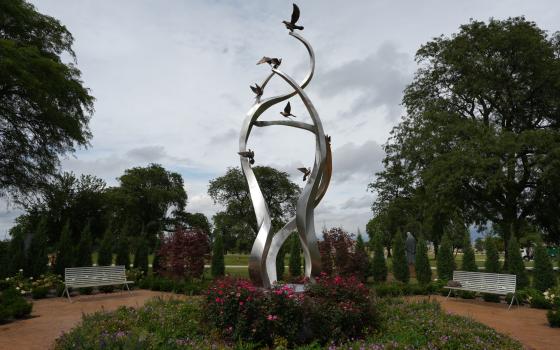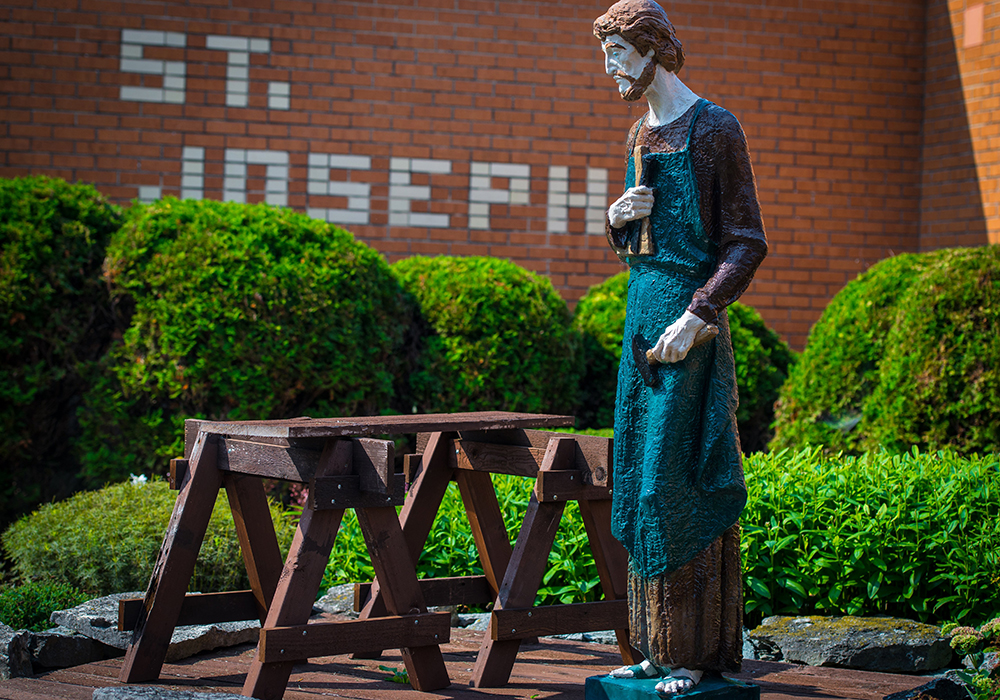
A statue of St. Joseph the Worker stands outside of St. Joseph Church in Oneida, Wisconsin. The feast day of St. Joseph the Worker, the foster father of Jesus and a carpenter, is May 1. (OSV News/Sam Lucero)

by Scott Hurd
Join the Conversation
Send your thoughts to Letters to the Editor. Learn more
May 1's memorial of St. Joseph the Worker is meant to celebrate labor and highlight the importance of work to human flourishing. In a world contending with AI disruptions, however, St. Joseph the Worker might also symbolize those facing the loss of work by forces beyond their control.
Scripture describes Joseph as a "carpenter" — an occupation he may have adopted because he, or an ancestor, had lost ancestral farming lands due to extreme taxation.
In Joseph's day, Roman authorities had imposed a tax as high as 28-40% on farmers. When they were unable to pay, their lands were confiscated, forcing them to find new ways to provide for themselves and their families. (These first-century economic details come from the National Geographic book Jesus: A Chronicle of His Life and the Origins of Christianity.)
Some became laborers, helping reconstruct the city of Sepphoris just north of Nazareth, where Joseph lived. As a "carpenter," it's possible that Joseph worked here, and perhaps Jesus as well. It is unlikely that Joseph had the "carpenter's shop" which popular devotion has imagined — especially in a region of olive trees, whose wood is notoriously difficult to work with.
Other displaced farmers turned to fishing, either from the shores of the Sea of Galilee or by pooling their resources to hire a boat. This resulted in overfishing, and possibly explains why the Gospels twice describe Jesus' apostles — some of whom were experienced fishermen — working all night without catching anything.
This massive disruption of work fueled outrage at the occupying Roman authorities and the tax collectors who represented them. And it led to widespread hunger amongst the workers themselves, crowds of whom followed Jesus into the wilderness for days, and which Scripture describes as having "nothing to eat."

(Unsplash/Kate Sade)
Today's workers fear losing their livelihoods, not from overtaxation, but by artificial intelligence. And not without reason. Some purveyors of these tools prophesy a future in which AI replaces huge swaths of human work. Dario Amodei, the CEO of the Claude chatbot's parent company, predicted that AI could wipe out half of all entry-level white-collar jobs within five years.
Amodei's former boss, Sam Altman, went even further. This chief executive of the company behind ChatGPT said, "Shame on me if OpenAI isn't the first big company run by an AI CEO" And his prediction as to when some division of OpenAI is run mostly by AIs? "Some small single digit number of years."
Meanwhile, as we race toward this dystopian future of mass unemployment, AI tools are ironically being heavily hyped as a boon to workers that enhance efficiency and productivity while eliminating monotonous tasks to free up time for more creative activities. The reality, however, is frequently turning out to be quite different.
A recent UC Berkeley study found that AI use actually intensified workloads. Initial adoption of AI tools, researchers discovered, can translate into "workload creep" by which employees take on more than they can handle, resulting in burnout and sloppy work. "You don't work less," one sufferer complained. "You just work the same amount or even more."
Another study, published in Harvard Business Review, noted heavy AI adopters experiencing "AI brain fry" — a buzzy mental fog that leads to headaches, workplace errors, "decision fatigue," and thoughts of quitting. "I was working harder to manage the tools than to actually solve the problem," admitted one senior manager.
Advertisement
In the midst of all this, a majority of CEOs fear losing their jobs if they don't deliver measurable AI gains for boards and investors in a climate in which 95% of attempts to incorporate AI into business fail. This pressure gets passed down to middle managers who, fearing for their own jobs, often fib about how well AI adoption is going.
Some employers even use AI adoption as a pretext to eliminate jobs, while the workers who remain feel the strain of taking up the slack, wondering if their positions are the next on the chopping block, and experiencing immense psychological stress that some researchers have dubbed Artificial Intelligence Replacement Dysfunction, or AIRD.
It would appear that rushing headlong into AI adoption from fear of being left behind or losing one's job, or by being suckered by the hype, isn't exactly a winning strategy. Quite the opposite, in fact. And this failure, I suggest, offers Catholic leaders and Catholic organizations an opportunity to show the world a better way forward.
For instance, they can demonstrate that AI should be adopted with care, not reckless abandon. As Antiqua et Nova, the Vatican's doctrinal note on AI insists, AI applications "must all be evaluated to ensure they respect human dignity and promote the common good." Because decisions that promote needless fear and threaten mass unemployment are neither dignified nor good.
(Unsplash/Jeriden Villegas)
Before AI became widespread, Google sponsored a major study that identified "psychological safety" as the principal characteristic of high-functioning teams. Catholic leaders can promote such safety in this age of technological disruption, and reap the benefits. "Remember that you are leading people, not technology," says Santa Clara University ethicist Ann Skeet.
Fostering psychological safety can include honoring the principle that people should not be forced "to adapt to the speed and demands of machines", as Antiqua et Nova cautions. Instead, what can be adopted are machines "designed to support those who work."
Catholics can also advocate for "(p)olicies and regulations" to "ensure protections for workers," as the U.S. bishops appealed to Congress. With similar concern, Pope Leo described AI as launching a new "industrial revolution." The last industrial revolution led to widespread misery for unprotected laborers. This time can be different — but only if we learn the lessons of history.
The last industrial revolution led to widespread misery for unprotected laborers. This time can be different — but only if we learn the lessons of history
Finally, Catholics can pray that, as we enter this new epoch of AI, human work itself isn't a casualty, and people's lives aren't needlessly disrupted by forces beyond their control, as St. Joseph and his world experienced. Some jobs may change; that's inevitable when new technologies are introduced. But the fundamental need for work remains the same.
"The goal should not be that technological progress increasingly replaces human work, for this would be detrimental to humanity," stressed Pope Francis in Laudato Si'. Instead, "Work is a necessity, part of the meaning of life on this earth, a path to growth, human development and personal fulfilment."
That's a truth to celebrate on this memorial of St. Joseph the Worker. And it's a truth we need to defend. St. Joseph the Worker, pray for us!