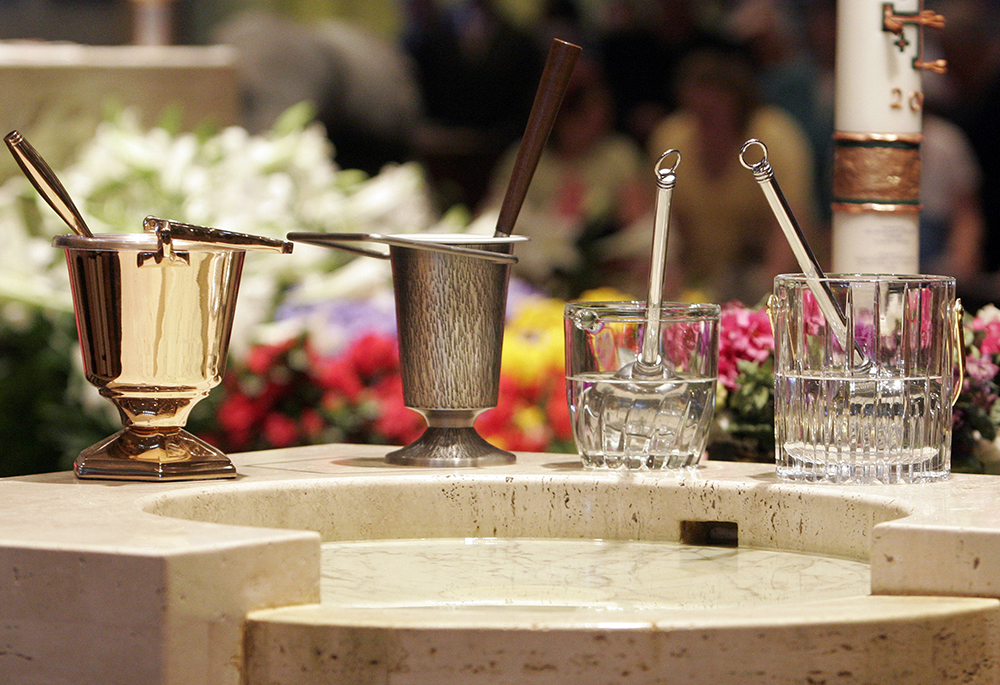
Aspersoriums with aspergillums used for sprinkling holy water are seen near a baptismal font during Easter Mass at a church in New York, in this file photo. (OSV News/Gregory A. Shemitz)

by Stephanie J. Peddicord
Join the Conversation
Send your thoughts to Letters to the Editor. Learn more
I traveled recently to visit extended family and, like many across the country, found myself as a visitor in the local Catholic Church. After two decades of marriage, my in-laws' suburban parish has come to feel familiar; I know the music, the flow of the Communion line, and the volume of incense to expect.
I've also come to anticipate the pastor's homiletics, which — generally speaking — skew more conservative than my personal preference. I wasn't surprised when he opened his remarks to share stories of the converted who had come to receive the sacraments at the previous night's Easter Vigil – more than 40 individuals in all, from all walks of life.
The pastor focused on a young man raised in a home with no faith. When asked how and why he had sought out the Catholic Church, he responded: "I changed my algorithm." He had replaced mindless scrolling with searches about religion, then Christianity, and finally Catholicism.
The people in the pews around me exchanged enthusiastic nods. I wanted to join them, but I felt my skeptical brow furrow.
This young man is part of a significant upward trend. According to The New York Times, several dioceses experienced higher numbers of Easter sacraments than they've seen in years. The Pillar reported that the Archdiocese of Newark, New Jersey, experienced the largest bump, with Philadelphia and others not far behind.
For those of us in ministry, these stories of Easter renewal come on the heels of years of "Good Friday" data. Since the early 2000s, our Catholic story has been one of anemia — a persistent bleed in Catholic affiliation and practice, particularly among young people. This year's sacramental surge, however, follows what Pew Research Center has reported as "a period of relative stability" of American religious life.
My organization, Goodfaith, has spent years immersed in this data. So why wasn't I celebrating this young man's conversion alongside my fellow Mass attendees?
Advertisement
There was something about that line — "I changed my algorithm" — that triggered my "Spidey sense."
I am raising two teenagers in what can best be described as a really strange time. In the wake of "The Anxious Generation" and a mountain of other literature, I am hypervigilant about social media. Yet, even with their restricted access, I am shocked by the things that reach them. Innocuous searches often lead down troubling rabbit holes — everything from AI-generated misinformation to inappropriate content.
I am particularly concerned about my 12-year-old son. Last year's limited series "Adolescence" and recent documentaries on the "manosphere" offer insight into a growing set of online subcultures geared toward young men. These "red pill" influencers have massive online followings; many are known for espousing "traditional" values while spewing hate speech against women, immigrants, LGBTQ+ individuals and religious minorities. Online extremism has mainstreamed content that was, until recently, considered fringe. But in the algorithmic economy, their outrageous commentary translates into likes and clicks.

(Unsplash/Jonas Leupe)
Disturbingly, the secular manosphere has spawned a Catholic version, fueled in part by the assassination of Charlie Kirk in September 2025. As Vox discusses here, Kirk's death stoked the flames of online personalities like Nick Fuentes, who once said he would join Antifa if they waved the banner of "Catholic fascism now." This is complemented by an equally viral trad wife movement, whose adherents extol the patriarchal values of "traditionalist Catholicism."
The problem is that these movements, as Steven P. Millies wrote, all look "very Catholic to the unschooled eye, even if many influencers offer a version of Catholicism unfamiliar to the Church." Further exacerbating this is the fact that Kirk, despite his documented hateful rhetoric, continues to be lauded by many Catholics in authority, including Cardinal Timothy Dolan and Vice President J.D. Vance.
All of these personalities and ideas have been conflated in the public sphere — making it difficult for average Catholics and "seekers" to discern what (or whom) is legitimate. The fact that these ideologies are often entirely incongruent with actual Catholic teaching seems unimportant to both the influencers and the followers.
Amid all of the celebration about our new converts this Easter season, I can't help but question how many are caught up in this manosphere matrix. As disciples, it is our universal mission to build up the kingdom of God, but is our singular goal "conversion?" If the pews are full, but the communicants themselves are espousing values antithetical to Catholic teaching, have we actually succeeded?
As disciples, it is our universal mission to build up the kingdom of God, but is our singular goal "conversion"? If the pews are full, but the communicants themselves are espousing values antithetical to Catholic teaching, have we actually succeeded?
As a church, this requires a higher-level discernment about our evangelical aims, especially at this fragile moment in American and world history. It begs serious questions about our moral responsibility in advancing a vision for the common good aligned with the Gospel, not with talking heads or social media demagogues.
Which leads me back to this young man and his algorithm. I don't personally know this new brother in Christ, and I've projected a lot on his conversion experience that may or may not be true.
So, in honor of the season of the Resurrection, I pray instead that his internet searches brought him to the Sermon on the Mount and the lives of the saints. I imagine he read Dilexi Te and was inspired by Pope Leo's bold and unapologetic defense of the poor, immigrants and refugees or his anti-war statements. I dream that he fell in love with Catholic social tradition and now has a faith-filled heart yearning for justice.
Or, maybe he — like so many Gen Zs — was just seeking meaning, purpose, and community and found it in our pews. And, that would be truly something to celebrate.