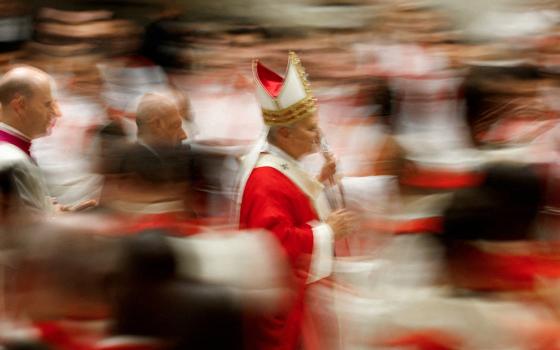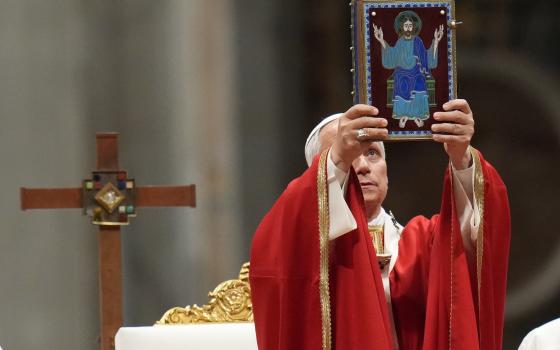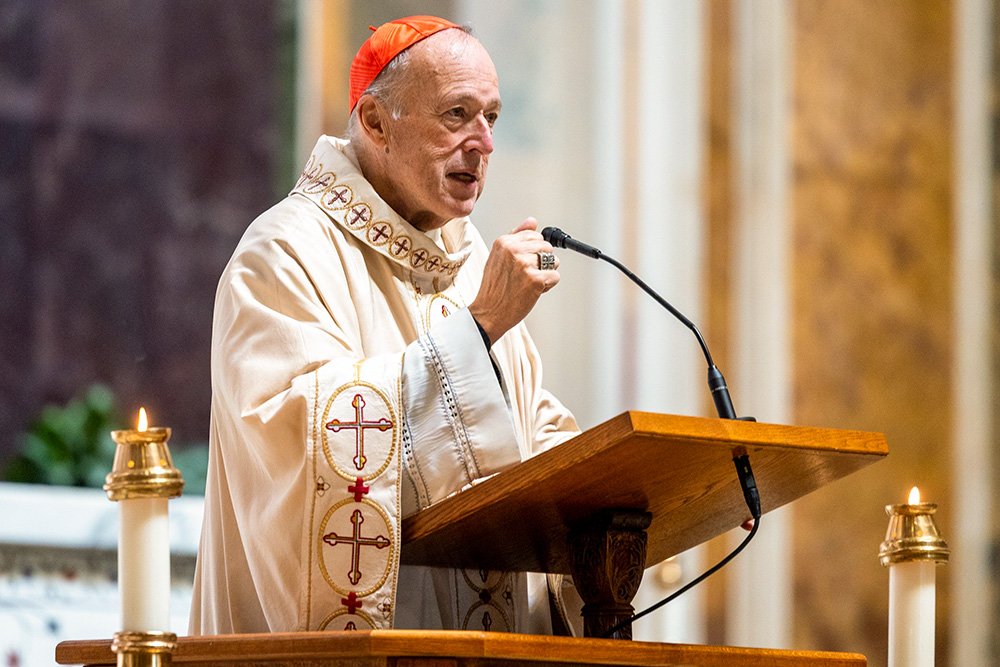
Washington Cardinal Robert McElroy gives his homily at a Labor Day Mass on Sept. 6, 2026, at the Cathedral of St. Matthew the Apostle in Washington. (OSV News/Catholic Standard/Mihoko Owada)

Join the Conversation
Send your thoughts to Letters to the Editor. Learn more
Cardinal Robert McElroy gave an important talk this afternoon (Sept. 26) about Pope Leo XIV's encyclical Magnifica Humanitas for the 52nd Thomas Verner Moore Lecture at St. Anselm's Abbey in Washington, D.C. All bishops should be promoting this encyclical. Not only is it timely given all the scary headlines about AI, the pope's encyclical provides the moral language and logic to have the discussions we need to be having as a society about this new technology.
McElroy, archbishop of Washington, D.C., opened with a story that could get him excommunicated.
"At the end of the conclave that elected Pope Leo, in keeping with tradition, all of the cardinal-electors greeted the new Pope individually, offered their promises of obedience and support and then conveyed a more personal greeting," the cardinal shared with the audience. "As I did so, I said to Pope Leo 'You picked a great name.' " Of course, they were still in conclave and participants are bound to secrecy. I suspect Pope Leo will not bring down the hammer on this innocuous story.
The cardinal used that story to draw parallels between the late 19th-century period of rapid industrialization and Pope Leo XIII's seminal encyclical Rerum Novarum and our own time of rapid technological changes, especially AI. Rerum Novarum was "a mandate to every succeeding age in the church to examine the 'new things' emerging in society, politics, culture and economic realities to place them also under examination in the light of the Gospel and Catholic tradition," a mandate that now falls to us.
McElroy recaps some of the highlights of the encyclical and offers a concise summary of the challenges posed by AI: "Technological change with universal reach. A transformation of the collective imagination. Tremendous acceleration of the access to knowledge. Raw power placed in the hands of a few entities effectively beyond the reach of government. The question of how privacy can survive in such a digital world."
"These are the piercing ethical questions that we must face in the age in which we live. And they are rooted in the most profound anthropological issues regarding what it means to be human," McElroy said, according to prepared remarks. "These questions can only be answered in a wide-ranging dialogue at this critical moment in the development of Artificial Intelligence. And the Church seeks to be a vital part of that dialogue so that the benefits of the digital age will be sustained and enhanced and the dangers minimized." He goes on to highlight the key principles of Catholic social doctrine that Leo articulated and how they can help shape this dialogue in fruitful ways.
In his discussion of the encyclical's fifth chapter, McElroy asserted: "Pope Leo says, the just war theory, which has been manipulated by so many national leaders to justify recourse to war, can no longer function effectively as a moral guide on the recourse to war." That is not exactly what the pope said, at least not in the encyclical. The pope said just war theory is "outdated." If something is outdated, it may just need an update, not to be tossed overboard. The cardinals discussed these issues with the pope at the consistory in June and perhaps McElroy has discussed it with the pope since. I am sure he knows more than the rest of us about the pope's thoughts. So far as the public record goes, there remains a certain ambivalence on the issue.
Advertisement
The most important part of McElroy's talk came at the end where he called for "a social contract for the digital age." He noted that "the key decisions that will determine the outcome to these questions are being made by the researchers who have created these technologies and the companies that own them" and that, however well intentioned, these same people "frequently suffer from the blinders of the technocratic paradigm which assumes all problems created by science and innovation can be fixed by science and innovation."
Instead, McElroy said, a far wider group of people must be involved in shaping the contours of AI and retrieved the idea of a social contract from Jean-Jacques Rousseau, who "saw the concept of the social contract as a reflection on the need to root the governance of society in the general will of the people as a whole." Rousseau was challenging the divine right of kings, but in our time, the church is challenging the awesome power of the technocrats.
And, then, McElroy shows why he is the intellectual leader of the U.S. hierarchy, and shares a quote he unearthed from Immanuel Kant:
I myself am a researcher by inclination. I feel the entire thirst for cognition and the eager restlessness to proceed further in it, as well as the satisfaction of every acquisition. There was a time when I believed this alone could constitute the honor of humankind, and I despised the rabble who knows nothing. Rousseau has set me right. The blinding prejudice vanishes, I learn to honor human beings, and I would feel by far less useful than the common laborer if I did not believe that this consideration could impart a value to all others in order to establish the rights of humanity.
Who else would have found such an on point quote?
The bishops have a unique opportunity in promoting Magnifica Humanitas. Unlike Laudato Si' or the church's teachings on economic matters, the debates about AI do not fall into the usual partisan and ideological divides, so it is not polarizing. More importantly, what the church brings to this discussion is unique and important while most others in the debate are incoherent or worse. And the stakes could not be higher.