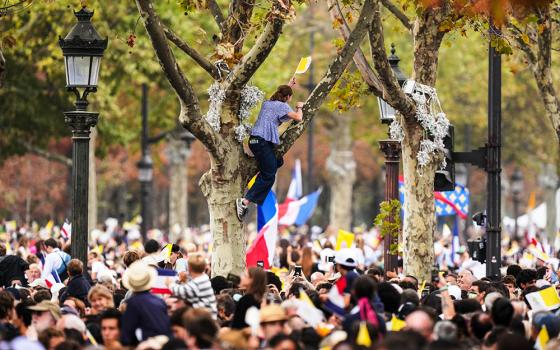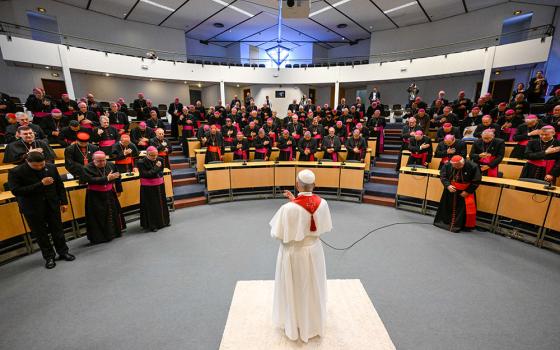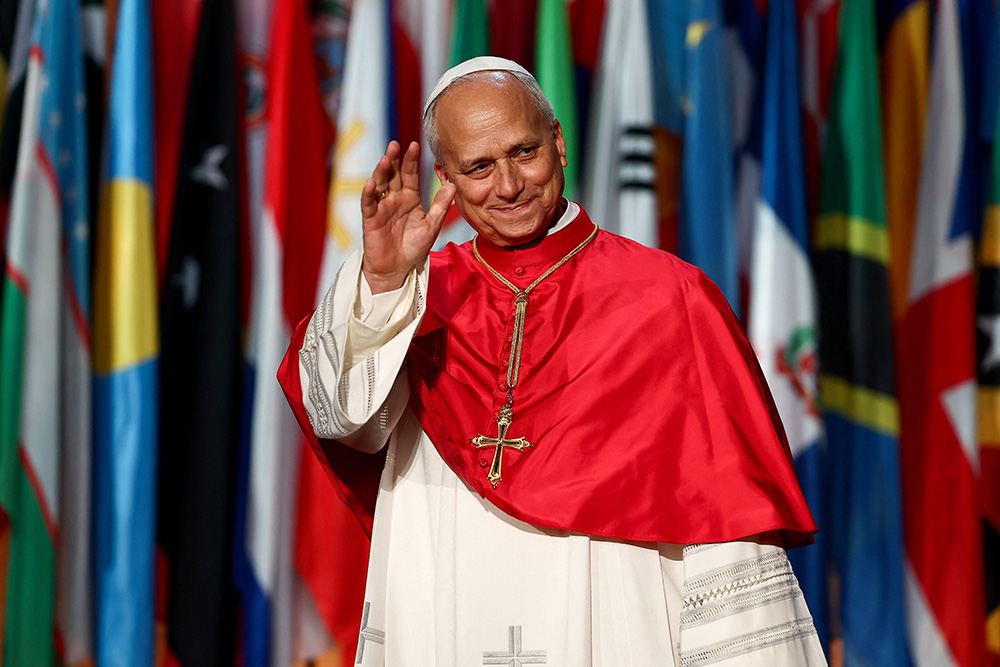
Pope Leo waves as he attends a meeting at the UNESCO headquarters in Paris Sept. 25, 2026, as part of his four-day apostolic journey to France. (OSV News/Reuters/Abdul Saboor)

Join the Conversation
Send your thoughts to Letters to the Editor. Learn more
Just two days after tech leaders themselves called for increased regulation of artificial intelligence at the U.N. Security Council in New York, Pope Leo XIV voiced his own concerns over the unchecked development of AI models from across the Atlantic. Leo, a critic of unchecked AI whose first encyclical was devoted to the topic, said that artificial intelligence must remain at the service of humanity rather than become "yet another instrument of domination and injustice."
Kicking off his four-day visit to France on Friday, Sept. 25, the pope brought his AI agenda to Paris at a time when the global conversation over AI regulation is exploding, with several tech industry executives leading the charge.
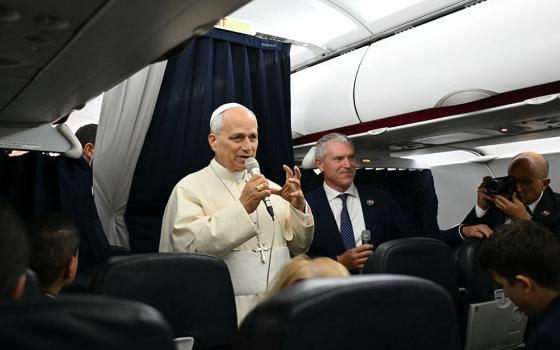
But even before Leo touched down on French territory for the first dedicated visit of a pope to the country since 2008, he was asked on his two-hour flight from Rome about the wave of tech leaders calling to slow down the pace of AI development due to ethical concerns.
The Vatican, he responded, is in dialogue with many tech industry leaders who are "very much open to looking for ways of making sure that AI does not displace or ultimately destroy humanity, but rather be a tool for human beings."
Leo would take up that theme throughout his first day in France, repeatedly celebrating the uniqueness of human life and underscoring its distinction from the machines intended to mimic it.
With the increased range and number of tasks being turned over to machines, "our ideas and relationships risk being impoverished by a process of dehumanization," Leo said at the headquarters of the United Nations' education, science and cultural agency (UNESCO) in Paris while standing in front of Vatican and United Nations flags.
"While 'intelligence' is attributed to computational systems, we struggle to recognize the inalienable dignity of human persons, whose lives are judged according to the criterion of efficiency and, when deemed no longer productive, are rejected and discarded," he continued. "Science itself, when reduced to a technique of power, no longer serves to elevate the human person, but instead risks degrading the fruits of human endeavor."
The pope also stated that AI amplifies the spread of false information, can be an obstacle to dialogue, and is unable to provide the answers to deep questions about the meaning of life.
Advertisement
Leo's visit to UNESCO is the first by a pope since St. John Paul II traveled there in 1980, and the agency has been the most proactive within the U.N. on AI ethics. Just as during his first term in office, however, U.S. President Donald Trump withdrew the United States from the organization last year.
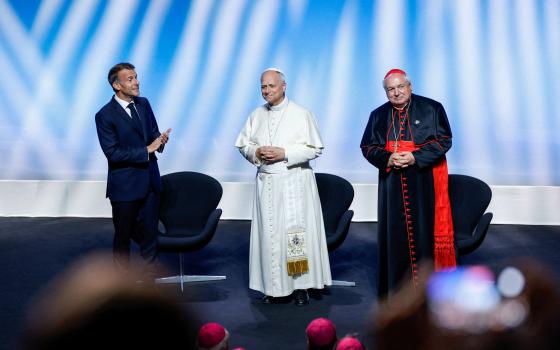
After landing in Paris, the pope was met by French President Emmanuel Macron, who has sought to position France as a leader in AI on the global stage and present Europe as an alternative to the global development of AI apart from the United States and China.
The two met privately for just under an hour at the Élysée Palace, the residence of the French president, for a bilateral meeting in which France's ambassador to the Holy See said AI would be prominently featured.
The pope then addressed French government and church officials, beginning his speech with a nod to his family's French ancestral roots in Normandy and Béarn, prompting a wink from Macron.
Before the prospect of artificial intelligence "invading and conditioning our daily lives," Leo said that "there is an urgent need for education in ethical discernment and the capacity to acknowledge the moral good."
Although the pope calls for regulatory measures around AI in his encyclical, Magnifica Humanitas, he stopped short of explicitly calling for AI regulation in his public speeches on Friday.
But in his speech welcoming the pope to France, Macron said that both France and the Catholic Church have a responsibility regarding AI development "to ensure that the most powerful models do not fall into the hands of those who would make decisions on behalf of all humanity, and that these most exponential advances do not cause us to lose control."
"That is why we must find a way to establish an international organization that reconciles technological progress, justice and humanism," Macron said, comments that stood in stark contrast to the rhetoric of the U.S. government toward artificial intelligence.
While Leo's visit to the U.N. agency was a central component of his France trip, it also coincided with the U.N. General Assembly in New York. Cardinal Pietro Parolin, the Vatican's secretary of state, who typically travels with the pope for international trips, was instead in New York for the assembly.
At the U.N. headquarters in New York on Sept. 22, Trump said that the United States rejects any "globalist scheme" to control artificial intelligence. The president has repeatedly called for less regulation of AI, even referring to it as "super intelligence" in his U.N. address and calling the technology "amazing."
Despite recent instances of rogue AI agents from Google Gemini and OpenAI falsifying credentials and hacking into other companies, Trump's science adviser Michael Kratsios told the U.N. Security Council that the rapid development of artificial intelligence "is not a reason to pause its further development or to constrain it with new global governance structures."
The administration's messaging stands in contrast with the messaging of several industry leaders who are calling for regulation over their industries.
Addressing the U.N. Security Council in New York, OpenaAI founder Sam Altman said that for AI to be democratic, "the most important decisions cannot be made by labs in San Francisco alone. They must be shaped through democratic processes, and by governments accountable to the people that they serve.
"At the international level, this will require cooperation," he said.
Dario Amodei, co-founder of Anthropic, told the council via videolink that "AI could be a risk to humanity as a whole" if models develop at a rate faster than developers are able to control them. He called "for global cooperation across the world between governments to set international standards."
Leo's speech at UNESCO was expected to be his most focused on artificial intelligence during his trip to France, but before returning to Rome on Monday he will make a speech on the roots of Europe and in support of multilateralism in Metz, near the German border. Such a venue could offer a stage for the pope to more explicitly call for a multilateral approach to regulating AI beyond what was written in his encyclical.
The National Catholic Reporter's Rome Bureau is made possible in part by the generosity of Joan and Bob McGrath.