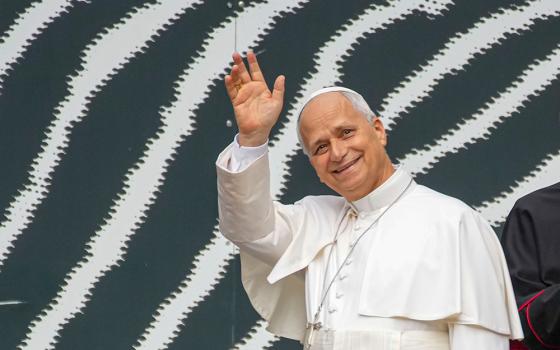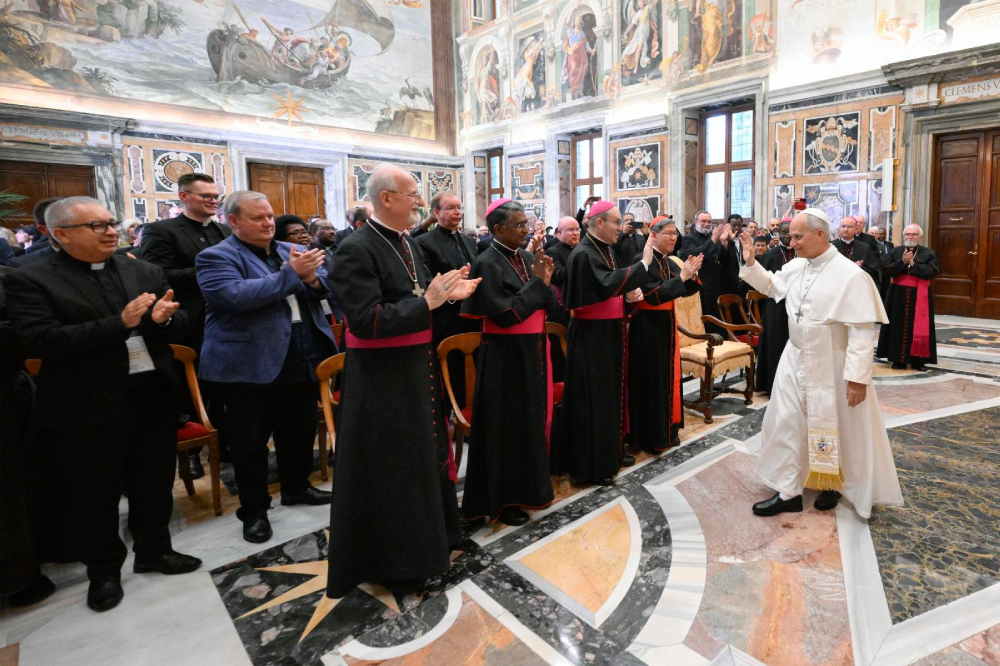
Pope Leo XIV waves after meeting with participants in the general assembly of the Pontifical Mission Societies in Clementine Hall at the Vatican June 1, 2026. (OSV News/Vatican Media/Simone Risoluti)

Join the Conversation
Send your thoughts to Letters to the Editor. Learn more
Much of the discussion about the relationship of the church to the culture is shaped by ideological leanings one way or another. I discussed this recently in a column about the relationship of pastoral theology to moral theology. Even when ideology is not at stake, the church lives in history, even while its foundations and its eschatological future transcend history.
The degree to which the church is shaped by the times in which it finds itself has been brought home vividly to me recently. I have been engaged in some research of the history of my parish church here in Connecticut in anticipation of our 150th anniversary next year. There are two histories of Catholicism in Connecticut: Fr. James H. O'Donnell's 1900 History of the Diocese of Hartford and Msgr. Thomas Duggan's 1930 The Catholic Church in Connecticut.
Both books tell the story of Bishop William Tyler, the first bishop of Hartford, and specifically of his declining health. O'Connell writes: "The Seventh Provincial Council of Baltimore, which convened on May 5, 1849, also saw Bishop Tyler in attendance; but on this occasion he brought with him a certificate from his attending physician that his health was in a precarious condition." Both historians report that the provincial council petitioned the Holy See for a coadjutor bishop to assist the ailing Tyler and recommended Bishop Bernard O'Reilly, vicar general of the diocese of Buffalo, for the post.
What's missing? There was no nuncio or apostolic delegate to the United States at the time. When Baltimore remained the only archdiocese in the country, and provincial councils were held with some regularity, the bishops wrote to the Holy See to request the erection of new dioceses and to recommend candidates for the episcopacy. What is more, as both historians detail, all correspondence with the Holy See was still sent through the Congregation for the Propagation of the Faith because the U.S. was still considered mission territory. It was the Propaganda Fide, not the Consistorial Congregation, forerunner of today's Dicastery for Bishops, that made the final recommendations to the pope.
The Lord Jesus promised he would be with his church until the end of the world. That was not a promise to free us from history.
What is not missing? No bishop was going to be consecrated without receiving a mandate from the pope. Despite the relative independence of the 19th century church in the United States from Vatican oversight, it was inconceivable that they would consecrate a bishop without the pope's consent. The now former Catholics in the SSPX should reflect on that fact a bit.
Duggan continues the tale of Bishop Tyler's declining health. "Although the first Bishop of Hartford had asked for a coadjutor in the spring of 1849, it was not till the autumn of 1850 that the announcement of the appointment was made," he writes. "Pope Pius IX was in exile in Gaeta in the Kingdom of Naples while the [Baltimore] Council was in session, and it took some time for the news of Bishop Tyler's death to reach the Pontiff; so that when the appointment was made, it was not a coadjutor but a successor that was needed. As the election gave Bishop O'Reilly the right of succession he immediately assumed control of the Diocese of Hartford."
The phrase "Pope Pius IX was in exile in Gaeta" jumps off the page! The revolutions that swept Europe in 1848 had not spared Rome and the pope had to flee for his own safety. Thanks be to God, let us hope those days are behind us.
There is something more significant in the timing. In 1849, the delay in transmitting requests for new bishops and the appointments in return were not only hampered by the politics of the day. Telegraphs were quite new and there was as yet no transatlantic cable to transmit them. The fastest way to get a message from the New World to the Old was via steamship, and they typically took at least 10 days to make the ocean crossing. It was not until 1858, when Queen Victoria sent a telegram to President James Buchanan over the first transatlantic cable, that communications between the Catholic Church in the U.S. and the papacy could be quickened. Even then, when Pope Pius X died in 1914 and again when Pope Benedict XV died in 1922, the American cardinals did not arrive in time to join the conclave electing a new pope.
Advertisement
Today, if Pope Leo XIV has a question about the U.S. church, he can consult with his aides in the Vatican, but he can also pick up his cell phone and call an American prelate to ascertain their opinion on any given issue. Emails have replaced letter packets on steamboats. Any Roman official can, with a few clicks on his computer, find much of the information he or she needs about the population or demographics or history of any diocese anywhere in the world. U.S. cardinals fly to Rome regularly to meet with the different dicasteries of which they are members or before which they have important business.
The victory of ultramontanism in the late 19th century, highlighted by the decrees of the First Vatican Council affirming papal primacy, jurisdiction and infallibility, led to a concentration of ecclesial authority in Rome. The appointment of the first apostolic delegate to the U.S. in 1893 increased Roman oversight of the U.S. church. But more than the conciliar decrees and the delegation, the advent of new information technologies and faster travel were critical to the increased authority the Holy See exercises over the universal church.
This concentration of authority may not be permanent. Yes, it is inconceivable that there will be a time when a bishop can be legitimately consecrated without a papal mandate. But just as the manner of recommending bishops changed with the arrival of a nuncio, it could change in the future with different methods of consultation, as foreseen in the synod's Study Group 7 report. Intermediate authorities are desperately needed if the Vatican is not to be overwhelmed and perhaps reviving the powers of the metropolitan archbishops might make sense, or endowing a country's episcopal conference with greater decision-making authority.
The Lord Jesus promised he would be with his church until the end of the world. That was not a promise to free us from history. The church will always have to orient itself to the times in which it lives, for better or worse.