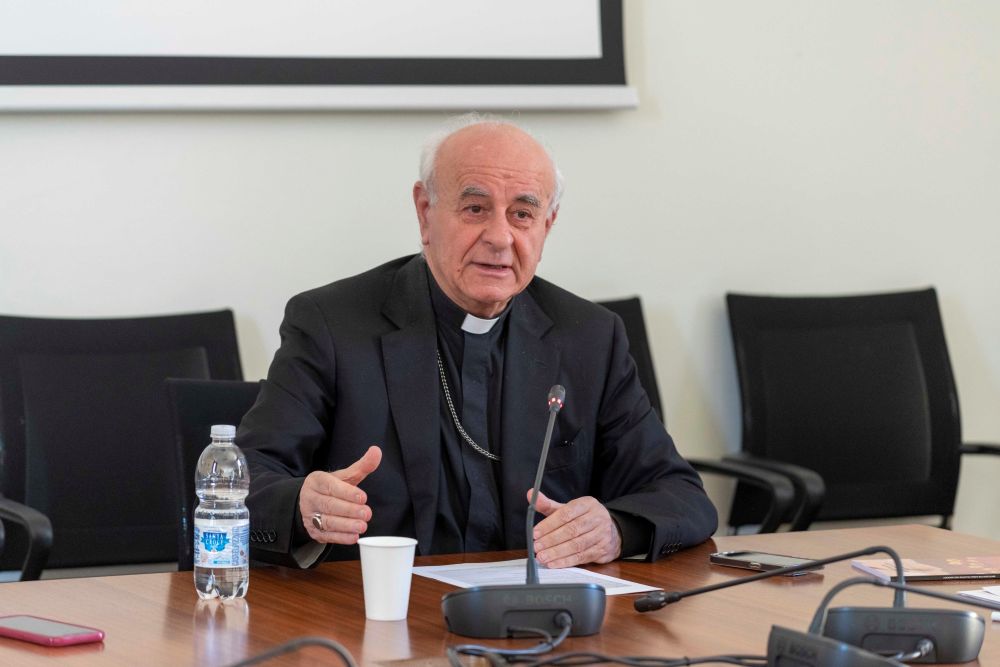
Archbishop Vincenzo Paglia, then president of the Pontifical Academy for Life, speaks to reporters at the academy's office at the Vatican May 14, 2024. He served as president of the Pontifical Academy for Life and grand chancellor of the Pontifical John Paul II Institute for Studies on Marriage and the Family from 2016 to 2025. (CNS/Courtesy of the Pontifical Academy for Life)

Join the Conversation
Send your thoughts to Letters to the Editor. Learn more
An important intellectual struggle among moral theologians, usually conducted behind closed doors or in the pages of journals few read, broke into public view in the past week. The struggle centers on these questions: How does the Catholic Church do moral theology? What is the relationship between foundational moral theology and pastoral theology? What is the role of experience and encounter in shaping our theology? These are the questions at the heart of both the criticisms and the defenses of Pope Francis' magisterium and, now, that of Pope Leo XIV.
The theological kerfuffle began with an interview with Archbishop Vincenzo Paglia at the Italian site SettimanaNews, in which the archbishop explained the reforms he enacted during his tenure at the John Paul II Institute for Studies on Marriage and Family. Paglia criticized his predecessors of performing "armchair theology." This was reported in English at the Catholic World Report. That news story provoked a long tweet by Bishop Robert Barron on X.
Barron characterized Paglia's approach in stark terms. "Instead of absolute moral norms grounded in a keen understanding of the basic goods, he and his colleagues were proposing a moral theory rooted in historical discernment of subjective and cultural experience — not an 'armchair theology' but one operating within history and within people's lives,' " Barron wrote. "This, of course, is the language of trendy postmodernism, and it is dangerous indeed." He added, "What any truly coherent moral program requires is the very thing that Archbishop Paglia and his colleagues were endeavoring to eliminate, namely, absolute moral norms."
Both prelates are engaging in a bad habit of caricaturing their opponent's position, which is not how Christians should debate one another. Paglia was wrong to criticize the John Paul II Institute's work before his tenure as "armchair theology." Two of the most profoundly humane, pastoral theologians I have ever known taught at the John Paul II Institute before Paglia's reforms. Barron was wrong to accuse Paglia of relativism.
Paglia argued that we need to attend to the realities of people's lives, how different moral norms are sometimes experienced as in conflict with one another in people's lived reality, and that attending to how we apply those norms in different cultural contexts is not only pastorally important but, also, sheds new light on the moral truths from which norms are drawn.
This is not relativism in the "trendy postmodernist" sense. It is more akin to the practice of casuistry, only with a feedback loop. Casuistry sought to apply moral norms to real life circumstances, taking account of mitigating factors for example, but it was a one-way street: The priest applied the rule. The experience of application may have given the priest additional wisdom as a pastor, but it did not affect the moral theology textbooks. Pastoral theology in the style of Francis, Paglia and others also applies moral norms to people's lives, but in a pastoral context which is more relational and, critically, then asks how the circumstances of people's lives inform our understanding of the moral norms.
Passionist Fr. Enzo Del Brocco, the president of the Chicago Theological Union, defended Paglia's approach at his Substack. In fact, Del Brocco did a better job explaining Paglia's approach than Paglia did himself.
Del Brocco argues that it is not the moral norms that are relativized by an emphasis on personal encounter, but our own limited perspectives. "Christian theology has often been renewed not in lecture halls but through encounters with people whose suffering exposes the limits of accepted assumptions," he writes.
Noting Paglia's long association with the Sant'Egidio community, with its emphasis on prayer, friendship and service, Del Brocco writes, "This perspective helps explain why Paglia has consistently emphasized history, discernment, and the concrete circumstances in which people live. Such emphasis is sometimes interpreted as a departure from objective moral truth. A more accurate reading is that it reflects a conviction that moral theology must remain attentive to the complexity of human lives if it is to illuminate them." Or, as Pope Francis used to say, "realities are greater than ideas."
Barron invoked the example of slavery to make his indictment. "Is slavery wrong? Intrinsically wrong?" he asks. (emphasis in original) "Wrong no matter what public opinion polls say about it, no matter what the current consensus on it might be? I imagine any decent person would say yes. But that yes is predicated upon precisely what the tradition calls the natural law and the basic goods. There are some values so fundamental that acts repugnant to them are by their very nature wicked."
Advertisement
Del Brocco takes up the same example. "What exposed the injustice of slavery was not simply the discovery of a better argument. It was also the witness of those who encountered its victims and refused to look away," he rightly notes, citing St. Peter Claver, Frederick Douglass, Harriet Tubman and William Wilberforce as people who insisted humanity not look away from the suffering of enslaved people.
N.B. A friend was being interviewed for admission to Harvard. He was asked, "What is the most consequential book published in English? There is one right answer." My friend did not come up with the answer, though he did get into Harvard. The answer: Uncle Tom's Cabin by Harriet Beecher Stowe which, more than any other writing, helped America's conscience confront the evil of slavery in its midst.
For Del Brocco, encounters with the enormity of evil did not replace moral truth. "Encounter exposed blind spots that had become invisible within accepted moral frameworks," he writes. "Reality did not abolish moral principles; it purified our understanding of them."
If Barron would stop caricaturing his opponents' positions, he might recognize a powerful argument for the pastoral efficacy of clear moral norms. In our time, many young people feel overwhelmed by our chaotic culture. As the late Duchess of Kent said in explaining her conversion to Catholicism, "I like to know what's expected of me. I like being told: You shall go to church on Sunday and if you don't, you're in for it!" Many of these young converts, and reverts, are like the duchess, and they look to Catholicism precisely in search of firm moral norms. The church must accompany them also.
Here are my wishes. I wish the Barron camp would admit that we all live in history and that our understanding of moral norms is affected by the times in which we live. I wish the Paglia camp would recognize that in this culture of coercive affirmation, experience can be used to distort our moral tradition, not to apply it. And I wish everyone, including me, get better at putting others Christians' arguments in the best light, not the worst.