(Unsplash/Ben Kelsey)

Join the Conversation
Send your thoughts to Letters to the Editor. Learn more
Having examined the problems with both the progressive and establishment wings of the Democratic Party, today I want to look at two related problems that affect the entire party. First, candidates, and their campaign staff, rise through a network that consists almost exclusively of the like-minded. Second, their views on cultural issues are far to the left of most voters.
The Cook Political Report currently lists only 19 House races as "toss-ups." Another 19 are ranked as leaning toward one party or the other. So, only 38 congressional districts out of 435 have not been gerrymandered sufficiently that they remain competitive between the two parties. In the other 398 districts, the politicians have chosen their voters, rather than the voters choosing their elected officials.
This causes many problems, but one is that neither party has rising political talent with the kind of experience persuading voters that is needed in a national campaign. More worried about a primary challenge, which always tends to come from the extremes, most members of Congress have no incentive to craft an argument that will appeal to someone on the other side of the partisan divide. They do not know how to get a person from "no" to "maybe" and then to "yes."
This has been especially problematic for the Democrats, and it is a problem that afflicts both the wings of the party. So, instead of meeting the national electorate where they are, Democratic politicians follow the money and the interest groups into an untenable strategy for the left.
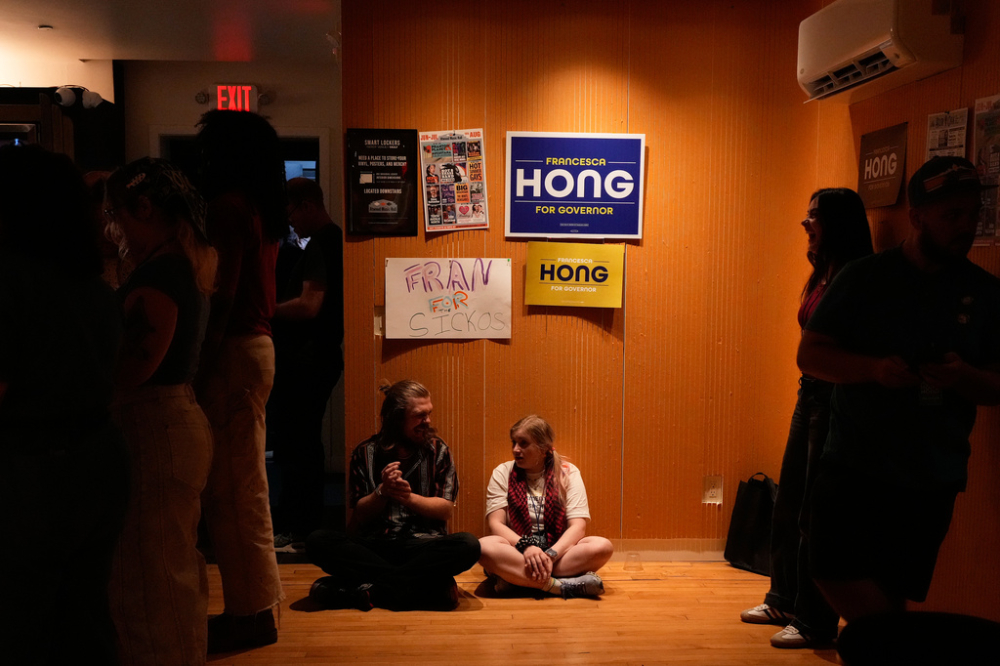
Attendees sit as they wait for election results during a primary election night watch party for Democratic gubernatorial candidate Francesca Hong, Tuesday, Aug. 11, 2026, in Madison, Wisconsin. (AP/Nam Y. Huh)
As Fareed Zakaria put it recently at the Washington Post:
When Democrats come under pressure, they find it much easier to move left on economics than toward the center on culture. If they speak plainly and say that the border must be controlled, repeat offenders punished, and standards of merit defended, or that biological sex matters, they risk revolts from activists, advocacy groups and highly educated staffers. So instead, Democrats offer a larger subsidy, a new benefit or a fiercer attack on billionaires while leaving untouched the cultural attitudes that alienate many voters.
This is profoundly true and it has been obvious for some time.
Back in 2019, I called attention to a paper by Lee Drutman of the New America Foundation. Drutman plotted voters into quadrants based on whether they self-identified as liberal or conservative on economic or social issues. Those who were conservative on both are the Republican base, while those who identify as liberal on both are the Democratic base. Those who say they are socially liberal but fiscally conservative — think Michael Bloomberg's campaign — constitute a mere 3.8% of the electorate. Those who are socially conservative but economically liberal, I called them "Pope Francis voters," were 28.9%.
Today's establishment Democrats still are more likely to follow the Bloomberg approach than the obvious path to victory. Today's progressives follow the model Zakaria questioned, proposing ever more radical economic ideas but refusing to move to the center on cultural issues.
Advertisement
In the 2020 Democratic primary, conducted during the COVID pandemic, Democrats turned to the most experienced candidate they had, Joe Biden. The former vice president also had something else: He did not sound like an extremist on any issues, including cultural ones. Remember the president saying "I'm a practicing Catholic. I'm not big on abortion," at a fundraiser in 2023. He added, "But you know what? Roe v. Wade got it right." Pro-choice advocates criticized Biden harshly for those and similar remarks. Bill Clinton's formulation — abortion should be "safe, legal and rare" — is no longer acceptable to the pro-choice activists. Today's Democrats are reluctant to admit any such ambivalence on cultural issues.
It would be wonderful if everyone perceived the dignity of the unborn child in the womb. Until that time, we have to contend with people with wildly different views on the issue. Millions of voters share an ambivalence on such fraught issues and Democrats who toe the extremist line, dismissing other views out of hand, turn those voters off.
The demand for ideological conformity to extreme views combined with the structural impediment caused by gerrymandered districts results in a party that has lost the art of persuasion. Good politics and lasting policies happen when people to the left of center come to agreement with those who are right of center, and the extremists on both sides are left disappointed.
A reader recently wrote thanking me for writing about the problems with the Democrats but asking when I was going to write a column about what is wrong with the Republicans. That is not a column; it is a sentence: The GOP has become a cult. Instead of answering to an extremist base, their politicians must move with the whims of President Trump.
The stakes are high. I fear the Democratic primary electorate in Michigan has already sacrificed a winnable seat in what will be a closely divided Senate — with all that portends for confirming Supreme Court justices. Unless the party actually confronts its own, highly educated, myopic intolerance on cultural issues, and relearns the art of persuasion, the Democrats will continue to lose. This has been obvious for some time yet both the establishment wing and the progressive wing refuse to budge.