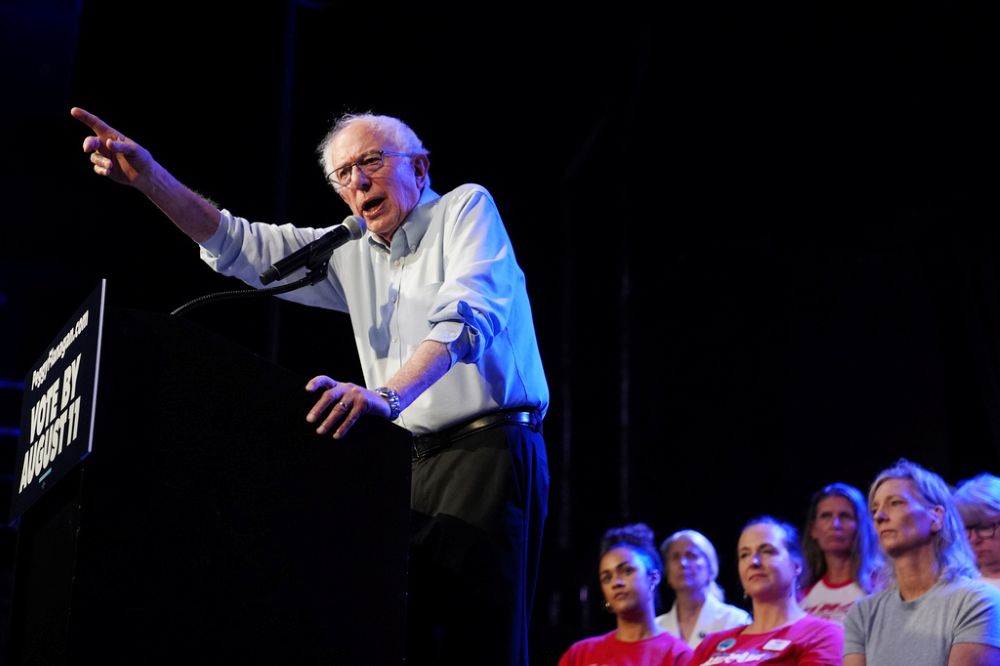
Sen. Bernie Sanders, Independent of Vermont, speaks during a campaign rally for Minnesota Lt. Gov. Peggy Flanagan, a Democratic candidate for U.S. Senate, July 20, 2026, in Minneapolis. (AP/Ellen Schmidt)

Join the Conversation
Send your thoughts to Letters to the Editor. Learn more
Having taken a whack at the progressive wing of the Democratic Party, now it is time to examine the deficiencies of the so-called "establishment" wing of the party.
In a recent appearance on MS NOW's Lawrence O'Donnell's show, Sen. Bernie Sanders was asked to define the differences between himself and the establishment. His reply was polite, but firm, and largely on target.
Sanders first set forth his ideological complaint, saying the establishment likes to tinker around the edges of policy, and fail to grasp, for example, the almost existential reality that working-class people face when confronting our broken healthcare system. The voters want a reliable and affordable healthcare system as a human right. They want affordable housing. A tax credit here, or a minor government investment there, will not achieve the goal.
Sanders is undoubtedly correct that most members of Congress do not appreciate the circumstances of working-class Americans. Most politicians, and virtually everyone they know and associate with, have jobs that provide them with health insurance. They make enough money to afford what they need. And, as often happens with an issue on which expertise is required, mastering the art of tinkering can overtake the need to step back and evaluate the whole system. Centrism is not a virtue in itself, although moderation usually is.
Second, Sanders indicted the way the establishment of the party conducts politics. He chastised them for having allowed political contributions and the campaign infrastructure those contributions make possible to corrupt the whole. "If you're the establishment, you go out to your big money people, your billionaire friends, give us money, we'll hire consultants, we'll do these really good 30-second ads, opposition research, we'll manipulate the media," he said. "That's how we do politics."
Sad to say, Sanders is exactly right. When I worked on a congressional campaign, our opponent attacked our candidate for not paying his taxes. The basis of the claim? The quarterly bill for garbage collection in his hometown got lost once and went unpaid. The charge was silly, but it worked. We were always asked about the candidate's sense of responsibility seeing as he had failed to pay his taxes. Opposition research yields these morsels that have nothing to do with governance but which can effectively hamstring a campaign.
Advertisement
What Sanders did not do is connect the two parts of his indictment and address the relationship between running campaigns and achieving policy outcomes. In 2010, after the Affordable Care Act was adopted, it was unpopular at first and Democratic candidates were told by their consultants not to talk about it because of its unpopularity. The Republicans kept talking about it. The ACA did not become more popular before election day, and it was a "shellacking" for the Democrats as President Obama said at the time. The party, from the president on down, campaigned hard to get the ACA across the finish line but then failed to keep campaigning to explain it and rebut the often misleading attacks Republicans were making against it.
Partly because of gerrymandering and the creation of mostly safe districts nationwide, congressional incumbents do not feel the need to campaign on an issue, year in and year out, again and again, aiming to shape public opinion, not merely to be shaped by it. Had all Democrats been running on Medicare for All the past several election cycles, or on a wealth tax, or on a climate change policy that led with the creation of good paying jobs, they might have built a political mandate for enacting those policies. Building a governing coalition requires that kind of perseverance.
Without such an effort to convince the public that a particular policy would address their problems the establishment appears out of touch and devoid of vision.
In 1933, President Franklin Delano Roosevelt asked Frances Perkins to become his secretary of labor. Before accepting the position, she made sure the president would support policies she wanted to implement, and she was instrumental in crafting many of the policies aimed at confronting the Great Depression in the busy first 100 days of the administration.
The proposal for what would become Social Security, however, was not one of those early policies. The president himself was skeptical: "Oh, we don't want the dole; not the dole!" He sent Perkins to inform the public about the issue, to explain that it was old-age insurance, not the dreaded dole. In 1934, the Democratic Party campaigned on the issue. FDR's vice president, John Nance Garner, hoped the party would lose only 37 seats in the House. In fact, they actually won nine seats. In the Senate, the Democrats increased their caucus from 59 to 67 seats. Social Security was enacted the next year. The people had backed the party with a vision and clear goals.
Breaking through today's media landscape and building consensus in our polarized time is a lot harder now than it was in 1934. FDR and Perkins knew that it was the terrible suffering caused by the Great Depression that made the policy possible. Still, it was their vision that seized the moment and channeled the public will. It is the establishment's lack of vision that has made them such easy targets.
You are reading a selection from Michael Sean Winters' weekly newsletter. To get the full edition — including the "In the News" links roundup — delivered 24 hours before it appears online, sign up here!