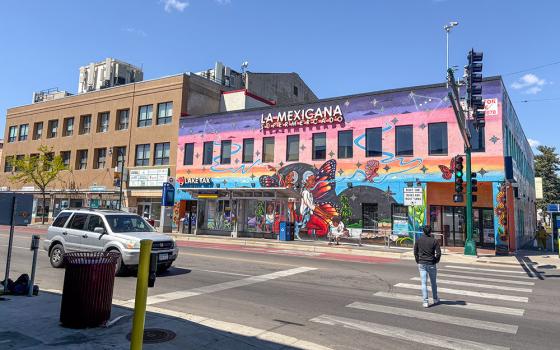
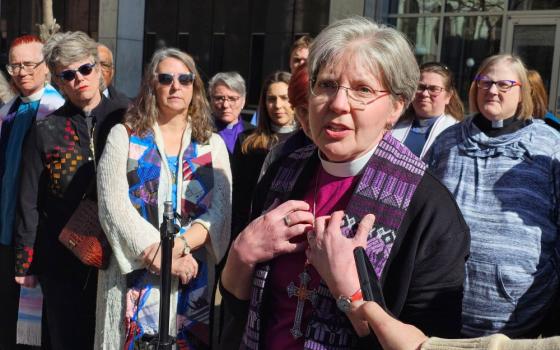
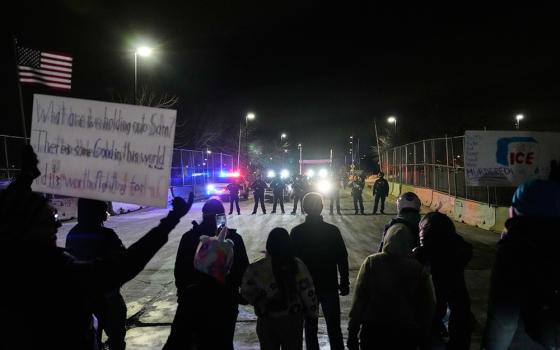
People take part in a demonstration in Minneapolis Jan. 25, a day federal agents shot and killed Alex Pretti, a 37-year-old intensive care unit nurse who was filming at a protest against the immigration crackdown in Minneapolis. (OSV News/Reuters/Shannon Stapleton)

by Kat Armas
Join the Conversation
Send your thoughts to Letters to the Editor. Learn more
On Sunday, Jan. 18, protesters interrupted a worship service at a church in St. Paul, Minnesota, to draw attention to David Easterwood, a pastor at the church, who also appears to serve as a top ICE official in the Twin Cities. Predictably, the internet erupted. Was this action morally acceptable? Should the federal FACE Act be invoked? For many, the conclusion was swift: protesting in a church is wrong.
But Scripture rarely allows us the comfort of such tidy conclusions. The biblical witness presses us to ask harder questions about power, complicity and what faithfulness looks like in the face of systemic harm. The real question is not whether an action disrupts order, but which order it disrupts — and whose safety, power and comfort that order is designed to protect.
Let us be clear: The situation in the United States is dire. Innocent people are being terrorized in their homes, on their way to school and even at immigration court, where they are legally required to be. They are following the rules. They are doing everything "right." And they are still being punished by a system that treats their existence as a crime.
If history — and Scripture — teach us anything, it is this: Disruption is not the scandal. Injustice is. And the church has never been most faithful when it protects its own comfort, but rather, when it risks disorder in defense of life. Protest inside a church draws the fault line clearly between empire and conscience, between order and justice.
Christian tradition offers no vision of holiness divorced from justice — the sanctuary was never meant to shield us from the cries of the oppressed, but to train us to hear them.
The Bible is filled with stories of people doing what those in power deemed "wrong" in order to confront injustice. Civil disobedience, defiance, even deception become tools of resistance when the systems governing society are themselves violent. "Protest" is not a modern invention — it is a recurring feature of the life of faith.
Take Moses. In Exodus, he repeatedly defies Pharaoh, demanding freedom for enslaved people. From the perspective of empire, Moses is a destabilizer, a threat to national security. His actions disrupt the economy, undermine authority and provoke chaos. Yet Scripture does not frame Moses as reckless or immoral — it frames his defiance as obedience to God.
Or consider Rahab in Joshua 2, who lies to the king of Jericho to protect Israelite spies. Her deception is treasonous in the eyes of the state. She breaks the law, betrays her city and aligns herself with a marginalized people. And yet, she is praised for her faithfulness and woven into Israel's story — and into the lineage of Jesus himself.
Jesus, too, consistently crosses lines that were meant to keep order intact. He heals on the Sabbath. He disrupts the temple economy. He eats with the wrong people and challenges religious leaders who have grown comfortable alongside empire. From the standpoint of Rome and the religious establishment, Jesus is unlawful, subversive and dangerous. That is precisely why he is executed.
When the apostles are later ordered to stop preaching, they respond plainly: "We must obey God rather than men." Their refusal leads to arrest and punishment. Scripture does not sanitize the cost of this defiance, it names it as faithful witness.
And before Moses ever confronts Pharaoh, before plagues and protests and parted seas, there are the Hebrew midwives. Shiphrah and Puah are commanded by the state to participate in genocide — to kill Hebrew baby boys at birth. They refuse. They disobey a direct order from the most powerful ruler in the world. They lie to protect life. The text says God deals well with them. Their "wrong" becomes the first act of resistance in the Exodus story.
The Bible does not offer us a morality that is neat or detached from real harm. When we are facing systemic evil, the lines are rarely clean. Faithfulness often looks like disruption. And sometimes, doing what is right means being willing to be called wrong.

A man holds up a sign as protesters gather in Minneapolis Jan. 8 at the scene of the fatal shooting of Renee Nicole Good by a U.S. Immigration and Customs Enforcement agent. Protests since the shooting have demanded that ICE leave the state of Minnesota and for the ICE agent who killed Good to be held accountable. (OSV News/Reuters/Tim Evans)
The Bible's morally complex witness did not end with the closing of the canon. It shaped how the church learned to survive empire. The same Scriptures that praised midwives who lied, prophets who defied kings, and disciples who chose arrest over silence also formed communities that understood faith as something lived publicly — and often dangerously.
Catholic parishes and mission centers have long functioned as more than sites of worship. In moments of political terror, they became places of refuge and resistance. Across Latin America — especially in the 1970s and 1980s — priests, religious sisters and lay leaders opened church doors to communities living under violent regimes, creating spaces where people could name injustice and imagine faithful responses to it.
In El Salvador, Archbishop Óscar Romero and local parish leaders transformed churches into public forums where the poor could speak openly about their suffering and be met with moral and spiritual solidarity. These spaces were intentionally formed as sites of resistance, where faith confronted power and the church refused the safety of silence. The sanctuary became a place where the Gospel took on flesh in the struggle for dignity.
Protest also entered the liturgical life of the church itself. In Brazil, clergy and lay activists shaped by liberation theology opposed land displacement and economic injustice through sermons and public witness rooted in parish life, bringing resistance into sacred space and challenging the separation of faith from public responsibility.
Liberation theology went further, reimagining worship itself as a site of political and moral formation. Across Latin America, base ecclesial communities used Sunday services to read Scripture through the lens of lived struggle. Prayers named state violence. Homilies exposed exploitation. Hymns strengthened collective resolve. In Nicaragua and Guatemala, this formation spilled into explicit acts of civil disobedience, as clergy and parishioners used churches themselves as sites of protest against state violence.
Churches also served as sanctuaries in the most literal sense. Religious communities sheltered Indigenous land defenders, political dissidents, and others targeted by unjust laws. Liberation theology names this protection resistance — a declaration that the sanctity of life outweighs the demands of empire. In these moments, sacred space became an embodied refusal to cooperate with violence, insisting that injustice would not be allowed to pass as normal.
Which is why the current outrage feels so misplaced.
Advertisement
Many seem more scandalized by a protest that interrupts a church service than by the reality that ICE has been intimidating and arresting people in and around churches, schools and hospitals. Over the past year, ICE has ignored due process, deported people to countries that are not theirs, denied access to legal counsel, used inhumane detention facilities and excessive force and even detained U.S. citizens. Most recently, 5-year-old Liam Conejo Ramos was detained in Minnesota and then sent to a detention center in Texas with his father. His family was here legally pursuing an asylum claim.
This reaction reveals something deeply unsettling about our moral priorities. It reveals a people more invested in preserving the appearance of reverence rather than defending the lives reverence is meant to honor. Yet, Christian tradition offers no vision of holiness divorced from justice — the sanctuary was never meant to shield us from the cries of the oppressed, but to train us to hear them. Scripture does not bless quiet compliance with violent systems. It blesses midwives who refuse orders, prophets who disturb the peace, apostles who choose arrest over silence and a savior whose disruption of religious and political order leads to execution.
If the church is scandalized by protest, it should ask why. If worship feels threatened by resistance, it may be because worship has grown too comfortable with the powers it was meant to challenge. The question before us is not whether protest belongs in church, but whether the church still belongs to the Gospel it proclaims.