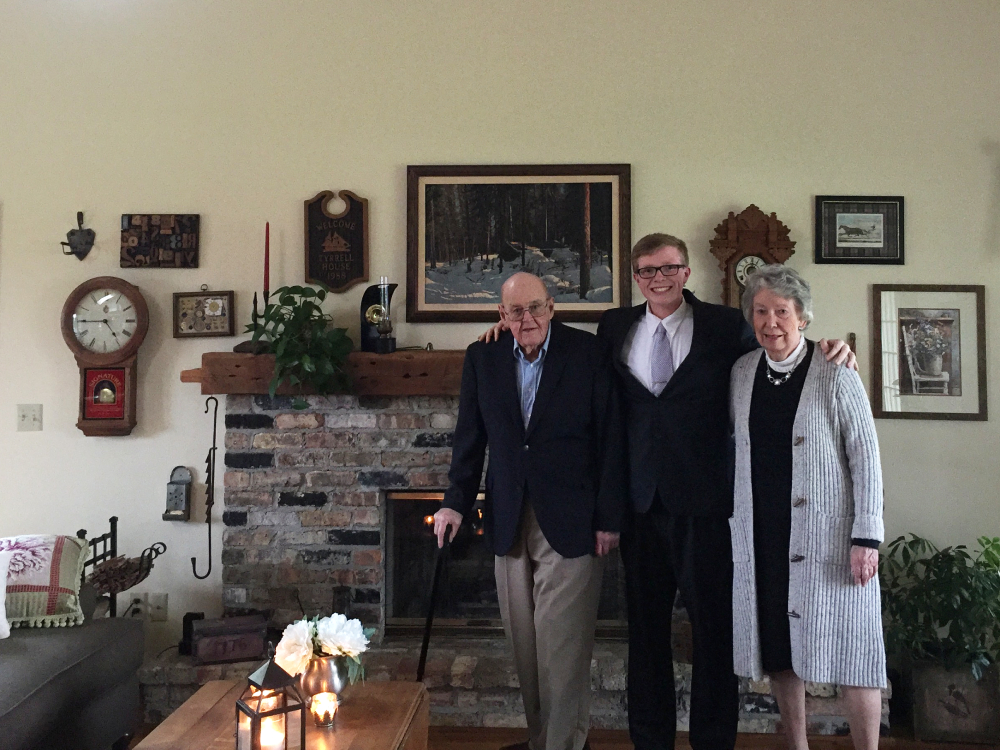
Liam Myers and his grandparents in their home on Highland Drive in Port Washington, Wisconsin. (Courtesy of Liam Myers)

by Liam Myers
Join the Conversation
Send your thoughts to Letters to the Editor. Learn more
When my grandma sold her house last year, she did not know the purchaser. Now her land and the surrounding 672 acres belong to the developer Vantage, who is building an AI data center that costs $15 billion.
Growing up, my grandma’s house was a sacred place to celebrate Christmas. She prepared a delicious meal for all the family to enjoy: liver pate, mushroom croustades and, my favorite, moon cookies. As a child, when it came time to open presents I was often asked to hand each gift to its recipient. It was a joy to search under the magical tree, full of handmade ornaments, its branches coated with ivory soap to look like snow. Grandma's tree was brightly lit and placed beside the window so that those driving by on Highland Drive could see, and smile.
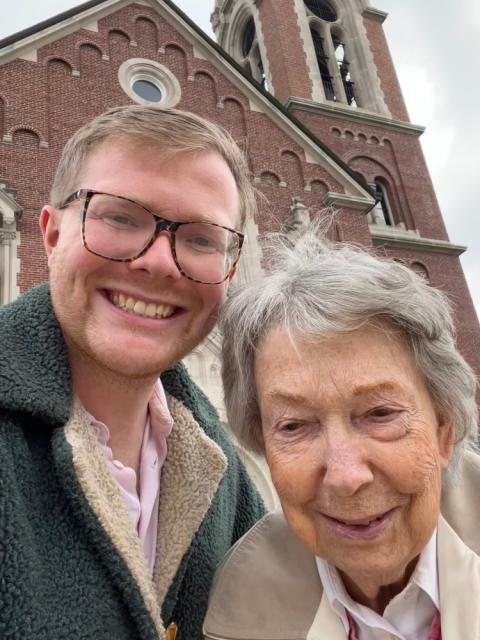
Liam Myers with his grandma. (Liam Myers)
My grandma had lived on that land since 1988. It is where I learned to mow the lawn and how to plant flowers and herbs in the garden. We often saw wildlife there; deer, turkeys, chipmunks and geese. I loved the afternoons spent in the yard, staring out in the distance toward Lake Michigan, watching the birds fly by.
Vantage's data center project is based in my hometown of Port Washington, Wisconsin, a city known for its historic lighthouse on Lake Michigan. Meanwhile, Vantage is calling their project the "Lighthouse" campus, "inspired by the iconic Port Washington lighthouse" as a "guiding light in data center design."
Once, I was in Port Washington with a friend who was visiting for the first time. As we drove down a hill they saw the lake and, astonished, gasped, "That’s not a lake, that’s the ocean!" Each of our realities is profoundly shaped by our perception. The landscapes we encounter help us learn what is a hill and what is a mountain. They teach us what it means to live in the world, and how we ought to treat the land and the neighbors we share it with.
What do data centers teach us about our relationship to one another? To the earth?
Midwestern comedian Charlie Berens said that data centers "have been replacing farms and forests all over Wisconsin." In a viral video critiquing the data center in Port Washington, he listed the many negative effects that it will bring to the town: destroy the land, take water from farmers, pollute the great lakes, lower property values because of light and sound pollution and increase power bills. Residents are not happy.
Midwest Environmental Advocates recently announced they are suing the Wisconsin Department of Natural Resources, stating that they did not complete an environmental impact statement before approving this project. Francesca Hong, the leading candidate for Governor in Wisconsin, announced that she would put a moratorium on all new data center construction. While this particular project is moving forward, the issue of data centers is not going away.
Advertisement
As Catholics and people of goodwill, we should critically examine whether data centers, and the broad usage of artificial intelligence, are enhancing or diminishing our human dignity.
Womanist theologian Melanie Harris reminds us that in order to resist injustice we must spend time remembering the land. Harris writes about "eco-memory," a term that "refers to the collective and individual memory of the earth and speaks to our continuing relationship with the planet." Harris' work has inspired me to be committed to memory, and to learning from and loving the land, especially where it is being damaged and forgotten.
'How can I hold my love for a place gone by alongside my anger over its desecration?' —Liam Myers
In his recent encyclical, Magnifica Humanitas, Pope Leo lifts up the concern of human dignity in light of increasing technological advances. He states that we are facing a decision; either to create a world where "the dignity of every person is safeguarded [and] justice is promoted" or to create an "inhumane and more unjust world." He goes on to directly confront AI and caution us to realize that "technological innovations, including artificial intelligence, are not neutral, for they can either foster participation and justice or exacerbate inequality, control and exclusion."
He also reminds us to think of the physical impact of utilizing AI while reminding us that data centers are not neutral. He states: "Current AI systems require enormous amounts of energy and water … which requires an extensive network of machines, cables, data centers and energy-intensive infrastructure … It is essential to develop more sustainable technological solutions."
At the heart of the encyclical is the question: Are our technologies leading to further flourishing of the human person, or are they diminishing our humanity and stripping our dignity?
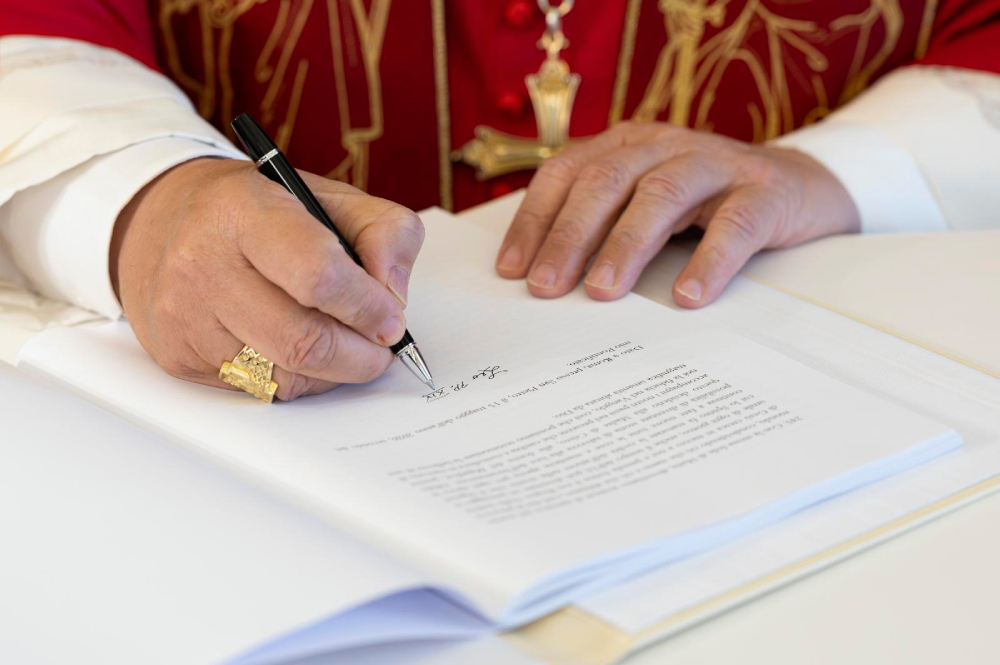
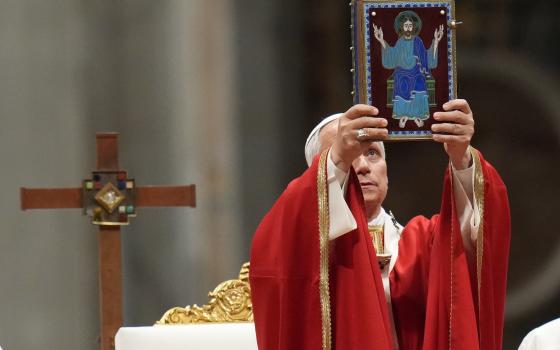
Pope Leo XIV signs Magnifica Humanitas at the Vatican's Synod Hall May 15, 2026, the first encyclical of his papacy, which focuses on the rise of artificial intelligence. (OSV News/Vatican Media/Simone Risoluti)
It’s hard to describe the feeling I have, deep in my gut, when I think about what is happening to the land. Concrete is being poured over what was once farmland. Land once traveled by bicyclists and monarch butterflies alike is becoming a place to store data and help train AI. The noise and light pollution is disrupting residents, and animals are being forced to find new places to traverse.
In the depths of grief, we must reckon with the reality that what once was, is no longer. How can I hold my love for a place gone by alongside my anger over its desecration?
In the backyard of my grandma’s house once stood a garden. She split her time inside and out, taking care of both people and plants. She loved to tend to the growing buds, then pick the grown flowers and put together beautiful bouquets to sell at our church’s farmers market. This garden was a place where memories were created and relationships fostered. This is where I learned who God is.
The status quo says AI is the future and data centers are inevitable and necessary. But I will continue to practice eco-memory. I will recall and speak of the land on Highland Drive, drawing on everything it taught me in order to resist.