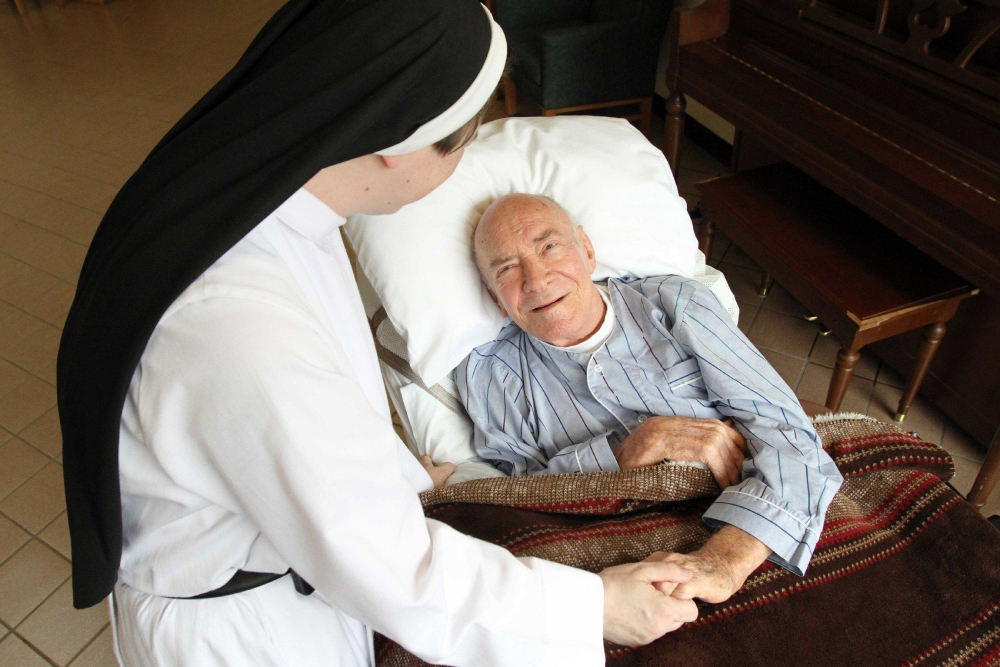
A patient is pictured chatting with Dominican Sr. Catherine Marie at Rosary Hill Home, a Dominican-run facility in Hawthorne, New York, that provides palliative care to people with incurable cancer and are in financial need. (OSV News/Gregory A. Shemitz)

by Enzo Del Brocco
Join the Conversation
Send your thoughts to Letters to the Editor. Learn more
As four orders of Catholic sisters challenge New York's assisted suicide law in federal court, Illinois prepares to implement its own End-of-Life Options for Terminally Ill Patients Act on Sept. 12. The law arrives in the home state of the first American pope, Leo XIV, who personally appealed to Gov. JB Pritzker not to sign it, as did Cardinal Blase Cupich of Chicago. What was once hypothetical for many Catholics is now becoming part of ordinary pastoral life.
The church has consistently taught that intentionally ending human life cannot be reconciled with human dignity. That witness remains essential. Yet another question now presses upon us with equal urgency: If assisted suicide is becoming part of the legal landscape, what are Catholics prepared to offer as an alternative?
Too often, public debate presents only two options: prolong suffering through burdensome treatment or hasten death through assisted suicide. Catholic tradition has always rejected that false choice. The church neither demands the use of every possible medical intervention nor accepts the intentional ending of life. Instead, it proposes a path of accompaniment, palliative care, proportionate treatment and compassionate presence.
The challenge is that these principles must become visible in lived experience.
Many who request assisted suicide do so not simply because of physical pain. Modern palliative medicine has made extraordinary progress in controlling many forms of suffering. Patients often fear becoming a burden, losing independence, facing isolation, exhausting their resources or losing a sense of meaning. These are not merely medical problems. They are profoundly social, relational and spiritual ones.
No legislation alone can address that kind of suffering. Loneliness has become one of the defining illnesses of modern society, and no prescription can cure the absence of love, belonging or hope.
The New York lawsuit reminds us that the church's alternative is not merely theoretical. For generations, the Dominican Sisters of Hawthorne have cared for the dying poor with incurable cancer, while the Little Sisters of the Poor and the Carmelite Sisters for the Aged and Infirm have ensured that the elderly are not left to die alone. Ironically, these very communities — whose ministries embody a culture of accompaniment — would be compelled under New York's law to counsel patients about assisted suicide or refer them for it, absent judicial relief.
Advertisement
It must be said, however, that as inspiring as the witness of these religious communities is, it cannot substitute for the vocation of the whole church. If we profess that every human life possesses inviolable dignity until natural death, do our parishes embody that conviction? Do we know who is caring for a spouse with dementia, a parent with terminal illness or a loved one at the end of life? Do we accompany exhausted caregivers and those who have no family at all? Or have we left this work largely to overstretched health care systems and a handful of religious orders while limiting our own witness to opposing legislation?
Our response cannot consist only of opposing legislation. It must also consist of building communities in which choosing death becomes less attractive because people know they will not face suffering alone. The credibility of our moral witness depends upon whether those who suffer encounter Christians before they encounter despair.
This begins with strengthening ministries of accompaniment. Every parish should consider how it might identify and support those living with terminal illness, chronic disability or advanced age. Volunteers can visit the homebound, provide rides to medical appointments, prepare meals, offer respite to exhausted caregivers, accompany families through hospice and remain present after a death through bereavement support. These ordinary acts proclaim an extraordinary truth: No person's worth depends on productivity, independence or health.
Catholic health care institutions likewise have an opportunity to deepen their witness by expanding access to high-quality palliative care, spiritual care, ethics consultation and support for families navigating difficult medical decisions. In this they already lead: An earlier Center to Advance Palliative Care report card found Catholic-run hospitals among the most likely of any to offer palliative care — roughly nine in 10. The goal is not merely to refuse participation in assisted suicide, important as conscientious objection remains. It is to demonstrate that compassionate care does not require intentionally ending life.
The broader society bears responsibility as well. Families often wish to care for loved ones at home but lack the financial means, the workplace flexibility or the community support to do so. Most already pay out of their own pockets — AARP's Public Policy Institute estimates that the average family caregiver spends roughly $7,200 a year, about a quarter of a typical caregiver's income — and many reduce their hours, their savings or their own careers to keep going. Caregivers face burnout, lost income and profound isolation. Mental health services remain unevenly available: According to the federal Health Resources and Services Administration, as of December 2025 some 137 million Americans, roughly 40% of the population, lived in designated mental health professional shortage areas. Palliative care, too, is still out of reach for many communities; the Center to Advance Palliative Care reports that only about a fifth of rural hospitals with more than 50 beds offer it, against the large majority of urban ones. These shortcomings deserve far greater attention than they typically receive. A truly compassionate society does not respond to suffering by offering death as a solution. It creates the conditions that allow people to live with dignity until their natural end, surrounded by the care, support and human presence they need.
Pope Francis repeatedly warned against what he called the "throwaway culture," reminding us that societies reveal themselves by how they treat those who are weakest and most dependent. His concern extended far beyond any single ethical issue. He defended the unborn, migrants, prisoners, persons with disabilities, the poor and the elderly because each reflects the same fundamental truth: Human dignity never depends on usefulness or autonomy.
Leo has continued to insist that authentic freedom is never exercised in isolation, but within relationships of mutual responsibility and solidarity. The deepest answer to suffering is not found in greater individual control over death, but in stronger communities willing to share the burdens of life.
The debate over assisted suicide will continue. Laws may change. Court decisions will come and go. Political majorities will shift. But the church's vocation remains constant. We are called not only to proclaim that life is sacred, but to make that truth visible in the way we accompany one another to the very end.
If our society increasingly measures human worth by autonomy and independence, the church must become the place where dignity is measured differently. Every person, regardless of age, illness or dependence, must know that they are never a burden to be managed but a brother or sister to be loved. That may become the church's most convincing answer to assisted suicide.