(Unsplash/Zach M)
by John Dolan
Join the Conversation
Send your thoughts to Letters to the Editor. Learn more
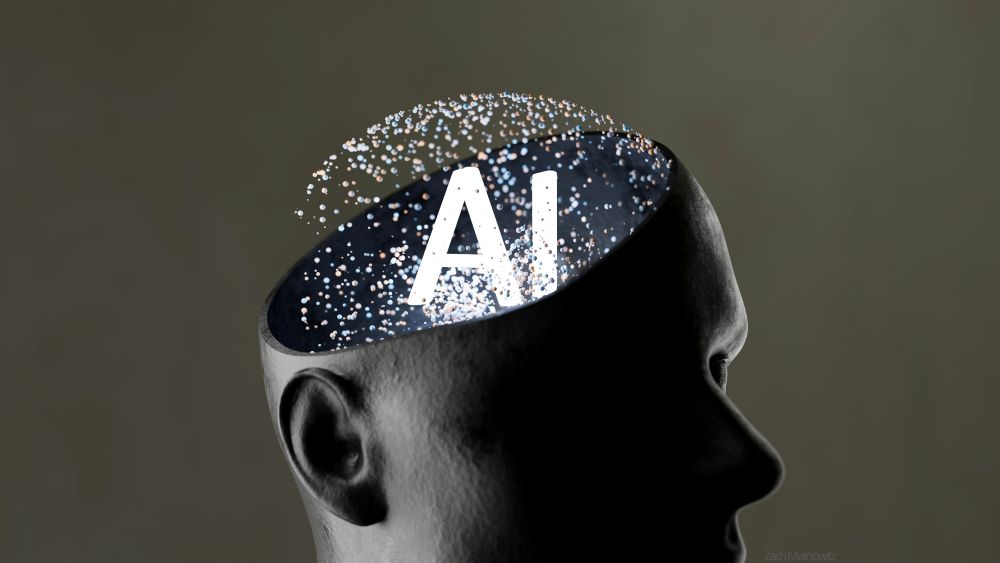
Artificial intelligence is becoming remarkably good at remembering things about us. It can retain our preferences, retrieve earlier conversations, recognize patterns in what we write and even anticipate what we may want to say next. A young person can spend hours conversing with an artificial intelligence that seems attentive and patient, remembers details friends may forget and remains available when friends are asleep.
There are important questions to ask about privacy, education, employment and human relationships. But I wonder if there is another question beneath them. What does it mean to be a human person? And especially in an age when a machine can store so much information about us, what does it really mean to remember a person?
I find myself going back more than four centuries to René Descartes. Born in France in 1596 amid enormous scientific, religious and intellectual upheaval, Descartes sought something absolutely certain upon which knowledge could be built. His method was to doubt everything that could conceivably be doubted. Yet even if I doubt everything, someone is doing the doubting. Hence his famous formulation, "cogito, ergo sum": "I think, therefore I am."
Descartes did not intend this statement to become a charter for individualism, nor did he deny God or the world beyond the self. Nevertheless, his emphasis on the thinking subject had enormous consequences. Pope St. John Paul II later reflected on the reversal that can occur between cogito and esse, between thinking and being. Rather than thought remaining grounded in being, we can begin to approach being itself through the thinking subject.
Artificial intelligence makes this old philosophical question unexpectedly contemporary. If we locate what is uniquely human principally in our ability to think, calculate, remember or use language, what happens when machines perform some of the tasks associated with these abilities better and faster than we do?
Gabriel Marcel offers another way of approaching the question. A French Catholic philosopher and playwright, Marcel was especially interested in presence, fidelity and communion. He resisted reducing the human person to a thinking subject standing before a world of objects. His philosophy is often summarized by the insight that "to be is to be with."
I find that insight especially helpful when I think about the very beginning of human life. Before I could ever say, "I think," I could already, in the most elemental sense, say, "I am." As a zygote, I possessed no philosophical understanding of myself, no autobiographical memory and no conscious recognition of another person. Yet I was not therefore less human. I was the same human life whose story I now tell.
And I was never simply "I." From the first moment of my existence, I was "with." The zygote does not come into existence somewhere outside relationship and later enter it. Its existence is received through relationship and immediately unfolds within another human body. Before I could recognize my mother, I was already with my mother. Before I could remember anyone, I was already being remembered, awaited and carried within a history larger than myself. Before consciousness, there was communion.
This suggests an important reversal of the Cartesian starting point. "Cogito, ergo sum" begins with the conscious "I": I think, therefore I am. But the earliest truth of my existence may be more primordial: I am because I have received being, and from the beginning my being is being-with. Thought eventually awakens within that prior gift. Consciousness discovers a relationship it did not create.
There is, in other words, a witness that precedes consciousness. Someone else can testify that I was before I was capable of testifying to myself. My first history had to be remembered for me before I could remember it myself.
From this perspective, the church's teaching on human dignity becomes especially important. In Dignitas Infinita, the Dicastery for the Doctrine of the Faith distinguishes four dimensions of dignity: ontological, moral, social and existential. Most fundamental is ontological dignity, belonging to the human person simply because he or she is human, created in the image and likeness of God and redeemed in Christ.
This dignity does not depend upon intelligence, independence, productivity, social recognition or moral achievement. If intelligence establishes my dignity, what happens when a machine performs tasks associated with intelligence better than I do? If memory establishes my dignity, what happens when a machine stores more information than I ever could?
Christian anthropology insists that human dignity precedes performance. Marcel helps us see something more: Relationship also precedes performance.
The Gospel of John takes us deeper still: "In the beginning was the Word, and the Word was with God, and the Word was God" (John 1:1).
Before there is a human cogito, there is already "with."
If we are created in the image and likeness of God, this matters. The word does not first exist in isolation and later enter relationship. The word eternally is "with God." Communion is not simply something we create after discovering ourselves as individuals. In some mysterious way, communion is already there at the beginning.
Then John makes another extraordinary claim: "The Word became flesh and dwelt among us" (John 1:14). The eternal "with" enters human history and geography. The word does not become an idea, abstraction or information. Jesus is born somewhere. He eats at tables, touches bodies, walks roads, weeps at the tomb of his friend, suffers outside a city and is laid in a particular grave.
Eternity enters geography. Communion becomes embodied.
This brings me to a word that has become increasingly important to me: anamnesis. We often translate it simply as "memory" or "remembrance," but the Christian understanding is much richer than recalling information about something that happened in the past.
Its roots lie in Israel's understanding of zikkaron, or memorial. At Passover, Israel does not simply remember information about ancestors who escaped from Egypt. "This day shall be a day of remembrance for you" (Exodus 12:14). The saving action of God is remembered as belonging to the worshipping community now.
Jesus gives this memorial its decisive Christian form at the Last Supper: "Do this in remembrance [anamnesis] of me" (Luke 22:19). St. Paul, our earliest written Christian witness to this Eucharistic command, helps us understand what kind of remembering this is: "For as often as you eat this bread and drink the cup, you proclaim the death of the Lord until he comes" (1 Corinthians 11:26).
We proclaim the death of the Lord: past. We eat the bread and drink the cup: present. We do this "until he comes": future. Anamnesis somehow holds them together.
The church gradually developed this understanding sacramentally. Justin Martyr connected the Eucharistic action to Christ's command. Irenaeus placed the Eucharist within the saving economy of Christ. The mystagogical tradition, particularly Cyril of Jerusalem, spoke explicitly of remembering Christ's Passion, Resurrection and Ascension within the Eucharistic offering.
At the Eucharist, we are not attempting to reconstruct an absent Jesus by remembering him hard enough. We are drawn sacramentally into the paschal mystery of the living Christ. Pope Benedict XVI described this beautifully at the Mass of the Lord's Supper in 2009: In the liturgical memorial, "our today comes into contact with his today."
Remembering becomes participation. Memory becomes communion.
St. Augustine takes us in another helpful direction. In Book 10 of the Confessions, Augustine explores memoria as something far deeper than our ability to retrieve information. He recognizes memory as belonging to the mysterious interior depth of the human person, where what we consciously grasp does not exhaust who we are.
Consider a person with advanced dementia who can no longer remember family members, explain the Eucharist or perhaps even recall having received Communion moments earlier. Is that person somehow less capable of belonging to Christ because neurological memory has deteriorated?
Certainly not.
The Eucharist does not depend upon the strength of my memory. Anamnesis is first an action of Christ and his church before it is an intellectual accomplishment of the individual communicant. The person is taken up into the church's remembering because the church herself stands before the father in Christ.
Anamnesis is ecclesial before it is cognitive.
Nowhere is this better expressed than in the conversation between the thief and our Lord at Calvary: the thief asks to be held in Christ's memory; Christ promises something greater — not merely, "I will remember you," but, "You will be with me" (Luke 23:42-43).
Here the person with dementia strangely resembles the person at the beginning of life. The zygote cannot yet remember; the person with advanced dementia may no longer be able to remember. Yet neither is outside communion. At one end of life, others remember my story before I can remember it myself. At the other, others may carry my story when I can no longer carry it alone. My dignity cannot therefore depend upon the strength of my memory.
This also helps me understand the connection between remembering and abiding. Jesus says, "Do this in remembrance of me" (Luke 22:19). He also says, "Abide in me" (John 15:4). I do not want to collapse these sayings into one, but sacramentally they illuminate one another. Christian memory is not possession of information about someone absent. It is participation in someone who remains present.
Pope Francis captured something of this when, at Corpus Christi in 2020, he described the Eucharist as healing our "wounded memory." He then reversed the direction in which I ordinarily think about Eucharistic memory. I come believing that I am remembering Christ only to discover something prior: "He remembers me!"
Before Christian memory is something I accomplish, it is something into which I am received.
This becomes even more important when we confront death. When someone we love dies, we retain photographs, letters, recordings and increasingly thousands of digital traces. But none of these is the person. Suppose every person who knew me eventually dies, every photograph disappears and every server containing information about me ceases to exist. Have I become nothing because no human consciousness remembers me?
Christian faith says no. My existence never depended ultimately upon another human being's ability to recollect me. I am remembered by God. Even "remembered" is inadequate because God does not remember as we recall something that has become absent. The dead do not continue to exist because we remember them. We dare to remember them because they remain known and loved by God.
This understanding of anamnesis leads me from time to place. Cardinal Pierbattista Pizzaballa offers a beautiful perspective in his April 27 pastoral letter, "They Returned to Jerusalem with Great Joy." Writing while the Holy Land remains wounded by war, polarization and mistrust, Pizzaballa turns toward the final city of Scripture.
The first city explicitly built in Scripture is Cain's city after the murder of Abel (Genesis 4:17). Later comes Babel, humanity's attempt to build upward and "make a name for ourselves" (Genesis 11:4). But Revelation ends with a city moving in the opposite direction: "the holy city, a new Jerusalem, coming down out of heaven from God" (Revelation 21:2).
Jerusalem receives from God what it cannot secure by its own power. Perhaps this is also a way of thinking about anamnesis. We do not climb backward through history to recover an absent Christ. We receive the living Christ who gives himself to us.
Christian anamnesis neither worships the past nor deletes it. It allows history to be taken up into redemption. Perhaps the risen Christ offers the best image. His wounds have not disappeared, but they no longer bleed. The wounds by which he was killed become the wounds by which his disciples recognize him (John 20:24-29).
Advertisement
Twenty days after Pizzaballa signed his letter in Jerusalem, Pope Leo XIV signed his first encyclical, Magnifica Humanitas ("Magnificent Humanity"), on safeguarding the human person in the time of artificial intelligence, at St. Peter's in Rome on May 15. Beautifully, Leo begins with almost the same biblical architecture. Humanity faces a choice between constructing another Tower of Babel and building "the city in which God and humanity dwell together." Leo asks what kind of "construction site" our technological age will become.
Technology itself is not Babel. Human creativity is a gift, and technology can heal, connect and educate. Leo's concern is deeper: What vision of the human person guides what we build? Babel sought stability and power, and above all to "make a name." Leo warns against a technological culture that can reduce the mystery of the person to data and performance.
Leo does not use the word "anamnesis." Yet as he approaches his conclusion, he turns to the Eucharist. Drawing upon St. Augustine, he reflects on the "Amen" with which we receive the Body of Christ. Against technological networks that can leave us isolated even while appearing to connect us, Leo points toward another kind of communion: the Body of Christ.
Perhaps this is why anamnesis matters in the age of artificial intelligence. The church does not merely preserve information about Christ. She remembers him by receiving him. The Eucharistic memorial does not simply tell us who Jesus was; it draws us into who he is and, in him, into who we are.
This brings us back to John: "The Word became flesh and dwelt among us" (John 1:14). Christianity's answer to Babel is not a better tower. It is Emmanuel.
The prologue tells us that "the Word was with God" (John 1:1). The Incarnation tells us that the word came to dwell with us (John 1:14). Eucharistic anamnesis tells us that this "with" cannot simply be conjugated in the past tense. Revelation brings the movement to completion: "Behold, God's dwelling is with the human race" (Revelation 21:3).
God was with us. God is with us. God will be with us.
Perhaps, then, the great question before us is not whether a machine will someday learn to say, "I think, therefore I am." It is whether we will remember who we are.
And at the beginning, at the center and at the end of the Christian story remains the same promise:
God with us.