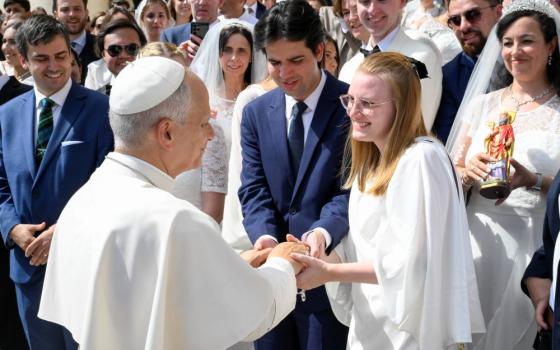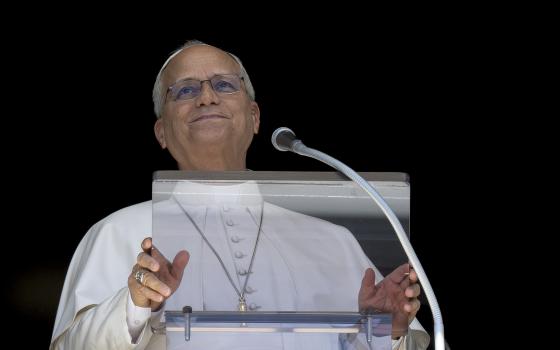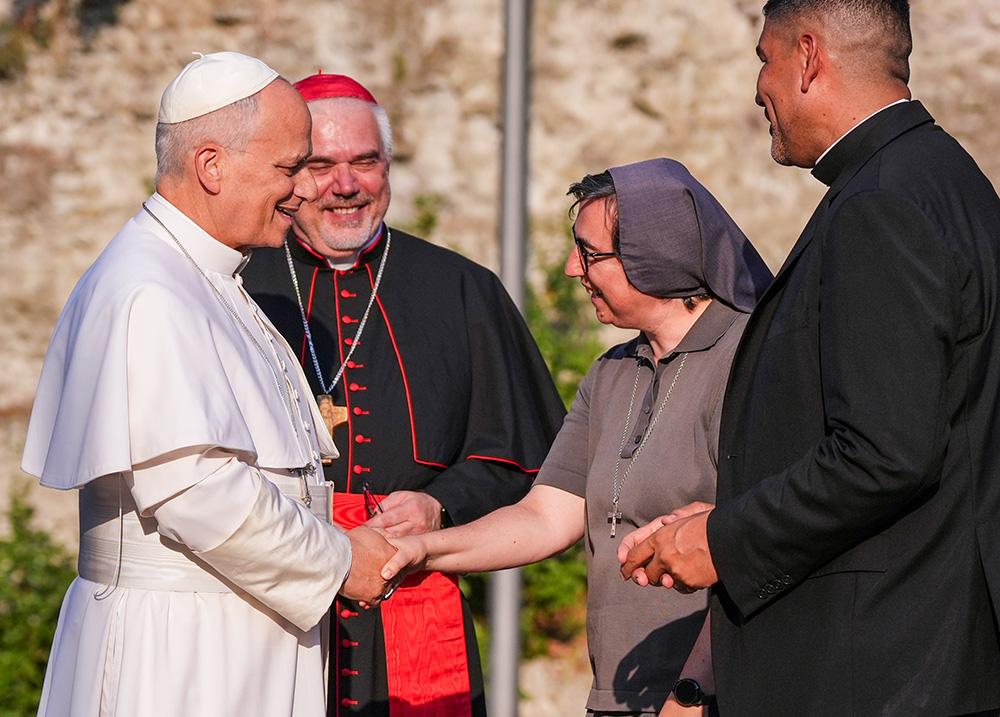
Pope Leo XIV greets Salesian Sr. Alessandra Smerilli, secretary general of the Vatican Dicastery for Promoting Integral Human Development, at Borgo Laudato Si' in Castel Gandolfo, near Rome July 29, 2026. (AP/Alessandra Tarantino)


Religion News Service
Join the Conversation
Send your thoughts to Letters to the Editor. Learn more
Nearly a year after Pope Leo XIV told a Rome meeting of synod team leaders that the problem of including women in Catholic Church management and ministry was essentially a cultural issue, there has been little movement on the issue in dioceses around the world. To complicate matters, women are treated as second-rate in many secular societies, and the church, while countercultural in so many ways, supports such stumbling blocks for women.
Significantly, as the Curia has added women to significant managerial positions, the altar rail remains a barrier to women in liturgical ministry.
As for management, this month at the Vatican, Salesian Sr. Alessandra Smerilli became the new prefect of a major curial office, the Dicastery for Promoting Integral Human Development. For five years, she was the dicastery's secretary, or No. 2 official, under Canadian Cardinal Michael Czerny. Now she leads some 80 dicastery members in an office dedicated to the church's central mission: acting on the precepts of the Gospel throughout the world.
Two other women have been announced to lead Curia offices: Consolata Missionary Sr. Simona Brambilla has led the Dicastery for Institutes of Consecrated Life and Societies of Apostolic Life, responsible for men and women religious (sisters, brothers and priests), since 2025; and Maria Montserrat Alvarado will lead the Dicastery for Communication, overseeing Vatican media, radio, the press office and publishing, beginning in November.
These are not minor positions, and the women filling them are accomplished managers dedicated to Catholicism.
Catholic social teaching supports women in the workforce. The current pope's namesake, Pope Leo XIII, complained about the exploitation of women as factory workers in his encyclical Rerum Novarum (1891). Since then, however, Vatican statements mentioning women often praise, or even prefer, women as wives and mothers. Leo XIII even wrote that women are naturally suited to domestic work and that they must protect their modesty.
It fits into a worldwide cultural and religious problem that oppresses women. In Afghanistan, under the Taliban, girls are banned from school after sixth grade; some meet in hidden classrooms. Like all women there, young and old, they are covered head to toe. Today, some 2.5 million girls in Afghanistan are sentenced to marriage and modesty, mostly hidden from the rest of society.
Catholic teaching is not so extreme, but the church exists in some very culturally closed societies.
Advertisement
As for women in ministry, while many expand the term "ministry" to include all manner of office work, teaching, social service and the like, technically it refers to the spiritual work of ordained clergy. In fact, the dictionary definition of "the ministry" is "clergy."
And even as the church moves women into increasingly important management positions — Sr. Raffaella Petrini of the Franciscan Sisters of the Eucharist has headed the Governorate of Vatican City State, and as such is its major administrator, since March 2025 — the Catholic Church still bans women from ordained ministry.
The ban is more than a speed bump along the way to having women fully recognized as persons inside and outside of Catholic circles. There are significant theological objections to women priests and, consequently, to women bishops.
But those objections do not extend to women deacons.
Despite the historical, theological and anthropological affirmations regarding women deacons, even the slightest attempts at including women in liturgy — ordained or not — come against the cultural brick walls around the world, to which Leo XIV alluded.
In 2021, his predecessor, Pope Francis, changed canon law to allow women and men not headed toward ordination to be formally installed as lectors (readers) and acolytes (altar servers), but only a scattering of dioceses have done so. Are ancient blood taboos stopping progress?
For those who say banning women from the sanctuary has been abandoned, perhaps the church's 1967 instruction on sacred music will give them pause: "Whenever the choir also includes women, it should be placed outside the sanctuary (presbyterium)." The document is still in force.
The church changes century by century, if at all. Look carefully at the next televised Mass from St. Peter's Basilica and see where the women are. The cultural problem may be closer than Leo thinks.