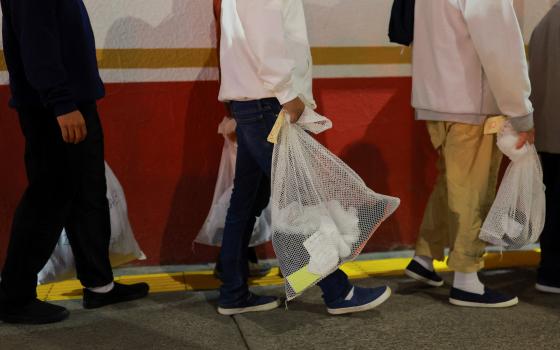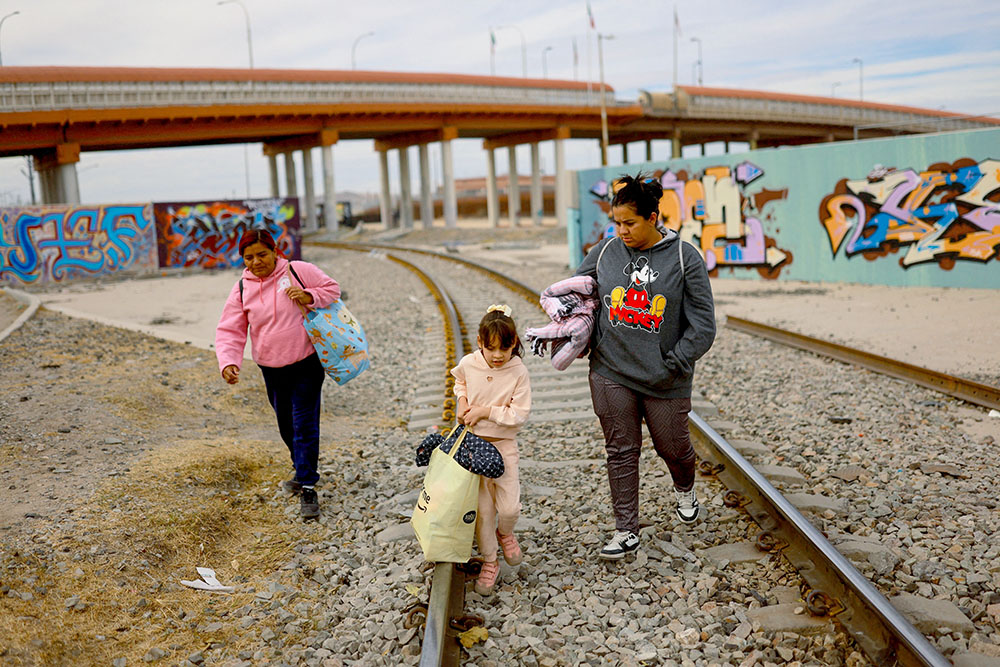
A Venezuelan migrant family deported from the U.S. walks near the border in Ciudad Juárez, Mexico, Jan. 22, 2026. (OSV News/Reuters/Jose Luis Gonzalez)
Bishop Mark J. Seitz
Dylan Corbett
Join the Conversation
Send your thoughts to Letters to the Editor. Learn more
On the border, "family" is less a household than a geography: grandparents on one bank of the river and cousins on the other, a baptism in one city and the funeral lunch in the other. The wall is real, but the families it divides do not feel divided.
For this World Day of Migrants and Refugees, Pope Leo XIV has taken as his theme "Even just one of these children," from the Gospel of Matthew: "See that you do not despise one of these little ones, for I say to you that their angels in heaven always look upon the face of my heavenly Father."
The church has long described its work among migrants as speaking for those who cannot speak for themselves. The impulse is generous, but we distrust the phrase, because it risks flattering the speaker. It assumes an absence where there is none. The children of whom the Holy Father speaks are not silent. They ask, in the plain grammar of children, where their mother is and when they are going home. The angels in Matthew's verse have no trouble hearing them. If a child seems voiceless, the fault lies with those who have stopped listening.
Those of us who gather each January for the March for Life in Washington, D.C., to keep faith with a life no one can yet hear know something about this. That witness is not about volume. It rests upon the conviction that a person's claim upon us does not depend upon being audible, or upon papers, or upon usefulness, and it was never meant to begin at birth or to end at birth.
The border sets before us a different test. Here the claim is made in words we can hear, and silence can no longer be an excuse.
Every morning, American-born children cross the bridge from Juárez, Mexico, to sit in our classrooms. At the border, their parents, who hold valid visas, are treated as suspects, as though they had cheated the rule that makes anyone born here a citizen. Children press their hands to the glass of a detention center visiting window to see their parents. Deferred Action for Childhood Arrivals recipients are told the ground beneath them was never solid. Beyond our city are the faces the headlines have made familiar, like Liam Ramos in Minnesota and the children held at Dilley, Texas.
Advertisement
The language of immigration policy is always in the aggregate: mass deportation, caseloads, quotas. The Gospel speaks in the singular. A shepherd leaves the 99 for the one, and Jesus concludes: "It is not the will of your heavenly Father that one of these little ones be lost." Even just one is a rebuke to a politics that can only see people in bulk.
Consider Austin, Texas, last Sunday. Wilber Rafael Garcés Pérez was delivering food for DoorDash when an Immigration and Customs Enforcement officer shot him. Days later, still in a wheelchair and sling, he was transferred to a detention center and will still need surgery to remove the bullet lodged in him. His attorney says he phoned his wife himself, from the car, to tell her what had happened.
Federal officials say he had a final order of removal; the circumstances are under investigation, and we will not presume to settle them. But notice how swiftly a person becomes a category, and how a man in pain still reached for his own voice and used it to call home. The question is whether anyone with power is prepared to hear it.
Several years ago, our work to offer humanitarian aid at the border was shaped early on by one child: a 17-year-old from Honduras battling a rare cancer. His illness took no interest in his legal status. He did not need a spokesperson; he needed someone to answer by their action. That answer became the Border Refugee Assistance Fund.
When Jesus says, "Let the children come to me, and do not prevent them," he attaches no condition. He does not add "unless their parents are undocumented," or "provided they were born to citizens." The Gospel offers no ranking of children by paperwork. What is asked is not complicated, though it is costly: to open our schools and parish halls to frightened families, to stand beside them in courtrooms and detention center parking lots, and to let policy be judged by what we hear from those it touches.
The children are speaking. The Holy Father is asking whether the church will listen, and whether we will let what we hear change us.