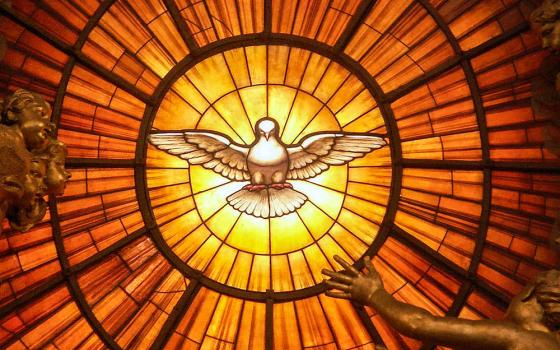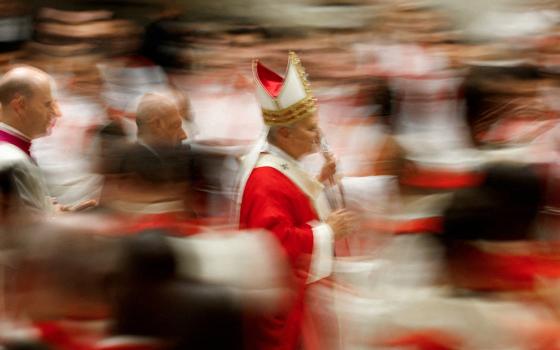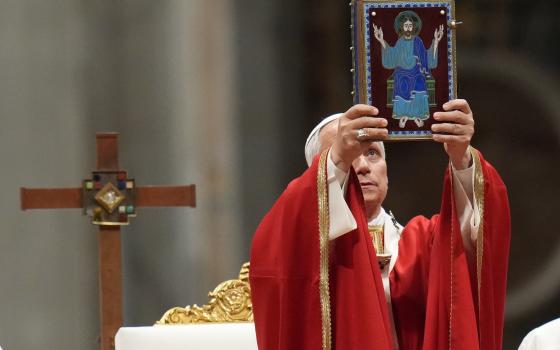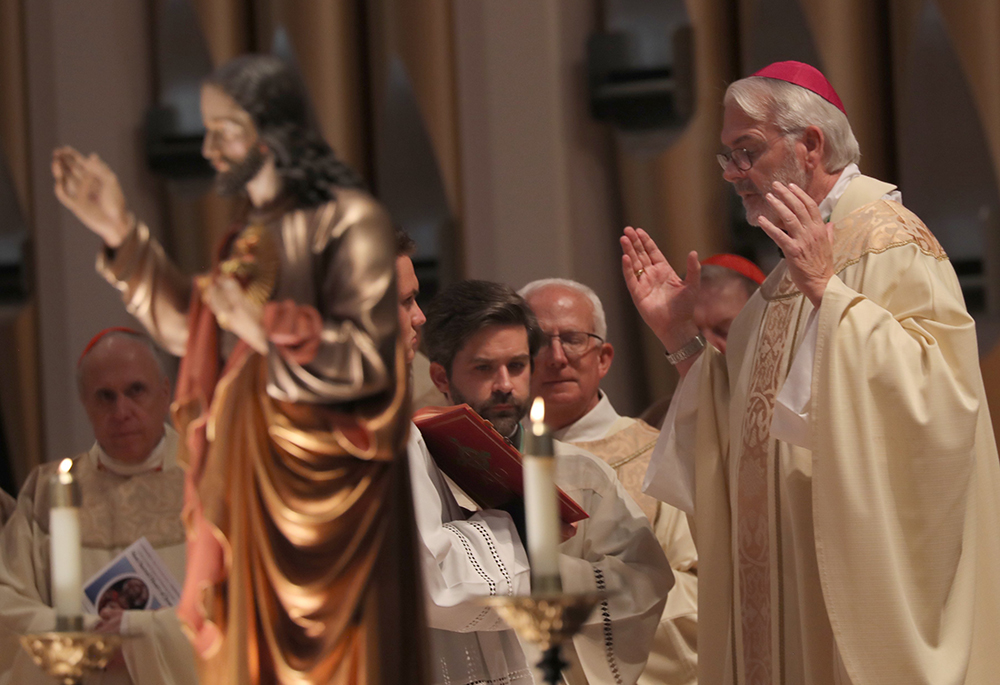
Archbishop Paul Coakley of Oklahoma City, president of the U.S. bishops' conference, concelebrates Mass as the bishops consecrate the U.S. to the Sacred Heart of Jesus in Orlando, Florida, June 11, 2026, during their spring plenary assembly. (OSV News/Bob Roller)

by Maxwell Kuzma
Join the Conversation
Send your thoughts to Letters to the Editor. Learn more
Every June, some Catholics get angry about Pride Month and call for "reclaiming June" from Pride celebrations through renewed devotion to the Sacred Heart. And while plenty of LGBTQ Catholics and their allies have responded with how they see no issue in celebrating both, this year the United States Conference of Catholic Bishops seems to have entered the ring with a new twist: a statement and corresponding video that explicitly connects devotion to the Sacred Heart with America's semiquincentennial.
The statement is short, and covers the basics of the devotion and why they have voted to consecrate the nation to the Sacred Heart. There is no explicit mention of LGBTQ people or June as the celebration of Pride month. But several aspects of this statement stood out to me.
Explicitly linking Catholic spirituality with national identity is a major theme, and I find it quite troubling when I look at the rise of religiously supported nationalist movements from history and within the context of the second Trump presidency. The bishops give glowing praise for the nation, reflecting "with gratitude on the blessings God has bestowed on our country," tempered only by broad statements about how the Sacred Heart asks us to "consider how we might foster truth, justice, and charity in American life." Yet, to appropriately consider how to embody these values means facing the reality that LGBTQ people are part of the human family and that we have lived experiences of prejudice and stigmatization within this country.
Referencing Pope Leo XIV's first apostolic exhortation, Delixi Te, they quote Paragraph 16: "God has a special place in his heart for those who are discriminated against and oppressed, and he asks us, his Church, to make a decisive and radical choice in favor of the weakest."
The approximately 30 million LGBTQ Americans experience plenty of discrimination, and are often among the more poor and unhoused members of society. About 26% of homeless LGBTQ youth report being forced out of their homes because of their sexual orientation or gender identity. That is not a reflection of justice or charity.
In a quote that speaks directly to how the Sacred Heart inspires a response to the weakest, the bishops quote Pope Francis, from his fourth and final encyclical, Delixit Nos, where he wrote:
In contemplating the pierced heart of the Lord [...] we too are inspired to be more attentive to the sufferings and needs of others, and confirmed in our efforts to share in his work of liberation as instruments for the spread of his love.
Francis was uniquely gifted in pastoral ministry, which is also one of the foundations of LGBTQ ministry. Through his writing and example, he demonstrated that same model that Jesus embodies in the Gospels: listening, encountering, connecting.
If June's dedication to the Sacred Heart means that we should put the example of Jesus at the center, then our model is someone who constantly rejected those who looked to rigidly enforce religious laws above the reality of human experience. Consider the many times in the Gospels when the Pharisees attempted to trap Jesus in some religious rule and the way he continuously returned to the real material needs of the people around him, such as when he addresses the disciples' hunger in Luke Chapter 6, refusing to spiritually bypass their reality.
Advertisement
The Sacred Heart of Jesus is not detached from human suffering, but beats within the living body of Christ: a body made up of the poor, the oppressed, the rejected, and all those wounded by systems of exclusion. As the bishops' statement says, Christ's love moves us to attend to those pushed to the margins — and the bishops also invite everyone "to see the face of Christ reflected in each sister and brother" — which means that queer and trans people are not outside the body of Christ but deeply woven into it.
As the bishops' statement says, Christ's love moves us to attend to those pushed to the margins ... which means that queer and trans people are not outside the Body of Christ but deeply woven into it.
It reminds me of something transgender theologian Dr. Nicolete Burbach said recently on "The Magnificast" podcast:
The church … it's like the body of Christ. You are saved corporally through incorporation into this body. This body is like a kind of mystical or sacramental unity which unites you with other bodies in the church in a very kind of physical way.
Hearing a trans theologian speak so powerfully about embodied incorporation into the body of Christ is deeply moving to me, especially because it reframes queer and trans existence not as alien to Catholic life, but as already participating in the sacred communion at the heart of the church itself.
When devotion to the Sacred Heart is linked to national identity in ways that risk narrowing its horizon, or when it is positioned — explicitly or implicitly — in opposition to the lives of LGBTQ people, it shapes how Catholics come to understand the heart of Christ. But the tradition of the church, grounded in the Gospels and reiterated by Leo and Francis, is clear: the Heart of Christ is revealed most fully in the wounded, the excluded and those on the margins. To contemplate that heart is to be drawn toward those whose dignity is often denied, not away from them. Devotion to the Sacred Heart, if it is to remain faithful to its own meaning, requires solidarity with LGBTQ people.