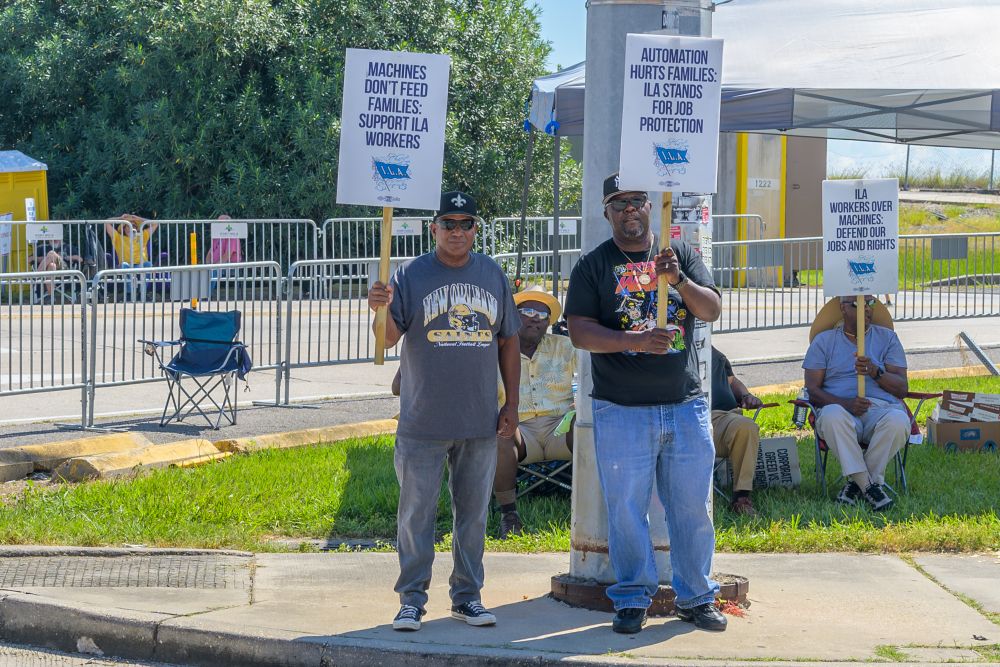
Striking International Longshoremen's Association workers stand on the picket line with signs near the entrance to Port of New Orleans Oct. 2, 2024. (Dreamstime/William Morgan)

by Aimee Shelide Mayer
Join the Conversation
Send your thoughts to Letters to the Editor. Learn more
My uncle Bob was a lineman with the International Brotherhood of Electrical Workers. As a child, I didn't know what that meant, except that he climbed telephone poles for a living. It sounded cool, and brave, especially in Michigan, with its rough winters. It was a hard job, but a good and worthy one as well.
Aside from my uncle, I didn't grow up in a union family, which may be surprising for someone who is now the executive director of the Catholic Labor Network — a Catholic nonprofit and private association of the faithful that advocates for Catholic social doctrine on the dignity of labor. My household was not a hotbed of social justice conversations or righteous anger against injustice and inequity. But I did learn from an early age that our faith should be put into practice in the world and that how we treat other people — especially those who experience poverty and marginalization — matters. The idea that all human life has dignity, from the womb to the tomb, was part of my solid Catholic education with the Nashville Dominicans.
But the rich Catholic social doctrine of our church that was first communicated in written form in Pope Leo XIII's 1891 encyclical Rerum Novarum ("On New Things") was completely unknown to me. It was not until college when I confronted for the first time the moral questions of how to live in the complicated realities between birth and death, and the ethical implications of systemic injustice. Our Catholic social doctrine upholding human dignity is not limited to the right to be born, but includes the right to a life where one can thrive free from the oppression of poverty, racism, abuse and exploitation.
Of the seven principles of Catholic social teaching, the principle on the dignity of work and the rights of workers remains the least well known, according to a 2022 report from the Loyola Institute for Ministry in New Orleans, led by Thomas Ryan. Perhaps this is why our church has drifted farther and farther from its historic "labor priest" era, where ordained Catholic clergy were regularly seen on the picket line and standing in solidarity with workers through collective action.
But our U.S. Catholic bishops, in their Labor Day statement, remind us annually of the importance of work, which invites humanity into the creative action of God. Their past statements have highlighted a present reality affecting economic life in our country. This year's statement is no different.
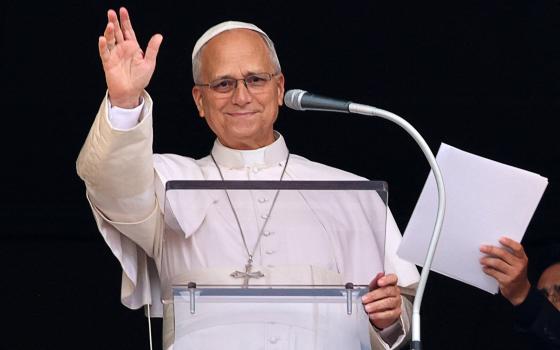
Unsurprisingly, the USCCB's 2026 Labor Day statement, signed by Archbishop Shelton Fabre of Louisville, chairman of the USCCB's Committee on Domestic Justice and Human Development, picks up themes from Pope Leo XIV's recent encyclical, Magnifica Humanitas, centering the primacy of the human person in any and all conversations about the economy:
Dignified work is not merely about productivity, but also participation in God's creation. A just economy is not judged on profit alone, but on inclusive growth and protection for the most vulnerable.
The message calls all Catholics to be "builders of communion" and to pay special attention to young and low-wage workers who are disproportionately affected by the growth of AI, lack of stable jobs and stagnant wages that do not meet the rising cost of living.
Advertisement
While the Labor Day weekend presents a welcome holiday during an often stressful time of year, we must not let the weekend pass without seriously considering the state of work in our country and the role our church has to play in supporting workers. That means upholding their rights enshrined in our social doctrine — specifically the right to a living wage, the right to organize and form unions, and the right to collectively bargain.
Instead, let's see Labor Day as an invitation — perhaps even a challenge — to intentionally focus on this most-unknown principle, which ironically touches the majority of the human race.
Most people spend the majority of their hours each week at work: working for pay, or without pay for loved ones as a caregiver. According to Catholic social doctrine, all work — paid or unpaid — is work. As Kate Ward so helpfully states in the introduction to her recent book, Making a Life: Catholic Social Teaching and the Meaning of Work, "The inclusive Catholic definition of work as any purposeful human activity helps us realize that work isn't just our paid job, but all the things we do that make up a life." The majority of the human race works for a living — meaning that they need to earn money for their livelihood, or provide the care needed for themselves and their family instead of outsourcing it to someone else.
Given that the majority of us work more than we do anything else in a day, it is time to start paying more attention to what work says about us, about humanity. Or, rather, what humanity says about work. As Ward puts it, "Work is important for how it changes the world, but more so for how it changes the worker." Catholic social doctrine flips the world's common understanding of work on its head. Instead of humankind being made for work, we learn in Genesis that work was made for humankind. God, in God's goodness, has given us work to help us grow in holiness and to thus, transform the world.
Now, don't get me wrong. Not all work is good, holy, and dignifying. The reason Leo XIII released Rerum Novarum was because of the growing attacks on human dignity in the wake of the Industrial Revolution. Unions and worker centers exist to uphold workers' rights and to advocate for policies and procedures that protect workers' safety, livelihood and job security. The Catholic Labor Network seeks not only to educate on Catholic social doctrine regarding the dignity of work and the Rights of workers, but to hold Catholic institutions (and all employers) accountable for how they treat their members.
Sadly, the Catholic Church is not always the exemplary employer we would want it to be with regards to supporting workers' rights and the tenets of Catholic doctrine. The U.S. bishops' 1986 pastoral letter, "Economic Justice for All," named this directly: "All the moral principles that govern the just operation of any economic endeavor apply to the Church and its agencies and institutions; indeed the Church should be exemplary."
They continue by quoting a challenge named by the 1971 Synod of Bishops, which remains a challenge today:
"While the Church is bound to give witness to justice, she recognizes that anyone who ventures to speak to people about justice must first be just in their eyes. Hence, we must undertake an examination of the modes of acting and of the possessions and lifestyles found within the Church herself."
They then give five areas where the economic life of the church needs renewal to reinforce "in U.S. society and culture those values that support economic justice," including: wages and salaries, rights of employees, investments and property, works of charity, and working for economic justice.
During this 40th anniversary year of "Economic Justice for All," and inspired by the first encyclical from our Chicago-born pope, our growing Catholic Labor Network is poised to respond to this moment and pick up the challenge of 1986. By serving workers and sharing the faith, we are helping reunite the rich tradition of our Catholic faith with the everyday realities of the working person and their families. As our members lay the foundation for local CLN chapters, Catholic social doctrine on the dignity of work will no longer be something unknown, but will serve as a source of inspiration, evangelization and conversion, so that our country and our world look less like a race to the top for the few, and more like the kingdom of God where the first are last and the last are first.