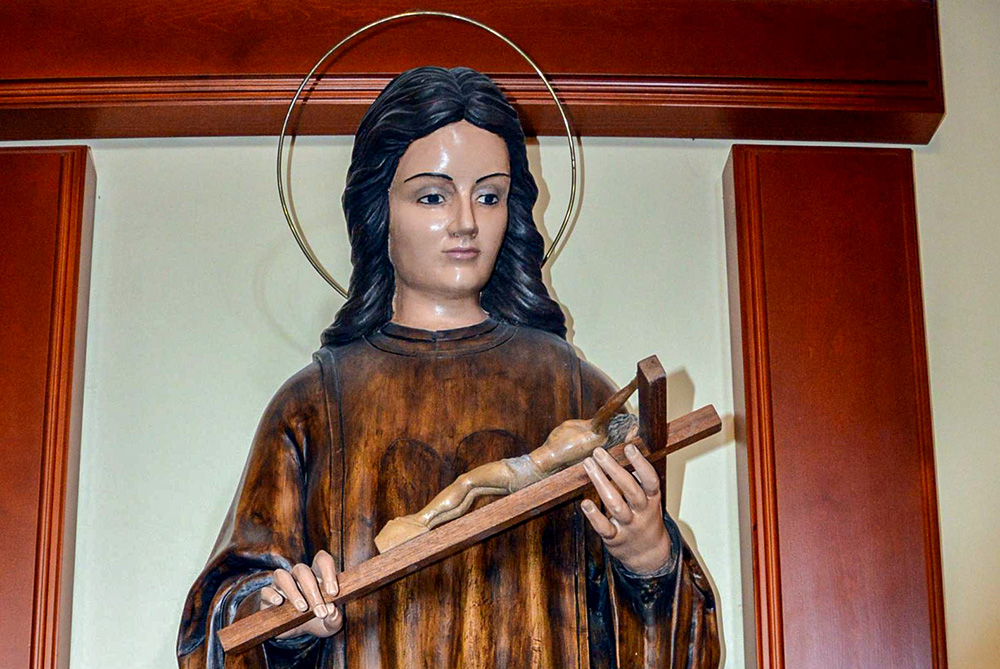
A statue depicts St. Marinos in a parish in Torrebaja, Spain. (Wikimedia Commons/Alfredo SÁNCHEZ GARZÓN)

by Emma Cieslik
Join the Conversation
Send your thoughts to Letters to the Editor. Learn more
August is Transgender History Month, a time to reflect on the transgender people who have led the way for transgender people's rights and who continue fighting for legal recognition and protection. This history is intimately tied to the Catholic Church, where a rich history of saints whom medieval historians now identify as transgender inspires a new generation of saints living among us.
Saints that transgress and explode gender binaries have existed since the beginning of the church itself — from people assigned female at birth who lived as men and entered monasteries (such as St. Babylas of Perge, St. Eugenios, St. Euphordyne of Alexandria, St. Theodore, St. Marinos, St. Pelagius and St. Hilarion), to saints who stated that God changed their gender (such as St. Onuphrius, St. Wilgefortis, St. Juana de la Cruz and St. Perpetua), and saints who were persecuted for cross-dressing (St. Joan of Arc).
But despite the wealth of evidence of holy gender nonconformity — stories of the saints' lives remain some of the best preserved examples of medieval literature — this gender expansiveness was, and in some circles remains, largely ignored by scholars.
That is why Alicia Spencer-Hall and Blake Gutt first began organizing conference panels which later led to their groundbreaking edited collection: Trans and Genderqueer Subjects in Medieval Hagiography. In it, Marinos' and Juana's stories are explored alongside that of the Patriarch Ignatios, Katherine, Eufrosine, Tristan de Nanteuil and Jesus. By diving into medieval written and visual descriptions of the saints' lives, Spencer-Hall and Gutt recognize and celebrate how these saints saw gender transgression as key to living and practicing their faith.
For Mother Juana de la Cruz, the presence of her pronounced Adam's apple was evidence not of bodily deviance but of divinity — physical proof of the miracle that God changed her gender from a man to a woman before she was born. She also had a deep singing and speaking voice, and when the mystic entered ecstatic trances she spoke in a low register as Christ spoke through her.
Similarly, Marinos was assigned female at birth, but cut his hair, wore men's clothes and joined his father entering a monastery. Years into serving as a monk, he was cast out on the accusation that he had fathered a child with a local innkeeper's daughter. Instead of clearing his name, Marinos chose to live in destitution outside of the monastery gate and raised the child until they were both welcomed back into the monastery to live under strict penance.
Advertisement
It was only until after his death that the fellow monks discovered that the accusation had been impossible and that Marinos had endured it all in the name of his faith. Falling to their knees, the monks called out for God's and the saint's forgiveness.
Perhaps the most profound example is Sophie Sexon's reflections on medieval depictions of Jesus' crucified body, where depictions of Jesus' side wounds in the Book of Hours and prayer rolls contain attributes of femininity and masculinity. In some artworks, blood pouring forth from Jesus' side is envisioned as milk for a newborn, just as Jesus's side wound is envisioned as the vulva through which a child came into the world. Through these depictions, Jesus —and thus God — contains the image and identities of all people.
As Gutt explained in an interview over Zoom, it's not about changing the stories or depictions of these saints, it's about taking them at their word and digging deeper.
"A text will say something like he was transformed. He was born a woman but then he was transformed into a man, and it was a miracle, and people will read the text and they might say that's clearly a metaphor. That's not real," Gutt explained."I'm just taking these people at their word when they show us how they are living their authentic lives."
Part of the pushback to recognizing the importance of gender in these saints' lives was transphobia, explicit bigotry against trans people, but part of it was also who was doing modern medieval scholarship.
"My favorite counterpoint to people saying transgender didn't exist as a term [is] well, neither did heterosexual, but yet you say everyone's heterosexual in the past," Spencer-Hall explained.
Queer and trans medieval historians needed to read these stories and document how they resonated with their own. They needed to feel seen on the pages of medieval manuscripts and illustrations to recognize that they were looking at their ancestors. Spencer-Hall pointed to the work of queer medievalist Basil Arnould Price, who teaches us "how we can recognize in premodern texts characters who might not express themselves as 'trans,' but in their practices, in their feelings, there is trans kinship and that is important and powerful."
And once queer and trans medievalists like Spencer-Hall and Gutt see themselves in these saints, they are sharing them with others, like transgender Catholic Max Kuzma, who are inspired by a rich history of saints who paved the way.
"Connecting to histories of queer and trans ancestors in the church is so important to me as a transgender Catholic man," Kuzma said in an interview. "Just as LGBTQ+ people have always existed in human society, we have of course always existed within the church. Learning these stories provides examples of positive role models and creates meaningful solidarity and a sense of community across time with those who came before us."
In a society and a church where transgender people are repeatedly told that they are new, that they have no history and are an "ideology" or a "danger," trans saints like Mother Juana and Marinos stand in open defiance and instead invite everyone to reflect on how gender is part of the mystery and miracle of God.
"When trans people claim sanctity or holiness for their own embodiments, their own identities, it's not about saying, 'Oh, trans people are better than cis people.' It's about saying we are just as good, and we are made just as intentionally to be who we are," Gutt explained.
For trans people who are so often shut out of Catholic spaces, who are increasingly denied legal protections in the United States today, this history "gives a sense of survivability of our current lives, not even necessarily the sanctity of queer and trans life, but the possibility," Spencer-Hall explained, and that has real consequences.
"People explore being their full selves with their family because there is suddenly a way for them to explain their identity, their authenticity in a way that touches where their family already lives."
For Catholic families where children dress up as saints for All Saints' Day or select a patron saint for confirmation, it's crucial that trans Catholics have a name, a story and a recognized church leader to reflect their lived experiences.
When they have the words to share their identities and the role models to recognize their own dignity and divinity in the eyes of God, transgender Catholics are recognized as living saints in their own right. Like the saints of ancient and medieval times who were persecuted for their faith, trans people today are targeted, abused and killed for who they are. It is, for many people, a form of social, spiritual and sometimes even physical martyrdom for being who they are.
Their existence and commitment to stay in Catholic spaces, to remain within a church that continues to rail against their very personhood despite the rich history of trans saints, is a form of faith that everyone should strive for.
As we celebrate Transgender History Month, may the trans saints who live among us — and the trans saints of the past two millennia — pray for us.