(Unsplash/Xiangkun ZHU)

by Christina Gebel
Join the Conversation
Send your thoughts to Letters to the Editor. Learn more
Benedictine monk Jean-Charles Nault calls it "the most forgotten topic of modern morality," and "perhaps the root cause of the greatest crisis in the Church today." Benedictine oblate and writer Kathleen Norris realized it described "half my life." Despite 16 years of Catholic schooling, I had never once heard the word uttered, and like Norris, it described a large portion of my life where I felt lost in ways I could not name.
It is called acedia, and its place in Christian history goes all the way back to the fourth-century desert father Evagrius Ponticus.
Using its Greek root, acedia translates to the absence of care, a kind of spiritual morphine. While it was once among the deadly sins, it eventually was combined with sloth. It is tempting to think of acedia as spiritual or physical malaise; however, it is far more complex, manifesting in paradoxical ways. Yes, it can show up as a torpor of spirit, weariness, sadness, going through life on autopilot, and an overall loss of the relish for life. But it also has a frivolous energy to it that feeds into restlessness, instability, fear of mediocrity, and the despair of a midlife crisis.
Acedia uses the spectrum of human experience to distract and deter us from the ultimate purpose of our life, thriving as a created child of God bestowed with the gifts and talents to serve God and each other. Once I understood how acedia manifests, I realized it has been hiding in plain sight, and in fact, we as a modern-day society are drowning in it, falling deeper into a polarizing divide amid widespread suffering.
A common lament of Christians today involves the struggle with the overwhelming time we are in: unchecked greed and power, overwhelming injustice and widespread violence. It is difficult, and often exhausting, to stay abreast of the new cycle, much less rouse the strength to make a meaningful impact toward the good.
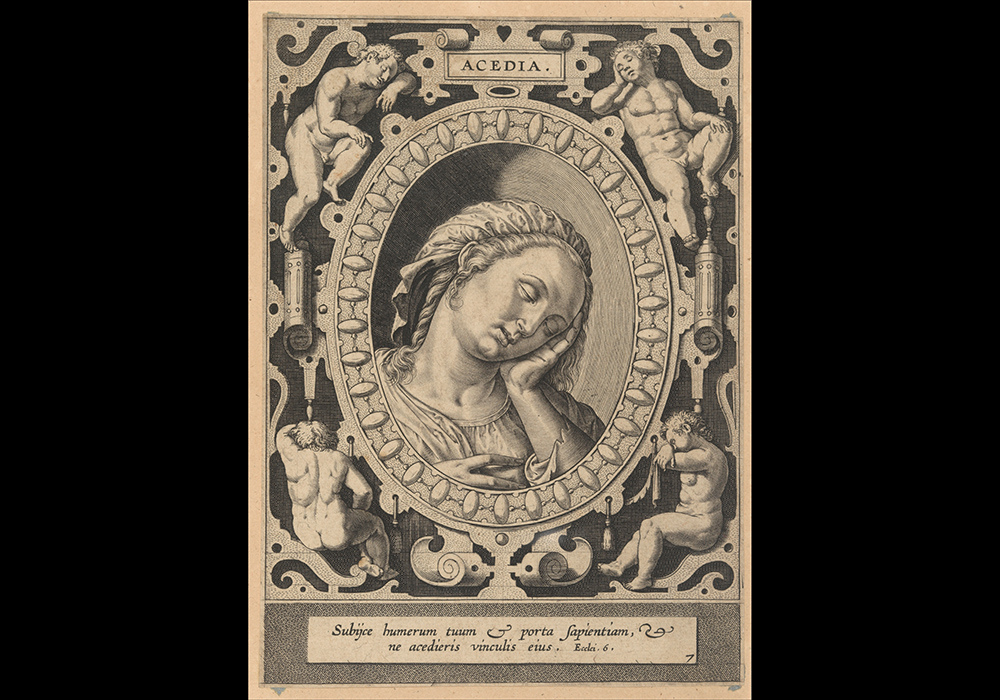
"Sloth (Acedia), from The Seven Vices," a pre-1612 print engraving by Hieronymus (Jerome) Wierix, after Philips Galle (Metropolitan Museum of Art)
In such chaos, the manifestations of acedia proliferate on a wide scale: weariness, despair, paralysis and a surrender to the overwhelm of it all. We see its frenetic nature, too: instability, restlessness with no real cure, and a sinking dissatisfaction with where one is, yet no real hope of things getting better.
Moreover, both sides of the political spectrum in the United States seem to lament the state of the world and the increasing division among people. Christians seem unrecognizable to one another. Both progressive and conservative Christians are aghast at each other's interpretation of the faith.
And yet, if our world is flush with acedia and its symptoms, is it reasonable to assume that overcoming it might also heal the deepening divide among the Christian family?
I believe the answer to that question is yes. The key to overcoming acedia in the climate of spiritual divide starts with understanding how the right and left are uniquely affected by it.
For the political right, acedia manifests as its temptation for excessive nostalgia of the past. "Make America Great Again" is literally the embodiment of how acedia deceives faithful believers into yearning for a falsified version of the past where today's problems did not exist. This disordered attachment to this fabricated remembering turns one's head from the problems of today toward a false thinking that recreating the past is a solution to the ills of the present. Here, acedia keeps the believer inert, in an imagined place that is both tempting and devoid of reality or truth.
Advertisement
For the political left, acedia shows up as the rejection of God and religion. This manifestation is best summarized by the words of Dr. Xavier Emmanuelli, co-founder of Doctors Without Borders: "We possess everything, but we don't have God. We have power, but we have lost its meaning. Our society that sweats anxiety … is going to disappear." In relentless pursuit of social progress, the left has venerated policies, movements and demonstrations that lack a fundamental source of truth or a unified vision for humanity. To suggest that our purpose in this life is writ on our hearts as divinely created beings is anathema to the gods of science and social movements and their ever-so-elusive goal of being the most enlightened, up-to-date and well-spoken on every passing issue.
With each side, the left and the right, running in spiritual circles — garnering more assuredness of their own correct convictions and the other's false ones — acedia succeeds in the isolated frenzy that ensues.
The answer, then, is to overcome the temptations of acedia in hopes of healing this chaotic division. But how?
Acedia helps us understand that the way to heal division — whether in society, the church or among Christians — is to lean further into what unites us: an authentic love of God and understanding ourselves as worthy of that love.
The process begins by individuals understanding acedia and how one uniquely falls prey to its illusions. In a time when we are taught that the solutions to our problems are external, confronting acedia requires deep internal work. Once the inward work is done in earnest, each person can come to a place of a deeper and more intimate relationship with God, a relationship that has perhaps been neglected and in need of healing. There, we can finally begin a conversation with God about our true purpose in life. This includes not only what our role is in confronting today's chaos, but also an authentic conversation about who God made us to be, how to live that calling in our broken world and how to accept God's unconditional love for us.
Acedia helps us understand that the way to heal division — whether in society, the church or among Christians — is to lean further into what unites us: an authentic love of God and understanding ourselves as worthy of that love. To find our way back to each other we must turn to the source who wishes the Christian family to be united in faith and love.
It may seem like we have a long way to go until we arrive at this place, but one thing that has comforted me in these times is that turning to the inner work of faith and spirituality is not a cop-out. It is a manageable step that is true to who I am and the faith from which I ultimately draw all that is good.