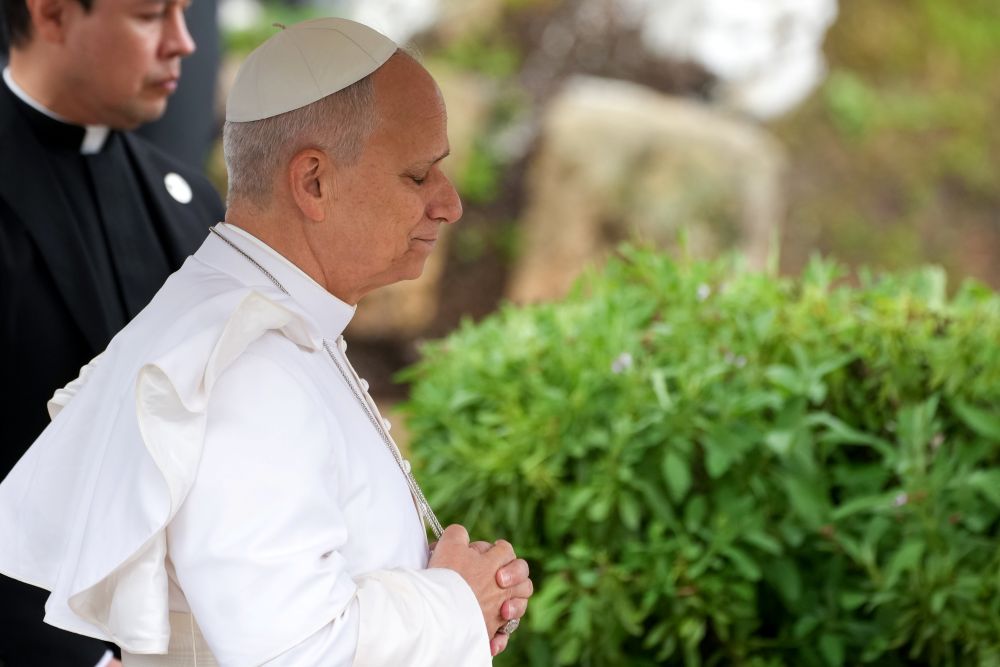
Pope Leo XIV prays during a visit to the archaeological site of Hippo in Annaba, Algeria, April 14, 2026. The site represents the ancient city where St. Augustine, the founder of the pope's religious order, served as bishop in the 4th century. (CNS/Lola Gomez)

by Arthur Purcaro
Join the Conversation
Send your thoughts to Letters to the Editor. Learn more
Editor's note: This is part of an occasional series on Augustinian spirituality. Pope Leo XIV is the first pope from the Order of St. Augustine, a religious order founded in 1244 on the values of community and friendship; service to the poor; and intellectual pursuits. Today there are some 2,800 Augustinians across 47 countries.
The very reason for our coming together as Augustinians has always been to encourage one another to share as God shares with us: freely and generously. We know we need one another to do this, and that the more we go out of ourselves to relate to one another, to creation itself, to God, and to our very own self, the more fully alive, the more fully human, the more like God we can become.
St. Augustine himself turned his back on worldly success and wealth to follow Christ by living the radical communion of goods exemplified in the Acts of the Apostles:
All the believers were one in heart and mind. No one claimed that any of their possessions was their own, but they shared everything they had. With great power, the apostles continued to testify to the resurrection of the Lord Jesus. And God’s grace was so powerfully at work in them all that there were no needy persons among them. For from time to time, those who owned land or houses sold them, brought the money from the sales and put it at the apostles’ feet, and it was distributed to anyone who had need (Acts 4:32-35.)
Our materialistic, consumer-oriented culture is permeated by individualism (selfishness, greed, pleasure and hunger for power). This points directly to the need for a more faithful witness to an alternative. This is the meaning of our way of life, our purpose for existence, our hope for the world: to give credible witness to the value of relationships, of living in harmony with one another, while respecting and celebrating diversity. We believe we are called to model and promote this lifestyle in all we say and do.

St. Augustine is depicted in a stained-glass window in Crosier House in Phoenix. (CNS/Crosiers)
The Rule of Augustine continues to call us to evangelical sharing, attentive to the cry of the poor as well as to that of the planet, since everything is interrelated and interconnected, through an integral ecology. In fidelity to the Gospel principles and the Rule, we are called to be socially critical.
Human dignity
Augustine states clearly in Chapter 1 of the Rule: "Honor God in one another whose temples you have become."
Human dignity is the foundational principle of all Catholic social teaching and is based on the firm belief that we are all created in the image and likeness of God. Human dignity is inalienable, an essential and intrinsic quality of every human being, not derived from legal mandate or individual merit or accomplishment.
Discover God, honor God, in ourselves, in one another, aware that no one is worth more, no one worth less. We are each and all of infinite worth that does not depend on the color of our skin or our economic status. Our worth resides not in our possessions, in what we have, but rather in who we are: the image and likeness of our divine Creator.
A basic principle underlying Augustine's spirituality and encouraging social responsibility, highlighted in one of his sermons, is that God created all that exists for everyone:
Do you think it's a small matter that you are eating someone else's food? Listen to the apostle: We brought nothing into this world. You have come into the world, you have found a full table spread for you. But the Lord's is the earth and its fullness. God bestows the world on the poor, he bestows it on the rich.
Common good
The circle of communion is enlarged to encompass all of creation and not just human beings alone. While the essential principle of Catholic social thought, the dignity of every human being, is recognized and validated, the intrinsic value of everything God created is identified uniquely and validated in their mutual relationship with one another.
Augustine interprets the notion of the body of Christ in terms of the totus Christus, the whole Christ, which is meant to include all those inhabitants across the entire planet, as well as our common home itself, with a view toward when Christ will be all in all.
Augustine clarifies in Chapter 5 of the Rule: "The more you are concerned about the common good rather than your own, the more progress you will know that you have made." Caring for and about what we hold in common is our vocation.
This is the Augustinian golden rule regarding a truly sustainable life for all, a veritable ecology based on justice, understood as right relationships, on all four levels: how we relate to ourselves, to our Creator, to one another, and to the rest of creation as well.
Subsidiarity
The third principle evident in Augustine's Rule is subsidiarity: the belief that everyone has something to offer and that all are responsible for being agents of our own destiny.
Augustine's exposition on authority and service, understood as followers of Christ, stood in stark contrast to the predominantly Roman practice accepted at the time. Subsidiarity emphasizes the need for consultation and participation, for doing with those affected rather than doing for them, inspiring each one to assume personal responsibility for the building up of a better world for all, rather than fostering a sense of dependence and paternalism.
Subsidiarity means "to help" or "assist," indicating that senior levels have an obligation to help individuals and subordinate groups to flourish, while avoiding the danger of swamping or absorbing them. Those most affected by decisions need to have a place at the table when decisions are made, based on the firm beliefs that we each have something to offer and that no one is worth more or less. Consequently, each and every one needs to be taken into account, not treated as an object.
Solidarity
For Augustine, as for Christ, reaching out in solidarity to help the poor is a matter of justice, not merely charity. Beyond wishing well, we are called to do good, to share, to try to level the playing field a bit more so that we can all benefit from the goods of creation for which God determined a universal destination.
For this to become more of a reality, the principle of solidarity needs to be exercised. Solidarity is action motivated by love, inspired by concern for the well-being of all. Solidarity implies that those who have more are called to share more. Solidarity is a firm and persevering determination to commit to the good of each person and all.
Advertisement
Communion
As Augustinians, we strive to give witness to, and work for, the building up of a better world for all, not just for some. This is an ongoing process of forging and fortifying ever-expanding concentric circles, sharing gifts and talents, attending to needs and wants, always reaching out, especially to those most in need, never closing the door, and never excluding.
Communion, as manifested by the harmonious diversity of the Trinity, is our model and goal. Dialogue is the path toward that goal, and we, working together as a community, are called to be instruments of communion, witnesses to the joy that following Christ entails. We all have something to offer; we all need one another. We are better together.
Reaching out, seeking ever-new pathways to draw people in, to share all God's gifts with everybody, as God planned from the beginning, is essential to our mission as followers of Christ in the Augustinian way of life. We search together for truth, sharing the journey, sharing the fruits.
This excerpt from the book Building a Better World: A Contemporary Augustinian Perspective has been edited for length with permission.